The days after the lake changed my family in ways no dramatic confrontation could have accomplished.
Colton recovered.
The experience frightened him.
It frightened all of us.
But eventually he came home.
My brother became almost obsessive about water safety.
No child went near that lake without active adult supervision again.
The drinking around swimming stopped.
Life jackets appeared in ridiculous quantities.
And every adult who had assumed somebody else was watching learned exactly how dangerous that assumption could be.
My brother also stopped making jokes about my career.
At first, the change was almost awkward.
He would begin saying something sarcastic, catch himself, and go quiet.
Then one afternoon he called me.
“Can I ask you something?”
“Yes.”
“What exactly do you do?”
I leaned back in my chair.
For years, I had wanted someone in my family to ask that question sincerely.
Now that he finally had, I discovered I did not need to punish him with the answer.
So I explained.
Trauma surgery.
Emergency operations.
Critical injuries.
Long overnight shifts.
The decisions that had to be made quickly.
The responsibility that continued after the dramatic moment was over.
He listened.
Really listened.
When I finished, he was quiet.
Then:
“Mom knew all of this?”
“Yes.”
Another pause.
“And she still told us you played nurse?”
“Yes.”
“Why?”
“I stopped asking a long time ago.”
My relationship with my mother changed too.
Not because she suddenly became apologetic.
For several weeks, she avoided the subject completely.
Eventually she called.
“Your brother is making this bigger than it needs to be.”
I closed my eyes.
There it was.
Not:
I’m sorry.
Not:
I treated you badly.
Not:
I lied about your work.
Just another attempt to reduce what happened.
“I’m not discussing this if that’s how you want to start.”
“Piper—”
“No.”
Silence.
Then I said something I should have said years earlier.
“You don’t have to be proud of me.”
She did not answer.
“You don’t even have to understand my career.”
I continued.
“But you will not mock it anymore.”
“Are you threatening me?”
“No.”
“I’m telling you what happens if you do.”
She became quiet.
“If you humiliate me at a family gathering, I leave.”
“If you tell people I’m pretending to be a medical professional, I correct you once and end the conversation.”
“If you make my work into a joke, you lose access to me for a while.”
“That’s ridiculous.”
“It’s a boundary.”
“You’re my daughter.”
“Yes.”
“That doesn’t mean I’m required to sit quietly while you insult me.”
She did not like that.
But liking it was no longer a requirement.
Months passed.
The next family gathering was my father’s birthday.
I almost did not go.
Then Colton called.
“Aunt Piper, please come.”
So I did.
My mother was there.
My brother was grilling.
Colton was running around the yard again, though nowhere near water.
A neighbor I vaguely recognized approached me.
“You’re Piper, right?”
“Yes.”
He smiled.
“Your mom told us you work in medicine.”
I looked toward her.
Mom immediately became interested in arranging napkins.
“What kind of medicine?”
Before I could answer, my brother spoke from the grill.
“She’s a trauma surgeon.”
No joke.
No smirk.
Just the truth.
The neighbor’s eyebrows rose.
“That sounds intense.”
“It can be.”
My brother pointed the grilling tongs toward me.
“She’s very good at it too.”
I looked at him.
He shrugged.
“Apparently I was late to figuring that out.”
That was as close to a public apology as my brother knew how to make.
It was enough for that moment.
My mother said nothing.
And surprisingly, I did not need her to.
For years, I had imagined vindication as a dramatic moment when everyone who dismissed me would finally be forced to acknowledge exactly how wrong they had been.
It did not feel like that when it happened.
There was no satisfaction in watching my brother discover the truth while his son fought for his life.
I would have traded every apology for Colton never to have gone into that lake.
What stayed with me instead was something quieter.
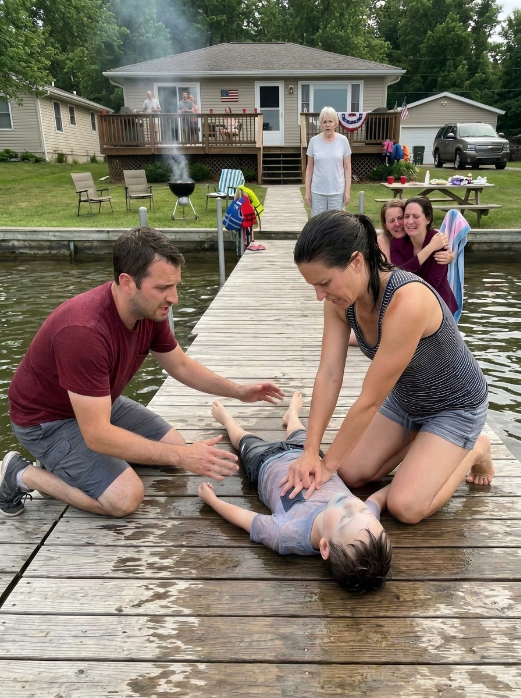
On the dock, when Colton was not breathing, nobody cared about status.
Nobody cared who had the better job.
Nobody cared who had won the last family argument.
Nobody cared what title appeared after my name.
There was simply a child who needed help.
And I knew what to do.
That knowledge came from years nobody in my family had respected.
Years of studying while other people slept.
Years of training.
Years of exhausting shifts.
Years of making terrible decisions under pressure because someone had to.
My mother’s jokes had never changed any of that.
They had only changed how willing I was to share my life with her.
One evening, Colton came to the hospital with my brother to bring me dinner.
He was doing well.
Before they left, he looked at the white coat hanging behind my office door.
It had my name embroidered above the pocket.
DR. PIPER — TRAUMA SURGERY
He stared at it.
Then at me.
“Aunt Piper?”
“Yeah?”
“Dad says you saved me.”
I shook my head.
“A lot of people helped you.”
“But you started.”
“Yes.”
He thought for a moment.
Then hugged me.
“Thank you.”
That meant more to me than every professional award I had ever received.
My brother stood behind him.
When Colton walked toward the hallway, my brother remained.
“I’ve been thinking about something.”
“That sounds dangerous.”
He smiled.
Then became serious.
“Why did you stop correcting us?”
I looked at him.
“Because eventually I realized you weren’t confused.”
His expression changed.
“You just preferred the joke.”
He looked down.
I continued.
“There’s a difference between someone not knowing who you are and someone refusing to know.”
He nodded slowly.
Then:
“I’m sorry.”
This time, I believed him.
Not because he said the words.
Because by then, his behavior had already changed.
That was what mattered.
I never needed my family to admire me.
I never needed them to introduce me as Dr. Piper at every gathering.
I did not even need my mother to understand why I chose trauma surgery.
I needed something much simpler.
Respect.
And if someone refused to give me that, I no longer planned to spend years begging for it.
The Fourth of July began with my family laughing because they thought I was pretending to be someone important.
It ended with them discovering something I had known all along.
My career was real.
My training was real.
My work mattered.
But the most important truth had nothing to do with the word doctor.
I had never needed a title to make me valuable.
And I no longer needed people who loved making me smaller to tell me how much space I was allowed to take up.
The End.
Latest Posts
- My Husband Mocked My Postpartum Appearance in His Brothers’ Group Chat—I Stayed Quiet for Five Days
Four months after giving birth, I thought my husband understood why I hardly recognized myself. Then I discovered the cruel joke he'd been sharing with his brothers, along with photos I never knew he'd taken. I kept my discovery secret for five days, determined to make him regret every word. “Dude, you weren't exaggerating 😂” …
- My Stepdaughter Called Me the Help Until My Envelope Changed Everything
The insult came before I’d even finished setting down the peach cobbler. I’d baked it at five that morning in the kitchen of the lake cabin we’d rented, and it was still warm under the foil. The smell of cinnamon followed me across the grass toward the pavilion tables, where thirty-two members of the Cole …
- My In-Laws Gave Their Other Three Children $20,000 for Houses and Gave Us Only a Card Two Years Later, We Bought the Old Miller Place for $41,500
The envelopes were tucked under the Easter plates. Each had a name written on it in my mother-in-law’s round schoolteacher handwriting. Kim opened hers first. She’s the oldest. Divorced two years. Raising two boys in a rented trailer behind the grain elevator. She looked at what was inside the envelope and put her hand flat …
- My Mother-in-Law Told Me to Lose Weight After Giving Me a Dress That Didn’t Fit, but Minutes Later, She Regretted Everything
I couldn’t get it over my hips. I stood in my bedroom in my underwear with the dress bunched around my thighs like a deflated balloon. Midnight blue silk. A designer label I’d only ever seen in magazines. Tiny pearl buttons down the back. Beautiful. And four sizes too small. I pulled. I tugged. I …
- Teen Wore a Dress to His Best Friend’s Funeral—The Family Nearly Had Him Removed Before He Reached the Microphone
My son’s best friend read the eulogy at his funeral in a red dress. I almost had him removed before he reached the microphone. My son Jack died 17 days after his 18th birthday. Cancer. Fourteen months from diagnosis to funeral. We found out late. Too late, as it turned out, and the treatment never …