Katie was in ICU after a hit-and-run. My mother-in-law called and said, “Come cook my birthday dinner, or lose your home.”
I stayed beside my daughter.
Then Katie whispered, “Andrew pushed me,” and when police opened the forged power of attorney authorizing the sale of my house, Barbara froze.
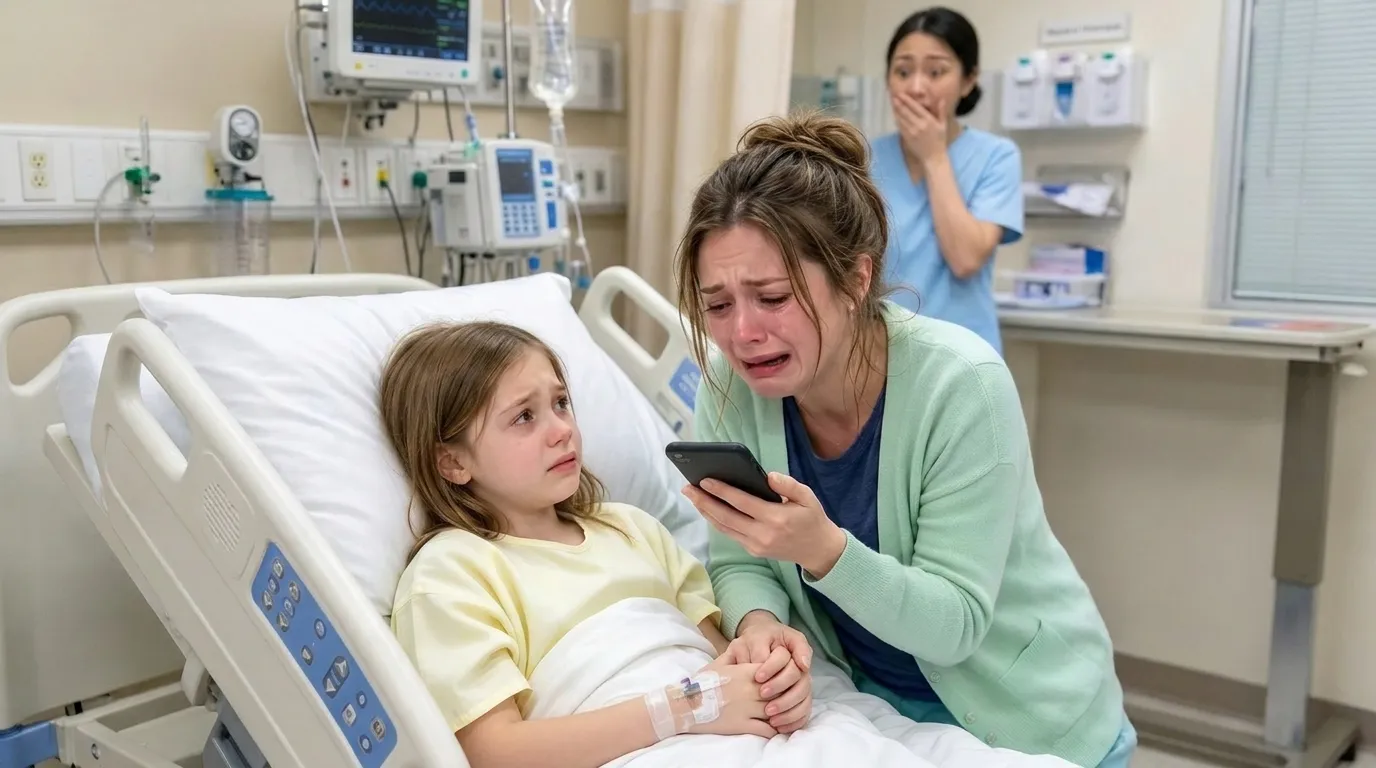
The call came while I was standing under hospital lights, staring at my ten-year-old daughter through a blur I could not blink away.
Katie had always been all elbows, ribbons, and stubborn little goals, the kind of child who practiced cartwheels in the hallway even when I begged her to stop before she knocked over a lamp. That Tuesday, she had been walking to gymnastics on the same route she took every week, and by sundown a nurse was asking me to sign forms with hands that would not hold still.
They told me she was stable, then they told me she was in intensive care, and somehow both things were supposed to live in the same sentence.
I sat beside her bed and watched the monitor count what my heart could not. Andrew, my husband, had not arrived yet, but my phone lit up with his name, so I answered before the first ring finished.
It was not Andrew. It was his mother, Barbara, and she sounded irritated before I even said hello.
“Where are you?” she asked, as if I had missed a hair appointment instead of standing beside my child in ICU.
“The hospital,” I said. “Katie was hit by a car.”
Barbara paused just long enough to pretend she had taken that in. Then she said Andrew had told her Katie was stable, and her birthday dinner was tomorrow, and people were already expecting the chicken I always made.
She had promised everyone I would cook because, according to her, I was the only one who knew how to make things look proper.
I looked at Katie’s small hand under the blanket. There was tape over the IV on her wrist and a bruise near her temple that made her look younger than ten.
“Barbara, my daughter is in intensive care,” I said, and my voice came out so flat I almost did not recognize it.
“You are so dramatic,” she said.
Those four words did not break me loudly. They settled somewhere deep and cold.
Then Barbara lowered her voice and told me that if I did not come home that night to help with her party, I should not expect to get back into the house.
Barbara did not own our house. She had no right to threaten me with a door she had never paid for. But Andrew had let her treat our marriage like an extra room in her own home for so long that she believed my place in it could be voted on over casserole dishes.
In the background, I heard Andrew say, “Mom, stop,” but he sounded tired, not angry.
Then he came on the line and told me Katie was stable and maybe I could just calm his mother down. He said it the way he always did, soft enough to sound reasonable and selfish enough to make me question myself.
I looked at my daughter and said, “No.”
That was all. I did not explain. I did not bargain. I did not ask permission to be a mother.
Andrew went quiet, and Barbara made a sound like I had embarrassed her in public. Then the call ended, and the room returned to the small hospital noises I had already started to hate.
I held Katie’s hand through the night while nurses came in and out, and every time my phone buzzed, I turned it face down.
Morning did not arrive like mercy. It came gray and thin through the blinds, with coffee that tasted burnt and a chair that had carved a line of pain across my back.
I was leaning over Katie’s blanket, counting her breaths again, when her fingers moved inside mine.
Her eyes opened slowly. Not all at once, not like people wake up in movies, but enough that I forgot the floor under me.
I bent close and whispered her name, and a nurse touched my shoulder like she was reminding me to breathe.
Katie looked at the ceiling first, then at me. Her lips moved, and I lowered my ear until I could feel the warmth of her breath.
“Mom,” she whispered. “Andrew did it.”
For one terrible second, my mind tried to protect me from the words. I told myself she was confused, that pain medicine and fear had made the world tangle.
Then Katie squeezed my hand so hard her little fingers shook, and she whispered it again.
“He pushed me.”
I did not scream. I did not drop to the floor.
I pressed the call button and told the nurse we needed someone from the police, because my daughter had just named the man who had been standing in our family photos for eight years.
Detective Reynolds arrived before noon. He listened to Katie once, then again, and his face never changed, which somehow frightened me more than if it had.
When she was done, he closed his notebook and looked at me with the kind of care people use when they are about to hand you a truth that has teeth.
“Amanda,” he said, “do not call your husband.”
I stared at Detective Reynolds. “Why?”
He glanced toward Katie’s room before answering. “Because right now, I don’t want anyone changing what they do because they know what she told us.”
That sentence changed the temperature of the hallway.
He asked me about Andrew, about Barbara, and finally about the threat Barbara had made the night before.
“She told you you’d lose the house?”
“She said I shouldn’t expect to get back in.”
“Does she own any part of it?”
“No.”
He watched my face. “Have you ever signed anything giving her or Andrew authority to sell it for you?”
I almost laughed, but nothing about his expression invited it.
“No.”
“Power of attorney?”
“No.”
“Anything that would let either of them sign your name?”
“Absolutely not.”
He wrote that down.
For the first time since Katie whispered Andrew’s name, my fear split in two.
One half stayed beside my daughter.
The other went straight home in my mind—to our mortgage papers, the kitchen drawer where we kept household documents, and every time Andrew had told me not to worry because he was “handling” something.
Reynolds did not tell me what the police had yet.
He only asked me to remain at the hospital and not warn anyone.
Later, footsteps sounded in the corridor.
Andrew appeared first.
Barbara came behind him.
She was dressed for her birthday.
Then she saw Detective Reynolds standing beside me with a document folder open on the table.
Barbara stopped in the doorway.
The detail I remember is her coat.
Not because it was expensive or unusual. It was simply too normal.
Barbara had dressed for the day she thought she was going to have.
Her hair was done. Her purse hung neatly from one arm. She looked like a woman prepared to be congratulated, fed, and fussed over.
Andrew looked as though he had not slept.
For eight years, I had trained myself to read his exhaustion as evidence that he was caught between two difficult women.
Standing there beside Detective Reynolds, I understood how convenient that story had always been for him.
“Amanda,” Andrew said.
I did not answer.
His eyes moved toward Katie’s room.
Then toward the folder.
“What’s going on?”
Detective Reynolds did not raise his voice.
“We need to ask both of you some questions.”
Barbara found her voice immediately.
“About what?”
Reynolds looked at her.
“First, about Katie.”
The color in Andrew’s face changed.
Barbara looked at him before she looked at me.
It was small.
Maybe another day I would have missed it.
But after a night beside my daughter’s bed, after hearing Katie whisper that Andrew had pushed her, I was finished dismissing small things simply because acknowledging them might make my life harder.
Andrew took one step toward me.
“How is she?”
I moved between him and the doorway.
It happened before I thought about it.
My body made the decision first.
“You don’t go in.”
His face tightened.
“Amanda, I’m her father.”
My stomach twisted at the word.
For years, Andrew had said that whenever it gave him authority.
Her father when he wanted to make decisions.
Her father when he criticized how much I worried.
Her father when Barbara complained that I was too protective.
But that morning, Katie had opened her eyes, gripped my fingers, and used his name.
Not Dad.
Andrew.
Detective Reynolds stepped nearer, not dramatically, just enough that the space between my husband and my daughter’s hospital room no longer belonged to him.
“She’s resting,” he said.
Andrew stared at me.
“What did she say?”
There it was.
Not What happened?
Not Is she awake?
What did she say?
I heard it.
Reynolds heard it too.
Barbara reacted faster than either of us.
“Andrew is upset,” she said. “His daughter is in intensive care, for God’s sake.”
His daughter.
Only twelve hours earlier, when I was refusing to leave Katie’s bedside to cook her birthday chicken, Barbara had called me dramatic.
Now Katie was suddenly useful as proof of Andrew’s distress.
I looked at my mother-in-law and remembered her voice on the phone.
Come home.
Cook.
Calm me down.
Or don’t expect to come back.
Barbara had spoken as though our front door were hers to lock.
As though my life were a privilege she could revoke.
Reynolds asked her to sit.
She did not.
“Why are we being questioned?” she asked. “Katie was hit by a car.”
The detective did not correct her immediately.
Instead, he looked at Andrew.
Andrew’s hands were open at his sides, but there was something too deliberate about the posture, as if he had decided what innocence should look like before walking into the room.
“Where were you yesterday afternoon?”
Andrew swallowed.
He answered.
I barely heard the words.
My attention had moved to the folder on the table.
A corner of one page showed beneath another.
My name was printed there.
Amanda.
For several seconds, I simply stared at it.
My own name looked strange in that room.
It belonged on Katie’s emergency forms.
On school paperwork.
On the coffee cup a nurse had labeled for me after asking three times whether I had eaten.
It did not belong in a police folder while my husband and mother-in-law stood across from me.
“What is that?” I asked.
Reynolds glanced down.
Andrew’s head turned at the same time.
Barbara did not move.
That was the second small thing.
Earlier, she had demanded answers.
Now she suddenly seemed to have none.
Reynolds placed his hand lightly over the pages.
“We’ll get to it.”
Andrew looked at his mother.
“Mom?”
Barbara finally sat down.
The hospital chair gave a soft scrape against the floor.
Nobody made a speech.
No one needed to.
I had spent years being told Barbara was controlling because she cared.
That Andrew gave in because he hated conflict.
That I was too sensitive when I noticed how often decisions about my home, my daughter, my holidays, and my time somehow ended with me doing what Barbara wanted.
The explanation had always required me to be the unreasonable one.
If I objected, I was dramatic.
If I set a boundary, I was disrespectful.
If I asked Andrew to stand beside me instead of between us, I was forcing him to choose.
So I had learned to swallow small humiliations because each one looked survivable by itself.
A dinner.
A holiday.
A key Barbara kept longer than necessary.
A plan Andrew forgot to discuss with me.
A bill he said he had already handled.
None of those memories proved what sat inside the folder.
But for the first time, I stopped automatically protecting the people who had taught me to doubt my own discomfort.
Reynolds asked Andrew another question about Katie.
Andrew answered too quickly.
Barbara interrupted him.
Reynolds asked her to let him finish.
She pressed her lips together.
I could hear a monitor through Katie’s partially closed door.
That sound kept me anchored.
Whatever else happened, my daughter was ten years old and injured, and the only thing she had asked of me without actually saying the words was to believe her.
So I did.
“I want to know about the document,” I said.
Andrew looked at me.
“Amanda, maybe this isn’t the time.”
For years, that sentence had worked.
Not now.
Not here.
Not in front of Katie’s room.
“It became the time when your mother threatened to put me out of my own house.”
Barbara’s head snapped toward me.
“I never said that.”
“You told me if I didn’t leave ICU and come cook your birthday dinner, I shouldn’t expect to get back into the house.”
“I was angry.”
“You said it.”
“You misunderstood me.”
I looked at Reynolds.
“I did not misunderstand her.”
Barbara began talking about stress.
About family.
About how nobody was thinking clearly.
She said Andrew had told her Katie was stable, and she had assumed I could come home briefly.
She said the dinner mattered because guests were coming.
She said she had been trying to keep things normal.
Every sentence made the previous one smaller.
First the threat had not happened.
Then it had happened, but she was angry.
Then it had happened, but I misunderstood.
Then it had happened, but apparently the real problem was that I was refusing to appreciate her reasons.
I had heard that sequence before.
Not with police present.
Not beside an ICU room.
But I knew it.
Andrew rubbed both hands over his face.
“Can we please not do this here?”
I looked at him.
“Where were you?”
His hands stopped.
“What?”
“When Katie was hurt.”
“Amanda—”
“You weren’t here when I got here. You weren’t here when they moved her to intensive care. Your mother called me from your phone. She told me you had already told her Katie was stable.”
I kept my voice low.
That made Andrew more uncomfortable than screaming would have.
“Where were you?”
Detective Reynolds did not interrupt.
Andrew looked toward him.
Then toward Barbara.
Then back at me.
I saw him searching for the version of himself I would accept.
The tired husband.
The overwhelmed father.
The man caught between two women who expected too much.
I had spent years helping him perform that version.
I was not going to help anymore.
Reynolds opened the folder.
Paper moved against paper.
Barbara’s fingers tightened around the strap of her purse.
The first page was not dramatic.
That may have been the worst part.
It looked ordinary.
Typed lines.
Blank spaces.
Signatures.
The kind of paperwork people put in drawers and forget until they need it.
Reynolds turned the document so I could see it more clearly.
My name appeared on it.
So did language granting authority over my affairs.
My eyes moved lower.
There was a signature where mine should have been.
It looked enough like mine to make my stomach turn.
But it was not mine.
I knew how I signed my name when I was rushed.
I knew the way the first letter leaned.
I knew where my hand naturally lifted from the page.
You can live beside someone for years and still learn, in one hospital corridor, how closely they have been studying the parts of you that you never thought needed protecting.
“I didn’t sign that.”
The words came out quietly.
Reynolds nodded once.
“You’ve never seen it before?”
“No.”
Andrew stepped forward.
“Wait.”
Detective Reynolds looked at him.
Andrew stopped.
Barbara had gone completely still.
The document gave someone power to act for me.
Power connected to the sale of my house.
My house.
The house Barbara had threatened to keep me out of less than a day earlier.
Suddenly her threat no longer sounded like an angry woman pretending she controlled something that belonged to me.
It sounded like a woman who believed paperwork had already made the threat real.
I looked at Barbara.
She would not look at me.
“Barbara.”
Her eyes stayed on the document.
“Did you know about this?”
Andrew spoke first.
“Don’t answer that.”
Reynolds turned his head toward him.
Barbara did too.
It was the first time since they entered the hospital that mother and son looked openly divided.
“Andrew,” she whispered.
He stared at the papers.
I could almost see calculations moving behind his face.
For eight years, he had survived family conflict by making sure someone else absorbed it.
Usually me.
Sometimes Barbara.
He softened whatever each of us had said until responsibility disappeared into misunderstanding.
But a document was harder to soften.
A signature was either mine or it was not.
Authority had either been given or it had not.
And I had just told a detective, in front of both of them, that I had never signed it.
Barbara looked at me then.
There was no birthday indignation left in her face.
No complaint about dinner.
No accusation that I was being dramatic.
I thought of Katie opening her eyes that morning.
Mom.
Andrew did it.
Two statements.
One from my child.
One from me.
He pushed me.
I didn’t sign that.
For the first time, I understood how much of my marriage had depended on women in that family being talked out of what they knew.
My daughter had been frightened and hurt, yet she had still said his name.
I had been threatened and exhausted, yet I had finally said no.
Now a forged power of attorney sat open between us.
Reynolds asked me to look carefully at the signature again.
I did.
“It isn’t mine.”
Barbara’s shoulders lowered a fraction.
Andrew said my name.
I did not turn toward him.
That surprised me.
For years, Andrew saying “Amanda” in that careful voice had been enough to pull my attention away from whatever boundary I was trying to hold.
This time, my eyes stayed on the page.
I thought about my house.
Not the property value.
Not the mortgage.
The actual house.
Katie’s backpack dropped beside the stairs.
Her gymnastics things on the laundry room floor.
The hallway where she practiced cartwheels.
The lamp I kept telling her she would eventually break.
Barbara had reduced that house to leverage.
Come cook my birthday dinner, or lose your home.
Yesterday, I had heard cruelty.
Now I was looking at paperwork that made the sentence feel like something else.
Reynolds did not accuse Barbara in front of me.
He did not announce some grand conclusion.
He simply continued asking questions.
That restraint made the moment more frightening, not less.
“Mrs.—” He stopped, then addressed Barbara directly. “Have you seen this document before?”
Barbara’s mouth opened.
Nothing came out.
Andrew shifted closer to her.
“Mom.”
She looked at him.
Then at me.
Then back at the signature.
Her face had frozen in the exact expression of someone who had just realized that the person she expected to control was no longer the only one asking questions.
Behind the door, Katie’s monitor continued its steady rhythm.
I reached for the handle.
Andrew moved as if he expected to follow me.
I turned.
“No.”
One word.
The same word I had given him on the phone the night before.
But it did not mean the same thing anymore.
Yesterday, it meant I would not leave my daughter to cook dinner.
Now it meant he did not get to walk past me simply because he had spent eight years assuming I would eventually move.
I stepped into Katie’s room and closed the door behind me.
Through the narrow window, I could still see the table in the corridor.
The forged power of attorney remained open beneath the hospital lights.
Barbara was staring at it.
And for once, nobody was asking me to make things easier for her.
Latest Posts
- Bride Banned Her Niece with Vitiligo from Her Wedding—
Bride Banned Her Niece with Vitiligo from Her Wedding—So Her Sister Prepared an Unexpected Gift My sister told me not to bring my daughter with vitiligo to her wedding because she would “ruin the wedding pictures.” So I gave her a wedding gift she never expected. My eight-year-old daughter, Sophie, has vitiligo, a condition that …
- My Husband’s Best Friend Drove Our Daughter to Ballet—
My Husband’s Best Friend Drove Our Daughter to Ballet—Then Her Teacher Asked Me a Chilling Question My sixteen-year-old daughter used to beg me to watch her dance. Then she stopped practicing, barely spoke to me, and began acting as though I’d betrayed her. I couldn’t understand what had changed. Before that, Audrey practiced ballet in …
- Mother Was Wary of Her Son’s Tattooed Doctor –
Mother Was Wary of Her Son’s Tattooed Doctor—but Never Imagined the Difference He Would Make in Their Lives I never expected the most intimidating doctor in the hospital to become my dying son’s favorite person. At first, I was grateful to see my boy smiling again. Then I noticed how often they whispered together, and …
- My Mother-in-Law Made My Baby Shower About Herself—Then My Husband Stood Up
I wanted a small baby shower, but my mother-in-law ignored nearly every request and turned the day into a celebration of becoming a grandmother. I kept swallowing my frustration for one deeply personal reason, until she crossed a line neither my husband nor I could ignore. I was seven months pregnant with our first child, …
- A Man Kept Manspreading Into a Woman’s Plane Seat for Hours –
A Man Kept Manspreading Into a Woman's Plane Seat for Hours – When He Returned From the Restroom, He Shouted, 'What the Hell Did You Do?!' I boarded that plane thinking the hardest part of my trip would be traveling without my husband. Instead, I found myself beside a stranger who treated my kindness like …