My Daughter-in-Law Told Me to Eat Leftovers While Her Parents Ate the 12-Pound Ham I Cooked—So I Took My Dinner and My Money Home
My daughter-in-law told me to find something in the refrigerator while her wealthy parents sat down to enjoy the luxurious dinner I’d spent two days preparing.
I didn’t raise my voice. I didn’t demand an apology.
Instead, I quietly lifted my twelve-pound honey-glazed ham from the kitchen counter, carried it to my car, secured it with the passenger seat belt, and drove home.
Christa probably assumed I was just a sensitive older woman who would calm down and forget everything.
What she didn’t know was that, before the evening ended, I would make three financial decisions that would change our relationship.
And when she showed up at my doorstep the following Friday, furious about the support she’d lost, she discovered something else.
Her spare key no longer opened my front door.
My name is Dorothy Hale. I’m sixty-three years old, a retired office administrator living in Barrie, Ontario.
I raised my only son, Owen, mostly on my own after his father left when he was nine.
For thirty-one years, I worked hard, paid my bills, saved what I could, and eventually paid off the mortgage on my little house.
Everything I did was motivated by one simple hope: that my son would have an easier life than I had.
I’ve never been wealthy.
But I’ve always believed in helping family.
When Owen married Christa six years ago, I welcomed her into our family with open arms.
I imagined holidays together, Sunday dinners, and a close relationship with the woman my son loved.
Unfortunately, things didn’t turn out that way.
Over time, I became the person they remembered when bills needed paying, childcare arrangements fell through, or something expensive needed replacing.
But when celebrations came around, I was frequently an afterthought.
Still, I told myself that helping them was simply what a loving mother did.
Somewhere along the way, my family began confusing my kindness with an obligation.
The trouble came to a head on a Thursday afternoon when Owen called.
“Mom, Christa’s parents are visiting this weekend. Could you make one of your famous hams?”
I smiled.
“Of course, sweetheart.”
“Christa says nobody makes ham like you. She keeps telling them how amazing it is.”
That compliment warmed my heart.
Finally, I thought, an opportunity to spend a lovely evening together.
I wrote down the ingredients and began planning.
On Friday, I visited the butcher I’d used for twenty-five years.
Mr. Kowalski selected a beautiful twelve-pound smoked ham.
“Special occasion, Dorothy?”
“My son’s in-laws are coming for dinner.”
“Then you’ll want the good one.”
It cost eighty-four dollars.
I didn’t hesitate.
Saturday morning, I woke at six.
I scored the ham, added cloves, and prepared my homemade glaze with honey, brown sugar, Dijon mustard, roasted garlic, and apple cider.
For four hours, I carefully basted it until the outside turned golden.
My house smelled wonderful.
I also prepared a large tray of scalloped potatoes because my ten-year-old granddaughter, Maya, loved them.
She called them “Grandma’s cheesy potatoes.”
On Sunday afternoon, with the food reheated and wrapped in thick towels, I loaded the car and drove forty minutes to Owen’s house.
Christa opened the side door.
“Oh,” she said, looking at the roasting pan. “You brought it.”
I laughed.
“Well, you asked for it.”
“Owen asked,” she corrected. “Just put it on the counter.”
I brushed off her tone.
Inside, her parents, Gerald and Elaine, were sitting in the living room, chatting comfortably.
Elaine gave me a small wave.
“Dorothy. Did you drive all the way from Barrie in that little car?”
“I certainly did.”
“How brave.”
She smiled politely before returning to her conversation.
Then Maya ran downstairs and threw her arms around my waist.
“Grandma! Did you make the cheesy ones?”
“I did, sweetheart.”
She squealed happily.
For a moment, everything felt worthwhile.
I carried the heavy roasting pan into the kitchen.
“Everything smells incredible!” Christa exclaimed.
For a moment, I felt appreciated.
I carved the ham, arranged the slices on a large platter, and transferred the potatoes into Christa’s serving dish.
Then I looked toward the dining table.
A spotless white tablecloth covered it. Fresh flowers stood in a crystal vase, and the finest dinnerware had been arranged beneath soft candlelight.
Five plates.
I counted again.
Gerald.
Elaine.
Christa.
Owen.
Maya.
There were six people in the house, including me.
I assumed someone had forgotten an extra setting.
“Christa, sweetheart, should I bring another plate?”
She barely looked up.
“Oh, Dorothy, you won’t need one.”
I paused.
“What do you mean?”
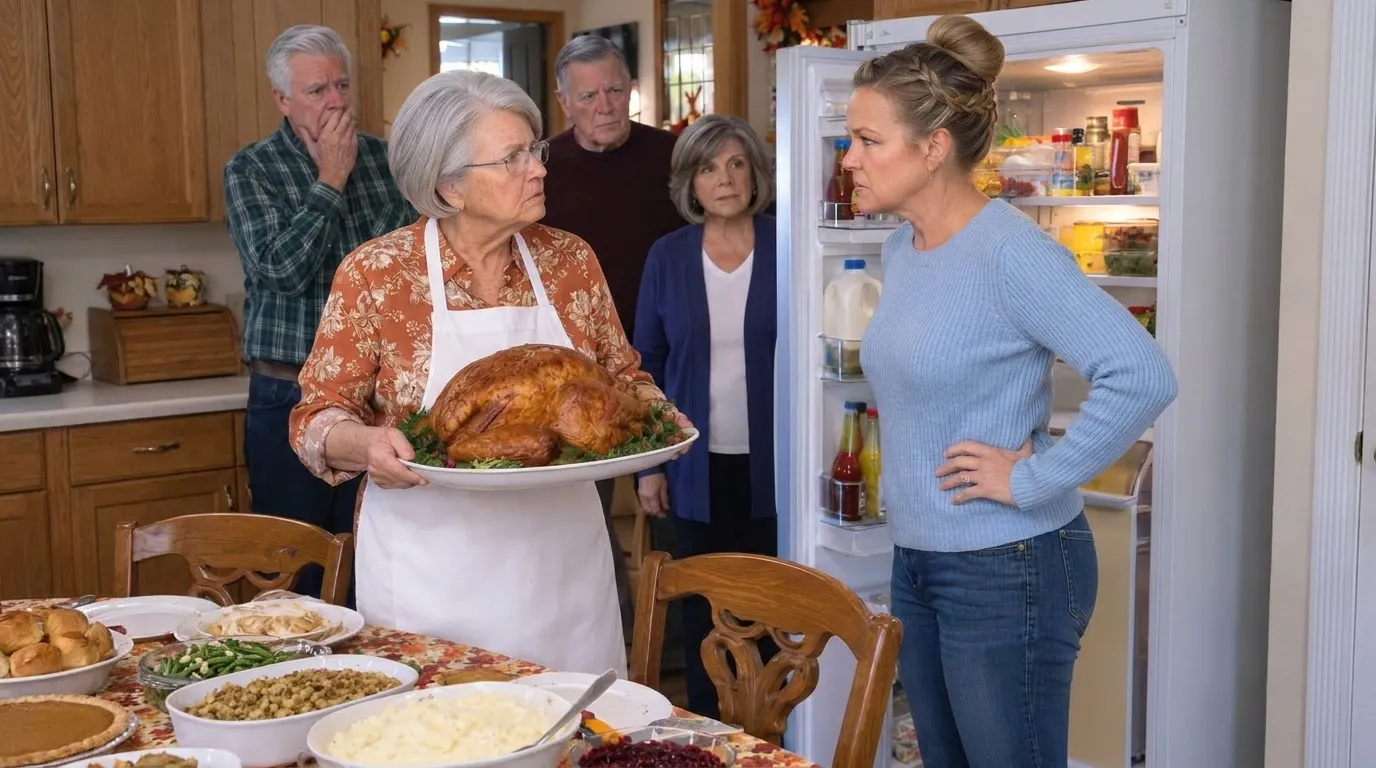
She noticed where I was looking, then pointed toward the refrigerator with one perfectly manicured finger.
“Dorothy, there’s plenty of food left over from earlier this week. Tonight’s dinner is for our guests.”
I stared at her.
“You mean I’m not joining you?”
She sighed.
“Please don’t make this awkward. My parents traveled a long way, and I wanted a nice family dinner.”
A family dinner.
Apparently, I wasn’t considered part of that family.
“You’re asking me to eat separately?”
“We’re trying to make the evening special for them.”
I glanced toward Owen.
He stood near the hallway, holding his phone.
He heard every word.
He didn’t defend me.
He didn’t offer another chair.
He didn’t even meet my eyes.
That silence hurt more than Christa’s remark.
I opened the refrigerator.
Inside were half-finished takeout containers, leftover pasta, and a small package of cheese.
I stared at the shelves.
I’d spent nearly two days preparing a meal that I wasn’t welcome to share.
And somehow, my own son thought that was acceptable.
I could have argued.
I could have reminded Christa that I’d purchased the ham, spent hours preparing it, and driven forty minutes to serve it.
But I suddenly felt too tired to explain why I deserved a place at the table.
I closed the refrigerator gently.
“Alright,” I said. “Now I understand.”
Christa smiled, apparently relieved that I wasn’t making a fuss, and turned toward the dining room.
I returned the ham and its carved slices to the roasting pan, packed the potatoes back into my container, and wrapped the warm pan in a kitchen towel.
Christa turned back as I picked it up.
“Dorothy, what are you doing?”
“Taking my dinner home.”
Then I carried the food outside.
I placed the ham carefully on the passenger seat of my Honda Civic.
It was heavy, so I did something that still makes me smile.
I fastened the seat belt around it so the pan wouldn’t slide.
It was an absurd sight.
A sixty-three-year-old woman driving home with a twelve-pound ham buckled into the passenger seat.
But somehow, I felt lighter than I had in years.
Nobody came outside.
Nobody asked me to stay.
My phone buzzed before I reached the highway.
It was Owen.
I pulled into a parking area and read his message.
Mom, where did you go? Christa’s parents are waiting for the ham.
I stared at the screen.
Not Are you okay?
Not I’m sorry.
Not a question about why I’d left.
Just concern that his dinner guests were still waiting.
I put my phone away.
Then I drove home in silence.
As the miles passed, I remembered other moments I’d tried to forget.
Two years earlier, Christa’s parents had spent Thanksgiving at my house while their kitchen was being renovated.
I’d cooked for two days.
When Elaine arrived, she looked around my living room and remarked, “Well, it certainly looks lived in.”
Christa laughed.
Owen pretended not to hear.
I remembered helping them move into their house.
I was sixty-one, carrying boxes upstairs while Christa stood in the hallway directing everyone.
I remembered the countless birthday cakes I’d baked for Maya.
Chocolate with raspberry filling.
Every year.
The birthday parties I’d helped organize.
The groceries I brought whenever I visited because Christa always seemed to be missing something.
Butter.
Flour.
Vegetables.
I remembered their vacation to Prince Edward Island the previous summer.
Owen had called to say the cottage rental was more expensive than expected.
I’d paid fourteen hundred dollars to help.
Christa posted dozens of beautiful vacation photographs.
Nobody mentioned my contribution.
And then there were the monthly expenses.
Owen had been on my phone plan since he was twenty-two, back in his college days.
When he married Christa, I added her, too.
I was still paying for both phones.
I’d also kept helping with his car insurance.
And for two years, I’d transferred four hundred dollars every month to support Maya’s expenses.
I’d assumed it covered school supplies, swimming lessons, and winter clothing.
I’d never asked for receipts.
I trusted my son.
I had never kept track of these things because I wanted repayment. I’d done them out of love.
But as I drove along Highway 400, I began wondering how much of that assistance had become something they simply expected.
For six years, I’d made myself available whenever they needed something.
Yet when it came time to eat a dinner I’d prepared, there wasn’t even an empty chair.
That was the moment I understood.
I’d become necessary to their expenses but optional to their celebrations.
Somewhere along the way, my generosity had stopped being appreciated and started being treated like an obligation.
When I reached home, I carried the ham inside and placed it in the oven to keep warm.
Then I poured myself a small glass of wine, sat at my kitchen table, and opened my laptop.
For the first time in years, I reviewed my finances with my own future in mind.
I wasn’t going to send angry messages.
I wasn’t going to demand apologies.
I was simply going to reconsider some decisions I’d been making for years.
First, I opened my phone carrier account.
There were Owen and Christa’s names.
Both were still connected to my family plan.
I reviewed the options and initiated the process of transferring their lines to their own billing arrangement.
They would receive proper notification before the next billing cycle.
I confirmed the request.
Then I called my longtime insurance broker.
“Patricia, it’s Dorothy Hale. I’d like Owen’s vehicle removed from my insurance policy at the next renewal. Please let me know what paperwork is required.”
She promised to review everything on Monday.
I made sure he would have time to arrange replacement insurance.
Finally, I opened my banking application.
There it was.
The automatic four-hundred-dollar monthly transfer.
I’d been sending that money for twenty-four months.
I stared at the screen.
That last decision was the hardest.
Maya meant the world to me.
She was the reason I’d endured countless uncomfortable dinners and little comments from Christa.
I never wanted her to suffer because of disagreements between adults.
I would never refuse to buy her school supplies, treat her to an outing, or help with something she genuinely needed.
But I also knew I could support my granddaughter directly without financing arrangements nobody explained.
Loving Maya didn’t require sending money indefinitely to two employed adults.
I canceled the recurring transfer.
Then I closed my laptop.
The house was quiet.
I wasn’t trying to punish anyone.
I was simply taking responsibility for my retirement.
I served myself two thick slices of ham with scalloped potatoes.
I used my favorite plate.
I sat at my own table.
And I ate the dinner I’d spent two days preparing.
It was delicious.
At 9:40, Owen sent another message.
Christa says you’re overreacting. Her parents had to order pizza. Can we talk tomorrow?
I read it twice.
They’d ordered pizza.
I almost laughed.
Then I turned off my phone and went to bed.
For the first time in months, I slept peacefully.
Monday morning, I remembered something else.
Three years earlier, when Owen had been hospitalized for a minor operation, I’d given Christa a spare key to my house.
It was supposed to be temporary.
She’d never returned it.
I’d never asked.
So I called a locksmith and arranged to have my locks updated.
When he finished, he handed me two new keys.
One went onto my key ring.
The other went into a kitchen drawer.
That was enough.
I wasn’t trying to hurt anyone.
I simply wanted control over who entered my home.
On Tuesday, Owen called twice.
I was shopping, so I let the calls go to voicemail.
His message sounded confused.
“Mom, Christa received a notification about our phone plan. And the insurance broker called. Is everything okay?”
I called him after dinner.
“Mom, what’s happening?” he asked immediately.
“Nothing terrible, sweetheart. I’ve been reviewing my retirement expenses.”
He sounded puzzled.
“What do you mean?”
“I’ve decided that you and Christa should handle your own phone bills and car insurance.”
There was a pause.
“Christa says we’re going to have to pay about $240 every month now.”
“That’s right.”
“And what about my car insurance?”
“The current coverage will remain until the renewal date. After that, you’ll need your own policy.”
Another silence.
“But you’ve always paid those.”
“I know.”
“Why stop now?”
“Because you’re thirty-five, Owen. You both have jobs, and these are expenses you can manage yourselves.”
He exhaled.
“Is this about Sunday?”
“Sunday helped me realize some things.”
He hesitated.
“Christa feels bad about what happened. She says she’s sorry things got awkward.”
I waited.
“She didn’t mean it the way it sounded.”
“What did she mean, Owen?”
Silence.
I could hear the television in the background.
“Does she understand why I was hurt?”
“She just wanted her parents to have a special dinner.”
“And where did that leave me?”
Owen didn’t answer.
Then Christa said something in the background that I couldn’t quite understand.
“Mom,” Owen sighed.
I recognized that tone.
He wanted me to make the problem disappear.
For years, I had.
This time, I didn’t.
“You don’t need to solve everything tonight,” I told him. “But my financial decisions are mine to make.”
We ended the call politely.
His silence had told me the conversation wasn’t finished.
Over the following days, Owen sent a few brief messages.
I responded kindly.
Christa said nothing.
Until Friday afternoon.
I was in my backyard preparing the garden for winter when I heard a vehicle pull into the driveway.
Christa’s white SUV.
She climbed out quickly and walked toward my front door.
She hadn’t noticed me standing beside the flower beds.
I watched her take a key from her purse.
She inserted it into the lock.
It wouldn’t turn.
She tried again.
Then she examined the key.
I walked around the side of the house.
“Hello, Christa.”
She turned.
“You changed the locks!”
“Yes,” I replied.
“Without telling us? Why?”
“I wanted to update the security of my home.”
I brushed the soil from my gardening gloves.
“It’s my home, Christa. The spare key was part of an old arrangement, and I’ve decided to end it.”
She stared at me as though I’d said something outrageous.
“Owen told me about the phone plan and insurance. And apparently you’ve stopped sending money to his account.”
“That’s correct.”
She looked incredulous.
“Dorothy, you can’t just withdraw financial support because you were upset about dinner.”
I set my gardening gloves on the porch railing.
“Christa, I spent two days preparing that meal because Owen asked me to. I bought an expensive ham, made Maya’s favorite potatoes, and drove forty minutes to your house.”
She opened her mouth.
I continued.
“When I arrived, you told me to serve everyone else and eat old leftovers by myself.”
“We had guests,” she replied.
“So did you.”
She frowned.
“I was your guest, Christa. Apparently, that never occurred to you.”
“My parents were important guests!”
I nodded.
“Yes. And I was family.”
For a moment, she looked uncomfortable.
“I didn’t ask for special treatment,” I continued quietly. “I only expected a seat at the table.”
Then her expression hardened again.
“If you wanted to feel included, you should’ve said something. But removing our financial support isn’t very mature.”
I almost smiled.
For years, I’d been called difficult whenever I expressed disappointment.
And now maturity apparently meant continuing to pay bills while pretending nothing was wrong.
I studied her expression.
She wasn’t asking whether I’d been hurt.
She wasn’t apologizing.
She was angry because the money was gone.
“I understand that these changes are inconvenient,” I replied. “But I’m retired, and I need to manage my finances responsibly.”
Christa folded her arms.
“If this is about us not spending enough time with you, we can talk about it. But cutting off our financial help isn’t going to make Owen and me visit more often.”
For a moment, neither of us spoke.
“You’re only pushing us away,” she added.
There it was.
The suggestion that my place in the family depended on what I provided.
Her words revealed something I’d been afraid to acknowledge for years.
She seemed to think that my financial contributions were the price of remaining welcome in my son’s life.
I thought about the phone bills.
The monthly transfers.
The vacation rental.
The countless meals.
Once, that possibility would have terrified me.
I might have apologized, restored the payments, and pretended nothing had happened.
But not anymore.
I smiled gently.
“Then I suppose we’ll all have to adjust.”
She blinked.
“What is that supposed to mean?”
“It means I love my family, Christa. But I don’t have to finance your household to prove it.”
She opened her mouth, then closed it again.
I picked up my gloves and gardening basket.
“I’m going inside now. I hope you have a pleasant afternoon.”
Christa stared at me.
I walked past her, opened my front door with my new key, and went inside.
I didn’t slam the door.
I simply closed it.
Through the kitchen window, I saw Christa standing on the lawn for another minute.
Then she returned to her SUV and drove away.
Slowly this time.
For the first time since Owen married her, I wasn’t begging for kindness, explaining away disrespect, or offering money to keep the peace.
I’d finally understood something important.
Being generous doesn’t mean giving people unlimited access to your wallet, your home, or your peace of mind.