Richard Sterling stepped forward, taking another document from the folio—this one bound in deep green leather, bearing the distinctive gold emblems of the Texas Department of Family and Protective Services and the District Court of Travis County.
“This is the conditional family settlement,” Richard announced. “Your mother spent three weeks drafting this with our estate planning team. She did not come here to destroy you, Colin. Because despite everything you have done, despite the cruelty, the neglect, and the sheer arrogance of your behavior… you are still Arthur’s son.”
Richard laid the green folder on the granite island, right next to Colin’s cold coffee pot.
“Under the terms of this trust agreement,” Richard detailed, “the title to this residence will be transferred into an irrevocable educational trust established for the sole benefit of your children, Lucas and Emma. The trust will pay the property taxes, the insurance, and the structural maintenance until Emma graduates from college.”
Colin’s chest heaved.
A faint glimmer of hope flickered in his bloodshot eyes.
“The… the kids keep the house?”
“The children keep the house,” Richard confirmed. “And you, Colin, will be permitted to reside on the premises as their custodial guardian—on three specific, non-negotiable conditions.”
Jessica wiped her nose with her sleeve, stepping toward the island with desperate eagerness.
“What conditions? Anything. We’ll sign anything.”
“Condition number one,” Richard said, his eyes locking onto Jessica. “Mrs. Jessica Vance will vacate these premises by five o’clock this afternoon.”
Jessica froze.
The air left her lungs in a sharp, anguished breath.
“What?”
“You are not a blood relative of the Vance lineage, Counselor,” Richard said with absolute, unyielding coldness. “Your name was never on Arthur’s original estate grants. Furthermore, the private investigation firm retained by our trust spent the last four months conducting a comprehensive financial audit of your personal accounts at Frost Bank.”
Richard pulled a thin manila envelope from the folio and tossed it onto the granite island.
It slid across the stone, stopping against Colin’s elbow.
“What is that?” Colin asked, his voice shaking.
“Open it, Colin,” I said softly.
Colin reached out with trembling fingers and pulled back the flap.
He drew out a stack of high-resolution bank statements and photocopied checks.
His eyes scanned the lines.
Once.
Twice.
Then his head snapped toward his wife, his mouth opening in an expression of shock that made his previous panic look like a minor inconvenience.
“Jessica…” Colin whispered, his words trembling with fury. “What… what is Veritas Capital Management?”
Jessica stepped backward, her hand flying to her mouth, her eyes widening in fear.
“Colin, wait… I can explain… that was for our future—”
“You took forty thousand dollars from my mother’s estate account in June!” Colin shouted, his voice cracking. “And another sixty thousand in September! You transferred it to a private LLC in Delaware under your maiden name! You told me that money was tied up in escrow for the firm’s tax audit!”
“It was an investment, Colin!” Jessica cried, backing toward the dining room. “The interest rates were collapsing! I was trying to protect our assets before she got sick and the state seized everything for her medical care!”
“She wasn’t sick, Jessica!” Colin shouted, tears finally pouring down his face as he slammed the papers onto the granite hard enough to sting his palm. “She was never sick! You told me she was losing her memory! You told me she was leaving the stove on! You told me she was hiding food under her mattress so we would have an excuse to put her in Oakridge!”
The room went silent.
The deputies did not move.
Richard did not blink.
I stood by the doorway, looking at my son as the final, horrifying realization broke through the thick fog of his vanity.
Colin sank back onto his knees on the floor. The broken pieces of the coffee mug cut into his shins, but he didn’t seem to notice.
He looked up at me, his face crumpled, his chest heaving with deep, racking sobs.
“You knew…” Colin wept. “You knew she was lying to me about the stove. You knew she was turning on the burners behind your back and blaming you.”
“I knew, Colin,” I whispered.
“And you stayed?” he sobbed, reaching toward my boots with hands that shook like dry leaves in a storm. “Why? Why did you stay in that kitchen and take the blame? Why didn’t you just call the police and have her arrested?”
“Because I wanted to see if you would ever look at me,” I said.
A single tear slipped from my eye, tracing the deep, permanent lines carved into my cheek by seventy-three years of living, loving, and grieving.
“I wanted to see if my little boy—the boy who used to sit on the porch in Round Rock and hold my hand when thunder shook the roof—was still inside that grown man’s chest,” I told him. “I wanted to know if you would look at your mother’s face, see the terror Jessica was causing, and say, ‘No, Jessica. We aren’t doing this to my mother.’”
Colin buried his face in his hands, his forehead pressing against the cold oak floor, weeping so hard that his shoulders shook.
“I waited for ten months, Colin,” I said, my voice barely louder than a whisper, yet carrying the crushing weight of an ancient mountain. “Every morning, when I poured your coffee. Every evening, when I washed your plates. Every Sunday, when I sat in the backseat of your car.”
I watched him struggle to catch his breath.
“I waited for you to say, ‘Mom, you don’t have to clean the kitchen tonight. Sit down with us.’ I waited for you to say, ‘Mom, this is your home forever.’”
I paused, looking down at his crumpled form.
“You never said it, Colin. Not once. You just looked at your phone, drank your wine, and asked if there was any dessert left.”
Jessica stood frozen against the dining room archway, her hands limp at her sides, her eyes hollow, stripped of all arrogance, all pride, and all power.
She looked like a woman who had spent nearly four years playing a game of subtle, domestic cruelty, only to discover that the board, the pieces, and the room itself were no longer hers to control.
“Condition number two,” Richard Sterling continued, his voice cutting through the sound of Colin’s sobbing. “Mrs. Jessica Vance will execute a full, unconditional quitclaim deed disclaiming any and all beneficial, marital, or equitable interest in this property, its contents, and the educational trust established for the children.”
He kept his eyes on her.
“She will also surrender the full one hundred thousand dollars embezzled into Veritas Capital Management to the trust within forty-eight hours, or a formal criminal referral for second-degree grand larceny and elder financial exploitation will be submitted to the Travis County District Attorney’s Special Prosecutions Division.”
Jessica didn’t scream this time.
She didn’t argue.
She nodded once—a tiny, mechanical jerk of her chin—and stared at the floorboards, her spirit completely broken.
“And condition number three,” Richard said, looking down at Colin.
Colin slowly lifted his head, his face smeared with tears and dried coffee.
“What is it? Tell me. I’ll do whatever she wants.”
Richard stepped back, gesturing toward the open doorway where the bright morning sunlight was beginning to burn through the winter fog, painting the limestone steps in ribbons of clean, golden light.
“You will sign the transfer documents, Colin,” Richard said. “You will maintain your employment as a civil engineer. You will raise Lucas and Emma in this house, with the assistance of a full-time professional domestic manager funded by the trust.”
Colin listened without interrupting.
“But you will not receive a single dollar of your mother’s lottery winnings. Not today. Not tomorrow. Not when she passes.”
Richard closed the brass folio with a sharp, heavy thud.
“Your mother has already executed her final will and testament, Colin,” Richard told him. “After providing for her home, her needs, and the children’s trust, she has committed the remainder of her twenty-seven million, six hundred and forty thousand dollars to the Arthur Vance Memorial Educational Endowment. It will provide full university scholarships to low-income children from the rural school districts where your mother worked for thirty years.”
Colin closed his eyes, let out a long, shuddering breath, and nodded.
“It’s fair,” he whispered, his voice cracked and hollow. “It’s completely fair.”
I stood on the threshold for a long moment, looking into the house where I had lived for nearly four years as an invisible ghost.
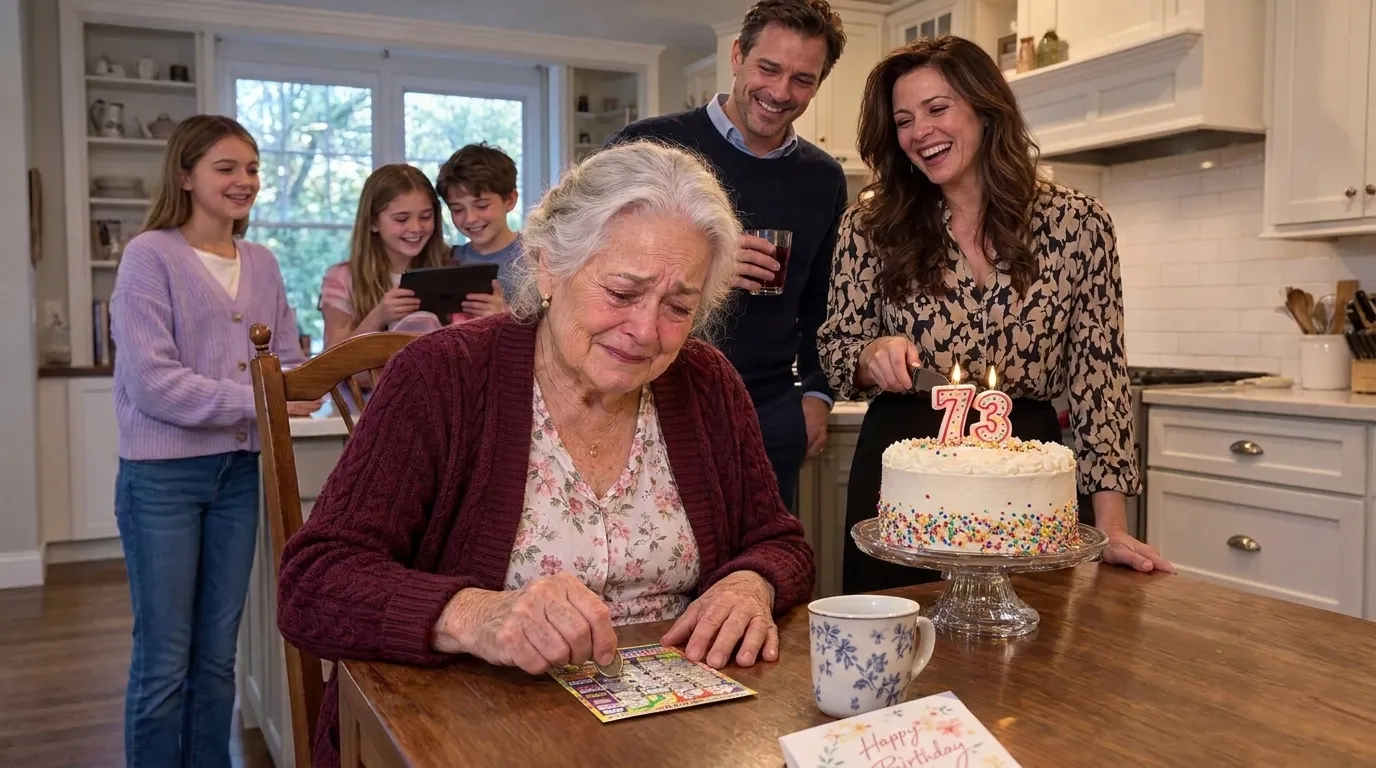
I looked at the kitchen island where I had baked my own birthday cake ten months ago.
I looked at the table where Jessica had given me what she thought was a two-dollar scratch-off card, laughing as she told me to see if I could win enough for bus fare.
I reached down, picked up my single floral suitcase, and turned my back on the room.
“Mom!”
Colin scrambled to his feet, rushing toward the doorway, his hands outstretched. He stopped just short of the threshold as the two deputies watched him with steady, impassive eyes.
“Mom… please,” Colin choked out, tears streaming into the corners of his mouth. “Where are you going? Where will you live? Please don’t go to a hotel… let me help you find a place…”
I paused on the limestone porch, the crisp December wind catching the hem of my cardigan.
I looked back over my shoulder one final time.
I looked at my son—not with hatred, not with bitterness, but with the quiet, unburdened peace of a woman who had finally paid her debts to the past and walked out of the prison of her own love.
“I bought a house three weeks ago, Colin,” I said softly.
Colin blinked through his tears.
“Where?”
“In Round Rock,” I replied, a small, radiant smile touching my lips. “On the corner of Maple and Sixth. The old Victorian with the wraparound porch and the pecan trees in the front yard. The one your father and I used to walk past every Sunday after church.”
Colin’s breath caught in his throat.
I could see that he remembered.
When he was ten years old, Arthur had lifted him onto his shoulders beneath those very pecan trees, laughing as they caught the falling nuts in his baseball cap.
“It has five bedrooms, Colin,” I told him, my voice rich with a quiet, untroubled warmth. “And a big kitchen with two double ovens. And an enormous garden out back where the roses still bloom in the winter.”
“Are you… are you going to be alone there, Mom?” he whispered, his voice breaking into the small, frightened whimper of a little boy.
“I am never alone, Colin,” I said.
I turned my face toward the street.
Idling at the curb behind Richard Sterling’s sedan was a dark green station wagon I recognized instantly.
Sitting in the driver’s seat was Martha Jenkins, my best friend from the library system, whom I had known for forty-two years—the woman who had sat with me in the hospice room while Arthur was dying, holding my hand when Colin was too busy with his golf tournaments to answer his phone.
Beside her in the passenger seat was her sister, Clara, holding two large travel mugs of steaming coffee, waving at me through the windshield with a bright, welcoming grin.
“I have my books, Colin,” I said, stepping down the first flagstone step toward the driveway. “I have my roses. And I have friends who love me when my hands are empty.”
Richard Sterling took my suitcase from my hand, placing it gently into the trunk of his car, while the court officer and the two deputies stepped back into the house to oversee Jessica’s packing.
Colin stood in the open doorway, clutching the doorframe with both hands, watching me walk down the long stone driveway.
He didn’t call out again.
He seemed unable to.
He stood there in his running shorts, surrounded by the cold, magnificent wreckage of his own pride. Looking back at him, I wondered whether he finally understood what he had traded away for a granite countertop and an empty chair at the end of the table.
I reached the green station wagon.
Clara shifted toward the middle of the bench seat, and Martha leaned across to push open the passenger door, her smile wide and radiant.
“Well, Margaret,” Martha chuckled, her eyes crinkling with warmth. “Did you leave them the bus fare?”
I laughed—a loud, clear, beautiful sound that rose into the cold Texas sky like a bird escaping a cage.
I climbed into the warmth of the car.
The smell of cinnamon, roasted chicory coffee, and old books enveloped me like a heavy woolen blanket.
I pulled the door shut.
The latch clicked into place with a solid, satisfying thud that severed nearly four years of silence and sealed seventy-three years of patience into history.
As the car pulled away from the curb, turning down the hill toward the highway that led to Round Rock, I looked out the side window at the live oaks dancing in the winter wind.
My cardigan was old.
My hands were wrinkled.
My hair was white as the morning frost.
But as the tires hummed against the asphalt, carrying me home to my porch, my pecan trees, and my roses, my heart was light as a feather, clean as the rain, and finally, beautifully, free.
Latest Posts
- My Husband Mocked My Postpartum Appearance in His Brothers’ Group Chat—I Stayed Quiet for Five Days
Four months after giving birth, I thought my husband understood why I hardly recognized myself. Then I discovered the cruel joke he'd been sharing with his brothers, along with photos I never knew he'd taken. I kept my discovery secret for five days, determined to make him regret every word. “Dude, you weren't exaggerating 😂” …
- My Stepdaughter Called Me the Help Until My Envelope Changed Everything
The insult came before I’d even finished setting down the peach cobbler. I’d baked it at five that morning in the kitchen of the lake cabin we’d rented, and it was still warm under the foil. The smell of cinnamon followed me across the grass toward the pavilion tables, where thirty-two members of the Cole …
- My In-Laws Gave Their Other Three Children $20,000 for Houses and Gave Us Only a Card Two Years Later, We Bought the Old Miller Place for $41,500
The envelopes were tucked under the Easter plates. Each had a name written on it in my mother-in-law’s round schoolteacher handwriting. Kim opened hers first. She’s the oldest. Divorced two years. Raising two boys in a rented trailer behind the grain elevator. She looked at what was inside the envelope and put her hand flat …
- My Mother-in-Law Told Me to Lose Weight After Giving Me a Dress That Didn’t Fit, but Minutes Later, She Regretted Everything
I couldn’t get it over my hips. I stood in my bedroom in my underwear with the dress bunched around my thighs like a deflated balloon. Midnight blue silk. A designer label I’d only ever seen in magazines. Tiny pearl buttons down the back. Beautiful. And four sizes too small. I pulled. I tugged. I …
- Teen Wore a Dress to His Best Friend’s Funeral—The Family Nearly Had Him Removed Before He Reached the Microphone
My son’s best friend read the eulogy at his funeral in a red dress. I almost had him removed before he reached the microphone. My son Jack died 17 days after his 18th birthday. Cancer. Fourteen months from diagnosis to funeral. We found out late. Too late, as it turned out, and the treatment never …