The following weeks were difficult.
Lauren moved back into her apartment alone.
Ethan did not end their relationship, but he stopped discussing the wedding.
They began counseling.
For the first time, Lauren had to explain not merely what she lied about—
but why she believed the truth about herself was somehow inadequate.
She called me often.
At first, our conversations were awkward.
One evening, she finally said:
“I spent years thinking you weren’t impressive enough for the world I wanted to enter.”
I remained silent.
“Then I found out Ethan’s family thought you were extraordinary.”
Her voice broke.
“That made me realize how backwards everything had become.”
“Lauren, being respected by Ethan’s family isn’t what gives me value.”
“I know.”
“Do you?”
She became quiet.
“I’m trying to.”
That was more honest than another quick apology.
I told her something I should probably have said years earlier.
“There is nothing wrong with wanting more for yourself.”
“You can want success.”
“Money.”
“A beautiful life.”
“But you cannot build that life by pretending the people who loved you before you had those things are beneath you.”
“I know.”
“And if you ever feel ashamed of where you came from again, remember this.”
She waited.
“You came from a home where one parent worked very hard to make sure you never had to wonder whether you were loved.”
Lauren started crying.
“I’m sorry, Mom.”
This time, I let myself cry too.
Repair did not happen in a single conversation.
But slowly, our old closeness began returning.
Not exactly as before.
Something broken does not always return to its original shape.
Sometimes it becomes something different.
More careful.
More honest.
Lauren also told Ethan everything.
No edited version.
No polished family history.
She told him about my job at the credit union.
About the years when money was tight.
About grocery budgets.
Secondhand furniture.
Scholarships.
The small house she once felt embarrassed by.
Then Ethan did something that surprised her.
He did not pity her.
He told her:
“I would have loved you without the wealthy-family story.”
That hurt her in a different way.
Because it showed how unnecessary all the lying had been.
Three months after the postponed ceremony, Lauren called me.
“Mom?”
“Yes?”
“Ethan and I are getting married.”
I became still.
“When?”
“Next month.”
She hesitated.
“It’s going to be small.”
“That sounds nice.”
“Just family and close friends.”
“I’m happy for you.”
Then she asked:
“Will you come?”
The question sounded almost ridiculous after everything.
But I understood why she needed to ask.
“Yes.”
She exhaled.
Then:
“And Mom?”
“Yes?”
“Can I still wear Grandma’s locket?”
I looked toward the drawer where I had kept it.
“Yes.”
On the morning of the second wedding, I arrived early.
There were no two hundred guests.
No giant floral arrangements.
No attempt to impress half the city.
The ceremony was held in a smaller chapel with only the people they genuinely wanted there.
Lauren stood in the dressing room wearing a simple wedding gown.
When she saw me enter carrying the velvet box, her eyes immediately filled.
I opened it.
My mother’s pearl locket rested inside.
Lauren touched it gently.
“Will you put it on me?”
She turned around.
I lifted the necklace and fastened it around her neck.
For a moment, neither of us spoke.
Then Lauren looked at our reflection.
“I spent years trying to make my story sound better.”
I touched her shoulder.
“You already had a good story.”
She smiled through her tears.
A woman from the chapel opened the door.
“They’re ready.”
Lauren took a breath.
I started toward the front.
Then she caught my hand.
“Not yet.”
“What?”
She looked at me.
“I’m not walking down that aisle until you’re sitting in your seat.”
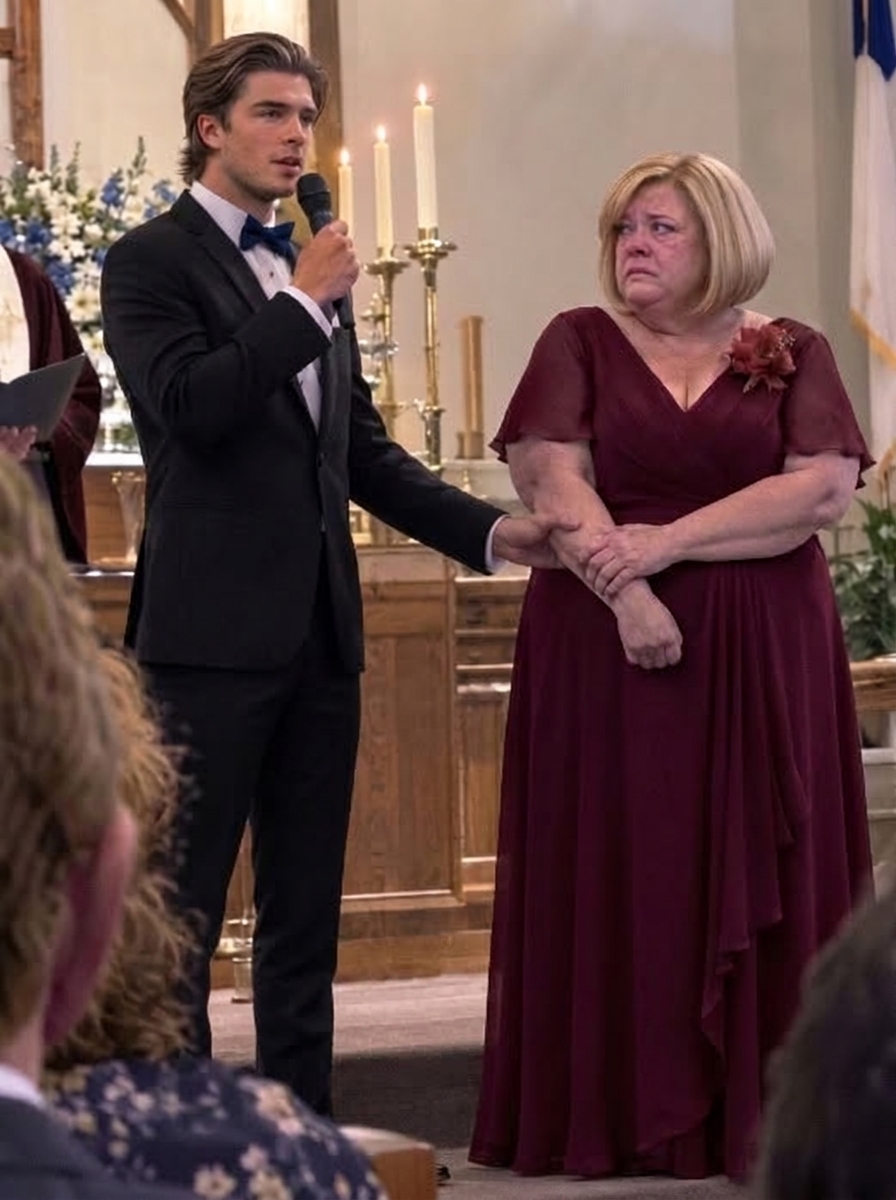
She personally walked me into the chapel.
Three months earlier, I had hidden behind white roses in the final pew because my daughter was ashamed for anyone to know I was her mother.
This time, Lauren walked beside me in her wedding dress.
Every person in the chapel could see us.
She brought me all the way to the front row.
Then she bent down and hugged me.
“I love you, Mom.”
“I love you too.”
Only after I was seated did she return to the entrance.
The music began.
Ethan stood waiting at the altar.
When Lauren appeared, he smiled.
This time, there was no secret sitting in the back row.
No invented family history.
No mother hidden behind flowers.
Lauren walked toward him wearing the pearl locket that had belonged to her grandmother.
When she reached Ethan, he took her hands.
Then his eyes moved toward me.
For one brief second, I remembered the first wedding.
His pale face.
The silent church.
The long walk toward the last pew.
But this time, Ethan simply smiled at me.
I smiled back.
Then the ceremony continued.
Lauren and Ethan eventually exchanged their vows.
Not the vows they had almost made three months earlier.
These meant more because both of them now understood exactly what they were promising.
Not perfection.
Not status.
Not appearances.
Truth.
When the officiant pronounced them married, everyone stood and applauded.
I cried.
Janice cried harder.
Ethan’s father pretended he had something in his eye.
And Lauren laughed.
Afterward, during the small reception, she came over and touched the pearl locket.
“Do you know what the worst part is?”
“What?”
“I thought I needed a better family story to impress Ethan.”
She looked across the room toward her new husband.
“But the story he respected most was already mine.”
I smiled.
“You just had to stop being ashamed long enough to see it.”
Lauren hugged me.
For years, I had believed the most painful thing my daughter could do was ask me not to attend her wedding.
I had been wrong.
The painful part was realizing she had learned to measure herself by wealth, appearances, and other people’s approval.
But the wedding that never happened forced her to confront the truth before she built an entire marriage on top of a lie.
Three months earlier, I had walked into a church intending to remain invisible.
Instead, my presence exposed everything.
And strangely enough, that exposure did not destroy Lauren’s future.
It gave her the opportunity to build one she no longer had to lie about.
The first time she walked toward the altar, she wanted her mother hidden in the last row.
The second time—
she refused to take a single step until I was sitting proudly in the front.
The End.
Latest Posts
- My Mother-in-Law Made My Baby Shower About Herself—Then My Husband Stood Up #2
I wanted a small baby shower, but my mother-in-law ignored nearly every request and turned the day into a celebration of becoming a grandmother. I kept swallowing my frustration for one deeply personal reason, until she crossed a line neither my husband nor I could ignore. I was seven months pregnant with our first child, …
- My Son Grew His Hair for His Best Friend’s Wig—Then Her Father Called Me to School
A 14-Year-Old Boy Grew Out His Hair to Make a Wig for a Classmate Who Lost Hers to Cancer – The Next Day, His Mother Was Called to the School, Where the Girl's Father Said, 'You Have No Idea What Your Son Did, Do You?' The gum stuck in my son’s hair nearly ended the …
- 80-Year-Old Woman Spent Seven Days Visiting an Old Friend…
80-Year-Old Woman Spent Seven Days Visiting an Old Friend – She Returned Looking Half Her Size with a Suitcase That Wasn't Hers I almost walked past my mother at the train station. She was standing beside a bench, gripping the handle of an enormous black suitcase. Her gray hair was flattened against her forehead, and …
- The Winning Ticket and the Life My Husband Hid
My Husband Was Lying in a Hospital Bed When I Won 100 Million Dollars, and Then I Heard Him Laughing to His Mistress That I Would Hand Him Every Penny If I Thought He Was Dying. I Hid the Ticket, Called a Lawyer, and Walked Away, Never Imagining That His Fake Illness Was Only the …
- My husband divorced me to marry my own mother. #2
My Husband Divorced Me to Marry My Own Mother My husband divorced me to marry my own mother. Everyone told me to move on, but instead… I showed up at their wedding. And when she said, “I do,” they had no idea what I had already done. When Mark left me, he didn’t even try …