My Bride Vanished on Our Wedding Day. Then a Maid’s Little Girl Uncovered a Secret My Family Had Buried for Thirty Years.
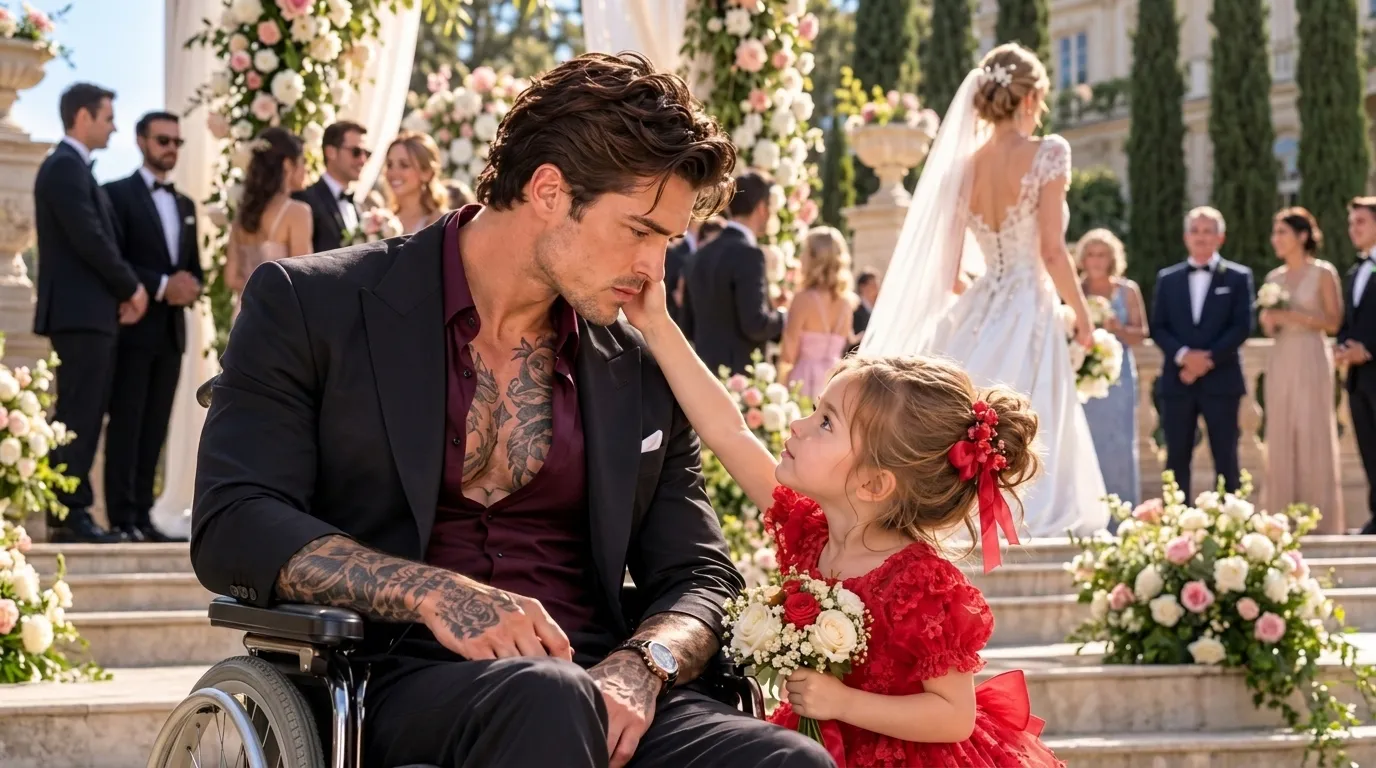
“Don’t be sad, Mr. Lorenzo. I’ll marry you when I grow up.”
The maid’s little girl said it less than twenty minutes after my bride supposedly abandoned me at the altar because I was in a wheelchair.
Three hundred guests had watched me endure that humiliation without breaking.
Rival families had whispered. Old enemies had smiled behind champagne glasses.
Men who had spent years waiting for Lorenzo Vitali to show weakness had finally been given the spectacle they wanted.
Yet somehow, it was the soft voice of a seven-year-old girl standing barefoot in the doorway of my study that nearly destroyed what little composure I had left.
That morning, my hands had trembled as I tightened my black tie for the fourth time.
Enzo, my butler of twenty-two years, noticed immediately.
“You’re staring,” I said.
“I am, sir.”
“Why?”
His weathered face softened.
“Because you look like a man expecting something good to happen.”
I almost smiled.
Good things and Lorenzo Vitali had not been acquainted for a very long time.
Two years earlier, an ambush had put me in a wheelchair.
My armored Mercedes had been traveling along a narrow mountain road outside Palermo when an explosive device tore apart the vehicle.
My driver, Gabriel Russo, died instantly.
I survived because the rear compartment absorbed less of the blast.
Survived.
That was the word everyone used.
As if waking up unable to feel your legs was the same thing as living.
Before the explosion, I had been thirty-six years old, six feet two, strong enough to frighten men simply by entering a room.
Afterward, men who once feared Lorenzo Vitali began watching me differently.
They watched my wheelchair.
They watched how long it took me to enter a car.
They watched whether I needed help reaching a staircase.
They searched for weakness in every breath.
But Bianca Moretti never did.
She came to the hospital carrying white lilies three days after I woke.
I expected pity.
Instead, she dropped the flowers onto the table and said, “You look terrible.”
I stared at her.
She shrugged.
“You always hated liars.”
That was Bianca.
Beautiful without trying. Infuriating without apologizing.
She had known me since we were teenagers, though our families had moved through different circles.
When everyone else looked at my wheelchair first and me second, Bianca somehow made it disappear.
She sat beside my hospital bed.
Argued politics with me.
Mocked my terrible taste in opera.
Brought me espresso when the nurses insisted caffeine was bad for me.
And when I finally returned to the Vitali estate, she came with me.
For two years, she never once made me feel diminished.
So when she agreed to marry me, I believed perhaps fate had finished punishing me.
I should have known better.
By eleven that morning, three hundred guests filled the gardens surrounding my estate.
White roses covered the marble terrace.
Crystal glasses shimmered beneath the Mediterranean sun.
A string quartet played beneath the cypress trees.
And scattered among our relatives were some of the most dangerous men in Italy.
Rivals.
Allies.
Enemies pretending to be friends.
Men who would happily attend my funeral wearing the same suits they wore to my wedding.
I rolled beneath the white pergola as Vivaldi filled the garden.
Bianca had chosen the music herself.
Five minutes passed.
Then seven.
Then ten.
The mansion doors never opened.
Whispers began moving through the guests.
At twelve minutes, my cousin Luca approached from behind the front row.
Luca Moretti had been beside me almost my entire life.
We had fought together as boys. Buried friends together as men.
After the ambush, he became my chief of security and handled many responsibilities I could no longer perform personally.
He leaned toward me.
“Want me to check?”
“No.”
My voice remained steady.
“If something is wrong, Enzo will tell me.”
Thirty seconds later, Enzo appeared.
And the moment I saw his face, I knew my wedding was over.
He approached slowly.
“Sir…”
“What happened?”
His eyes moved briefly toward the guests.
“There’s a letter.”
My fingers tightened around the wheels.
“Give it to me.”
The envelope carried Bianca’s seal.
Inside were three sentences.
I do not have the courage to spend the rest of my life beside a man who cannot stand.
I am sorry.
Do not look for me.
For several seconds, the entire world seemed to disappear.
I read it again.
Not because I hadn’t understood it.
Because some part of me refused to.
Bianca.
The woman who had kissed the scars along my spine.
The woman who had spent nights beside me when phantom pain made sleep impossible.
The woman who had told me repeatedly that my wheelchair changed nothing.
Had apparently changed her mind on our wedding day.
I folded the letter once.
Then twice.
I slipped it into the inner pocket of my jacket, directly over my heart.
And turned toward three hundred witnesses.
“There will be no ceremony today,” I said.
Nobody moved.
“The bride will not be joining us.”
Silence swallowed the garden.
Then chairs began shifting.
Guests avoided my eyes. Others stared too long.
Don Vittorio Ferretti, one of my father’s oldest rivals, stood from the second row.
He bowed respectfully.
But before lowering his gaze, I saw the tiny smile curling at the corner of his mouth.
He was enjoying this.
I memorized that smile.
Then I turned my wheelchair and rolled toward the mansion.
“Lorenzo,” Luca called.
I raised one hand.
“No one follows me.”
Inside my study, I closed the door.
Through the enormous windows, I could see servants quietly clearing three hundred untouched chairs.
From above, they resembled gravestones.
I didn’t drink.
I didn’t shout.
I didn’t throw anything.
I simply sat there.
My anger burned so quietly that it frightened even me.
Then came a tiny knock.
Not Enzo.
Not Luca.
Not one of my guards.
A child.
Before I could answer, the handle slowly turned.
A small face appeared around the door.
“Sofia.”
She slipped inside.
Sofia Russo was seven years old, the daughter of Rosa, one of the women who worked in the household laundry.
She had large dark eyes, brown curls that refused every attempt at discipline, and a habit of appearing in rooms where adults believed children should never be.
That afternoon she wore a pale yellow dress and carried one of the white roses from the ceremony.
“You’re supposed to knock,” I said.
“I did.”
“You’re supposed to wait afterward.”
“Oh.”
She considered this.
“Why?”
Despite myself, I nearly smiled.
Sofia walked closer.
She stared at the wheelchair.
Most children did.
Adults tried not to.
Children possessed no such hypocrisy.
Then she looked at my face.
“Are you sad?”
“No.”
“You look sad.”
“I’m tired.”
“My mama says grown-ups say tired when they don’t want children asking questions.”
I stared at her.
“Your mother talks too much.”
Sofia nodded seriously.
“Yes.”
Then she placed the white rose in my lap.
“I heard the wedding lady didn’t marry you.”
Apparently news moved faster among servants than criminals.
“That’s correct.”
Sofia frowned.
“Because of your chair?”
My jaw tightened.
“Apparently.”
She looked horrified.
“That’s stupid.”
“Sofia.”
“It is.”
She moved closer until she stood directly in front of me.
Then, with the absolute seriousness only a child could possess, she placed one tiny hand over mine.
“Don’t be sad, Mr. Lorenzo.”
I said nothing.
“I’ll marry you when I grow up.”
Something inside my chest cracked.
I had survived bullets.
Explosions.
Surgeries.
Funerals.
Betrayals.
Three hundred people watching my bride abandon me.
Yet those words almost broke me.
I looked away.
“You should find someone younger.”
Sofia considered that.
“Okay. But if I don’t, you’re my backup.”
A laugh escaped me before I could stop it.
It was the first genuine sound I had made all day.
Sofia grinned.
Then she said something that erased the smile from my face.
“The wedding lady was crying too.”
I looked at her.
“What?”
“Miss Bianca.”
My heartbeat slowed.
“Where did you see her?”
Sofia pointed toward the western side of the estate.
“Behind the kitchen.”
“When?”
“Before everybody sat down.”
I leaned forward.
“Was she alone?”
Sofia shook her head.
“No.”
“Who was with her?”
She shrugged.
“A man.”
“What man?”
“I couldn’t see his face.”
“Why?”
“He was holding her arm and they were walking fast.”
Every muscle in my body tightened.
“Was Bianca wearing her wedding dress?”
“Yes.”
“Did she look like she wanted to leave?”
Sofia’s little forehead wrinkled.
“No.”
That one word changed everything.
I opened my study door.
“ENZO!”
Footsteps thundered through the corridor.
Enzo arrived first, Luca several seconds behind him.
“What happened?” Luca demanded.
I looked at Sofia.
“Tell them what you told me.”
She repeated it.
A man.
The service corridor.
Bianca crying.
Someone gripping her arm.
Luca immediately crouched beside Sofia.
“You’re certain, sweetheart?”
“Yes.”
“You didn’t see his face?”
“No.”
“What about clothes?”
Sofia thought.
“A dark suit.”
Luca glanced at me.
“Half the men here wore dark suits.”
Then Sofia added, “He had a wolf on his hand.”
Silence.
Luca frowned.
“A wolf?”
“Shiny.”
She pointed at her wrist.
“Here.”
“A cuff link,” Enzo murmured.
I knew several families that used wolves in their heraldry.
But one name immediately entered my mind.
Ferretti.
Don Ferretti’s family crest was a silver wolf.
The same man who had smiled when my wedding collapsed.
Luca stood.
“I’ll handle it.”
“No.”
He looked at me.
“Lorenzo—”
“Lock down the property. Quietly. Retrieve every camera recording from this morning.”
Luca nodded.
“And Ferretti?”
I looked toward the empty garden.
“We do nothing until we know more.”
That night, we discovered something impossible.
Every security camera covering the western service corridor had a gap of exactly nine minutes.
From 10:41 until 10:50.
Someone inside my security network had deliberately erased the recordings.
Bianca had vanished at approximately 10:44.
The wedding note appeared inside her dressing room at 10:52.
Suddenly, humiliation became something else.
A kidnapping.
And possibly a message.
For the next three days, nothing came.
No ransom.
No demands.
No body.
Police were not involved.
Families like mine rarely invited government investigators into our affairs.
Instead, Luca mobilized almost fifty men.
Ports were watched.
Airfields checked.
Properties searched.
I barely slept.
But something else began bothering me.
The letter.
On the fourth morning, I placed it beneath a magnifying lens.
I had read thousands of handwritten notes from Bianca.
Her handwriting leaned slightly to the right.
The wedding letter leaned left.
The difference was subtle.
Almost perfect.
Almost.
Bianca had not written it.
Someone wanted me to believe she had abandoned me because I was paralyzed.
Someone wanted humiliation, not merely disappearance.
I called Enzo.
He arrived carrying coffee.
“Where is Luca?”
“Checking a warehouse outside Bari.”
“Good.”
Enzo set the cup down.
I watched him carefully.
“How long have you known Rosa Russo?”
His hand stopped for perhaps half a second.
Most people would not have noticed.
I did.
“Why?”
“Because her husband was driving my car when I was attacked.”
Enzo remained silent.
Gabriel Russo.
Until Sofia entered my study, I had never connected her surname to my dead driver.
That bothered me.
“How does the widow of the man who died saving me end up working inside my house?”
“She needed employment.”
“There are thousands of houses in Sicily.”
Enzo looked toward the window.
“Rosa asked specifically to work here.”
“Why?”
“I suggest asking her.”
So I did.
Rosa entered twenty minutes later.
She was thirty-three, perhaps thirty-four.
A quiet woman.
Beautiful in a tired way.
When she sat across from me, I noticed her hands trembling.
“You knew Gabriel,” I said.
Her eyes dropped.
“Yes.”
“He was your husband.”
“Yes.”
“Why didn’t anyone tell me?”
“I requested they not.”
“Why?”
She finally looked at me.
“Because I did not want your pity.”
That answer struck harder than expected.
“My husband died in your car, Mr. Vitali. People thought I should come asking for money. Compensation. Protection. Something.”
“But you didn’t.”
“No.”
“Instead you came to work here.”
“Yes.”
“Why?”
She hesitated.
Then reached into the pocket of her uniform.
She placed a small brass key on my desk.
“Because Gabriel believed the explosion came from inside your family.”
My chest tightened.
“What?”
“The night before he died, he told me someone had changed your route.”
“Changed it how?”
“He was ordered to use the mountain road.”
My breathing slowed.
“By whom?”
“He wouldn’t tell me.”
“Why?”
“He said he needed proof.”
Rosa’s eyes filled.
“The next morning, he kissed Sofia while she was sleeping and told me something I didn’t understand.”
“What?”
She swallowed.
“He said, ‘If anything happens to me, the wrong Vitali is going to inherit everything.’”
A chill moved through me.
I leaned back.
“What does that mean?”
“I don’t know.”
“Then what is the key?”
“Gabriel kept a deposit box in Palermo.”
“Have you opened it?”
“No.”
“Why?”
“He made me promise I wouldn’t unless another member of your family tried to kill you.”
I stared at her.
“My bride has been kidnapped.”
“I know.”
Rosa pushed the key closer.
“I think Gabriel would say that counts.”