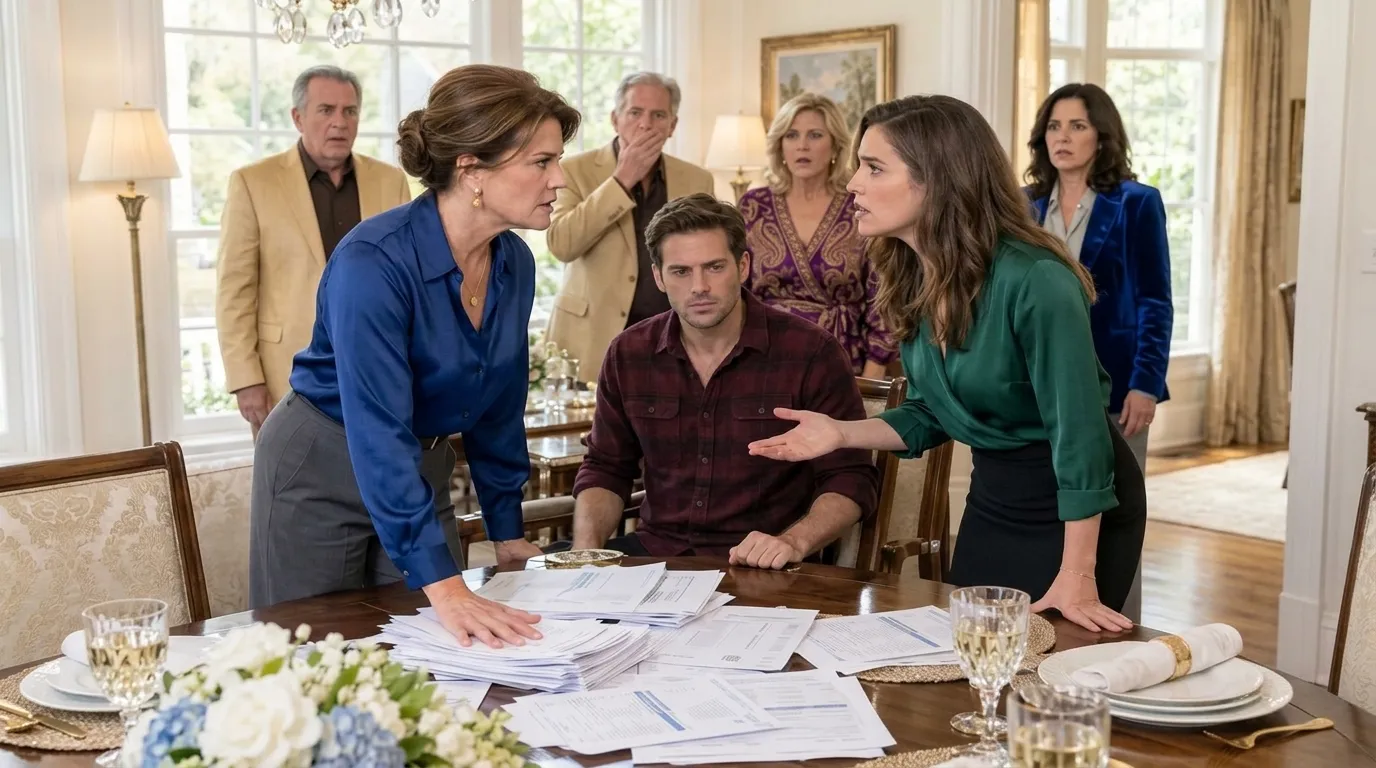
The following weeks were less dramatic than that table.
And much uglier.
Bank statements arrived.
Attorneys became involved.
Old emails were recovered.
Messages were reviewed.
What emerged was not one single moment when Mom and Nolan had decided to steal $144,000.
It was a series of smaller choices.
That almost made it worse.
Mom had first told Patricia I was struggling after college.
That part had contained some truth.
I had been struggling.
I worked constantly.
My rent ate most of my paycheck.
One unexpected medical bill had put me behind for months.
But Patricia had offered to help me directly.
Mom told her I would refuse out of pride.
So she suggested sending the money into Dad’s old business account, claiming she would use it to cover expenses for me without embarrassing me.
At first, Mom said she intended to do exactly that.
Then Nolan needed help.
His business was struggling.
One payment became a temporary loan.
Then another.
Then Mom used some money to cover one of her own debts.
Patricia continued transferring $3,000.
Nobody stopped her.
The description on every transfer remained attached to my name.
Eventually, the account was no longer temporary assistance.
It was income they expected.
Nolan used the money to build the appearance of success.
Car.
Club.
Credit cards.
Condo deposit.
My mother used some of it too, although less.
What mattered was that neither of them ever told Patricia.
And neither told me.
They simply allowed the family to believe the money was mine.
That lie benefited them twice.
They received the money.
And I received the humiliation.
For years, every time Patricia told me to be grateful, Mom remained silent.
Every time Nolan mocked my finances, he knew he was spending money everyone believed had gone to me.
That was the part I had the hardest time forgiving.
Not the car.
Not the condo.
The jokes.
I confronted Nolan about that privately.
We met at Grandma’s house three weeks after the birthday dinner.
He looked terrible.
No expensive jacket.
No smug expression.
“I know I was an idiot.”
“That’s easy.”
He nodded.
“I know.”
“Why did you make jokes about my apartment?”
He looked at me.
“What?”
“You knew Aunt Patricia thought she was paying my bills.”
His eyes dropped.
“So every time you called me broke, every time you joked about my furniture, you knew.”
He rubbed both hands across his face.
“I was trying to make it look normal.”
I stared at him.
“What does that mean?”
“If I suddenly defended you, Mom thought Patricia might start asking questions.”
That answer almost made me sick.
“You humiliated me to protect the money.”
“Yes.”
At least he didn’t lie.
I stood.
“Maya—”
“No.”
He stopped.
“You don’t get points because you’re finally honest after getting caught.”
He nodded.
“I know.”
That became the beginning of our new relationship.
Distance.
Not revenge.
Distance.
Patricia had her own apology to make.
She came to my apartment one Saturday carrying the same envelope of bank statements.
She looked around my living room.
The furniture Nolan had mocked.
Most of it really was secondhand.
I expected embarrassment.
Instead Patricia started crying.
“You lived here while I thought I was helping you.”
“I lived here because it was what I could afford.”
“I was awful to you.”
“Yes.”
She winced.
I wasn’t trying to punish her.
But I was finished making other people comfortable by softening facts.
“I thought you were taking my money and acting above everyone,” she said.
“I know.”
“I should have asked you.”
“Yes.”
She nodded.
That answer hurt her too.
Good apologies sometimes do.
She offered to begin sending the $3,000 directly to me.
I said no.
Her face fell.
“Why?”
“Because I don’t need you to replace one misunderstanding with another.”
“But that money was for you.”
“It was.”
I looked at her.
“And I wish I had received it four years ago.”
That was true.
Three thousand dollars a month would have changed those years.
I could have worked fewer overtime shifts.
Paid bills without panic.
Replaced my car sooner.
Gone to the doctor without calculating what the appointment would cost.
I wasn’t going to pretend otherwise.
“But I survived without it,” I said.
“And I don’t want the rest of my life built around proving that I deserved money I didn’t know existed.”
Patricia eventually pursued recovery from Mom and Nolan instead.
What happened legally was slower and less theatrical than people expect.
Because they had been authorized users on the account, there were questions about exactly what had been represented, what permission existed, and which transactions could be recovered.
Attorneys negotiated.
Records were produced.
Nolan sold the expensive car.
The condo purchase was unwound before completion.
My mother liquidated investments to cover part of what she owed.
Over time, Patricia recovered a substantial amount through a formal settlement.
She made one decision I did not expect.
After the settlement was complete, she asked me to meet her and Grandma.
She placed a cashier’s check on the table.
I did not touch it.
“What is that?”
“Part of what I recovered.”
“Patricia—”
“Listen first.”
I did.
“I sent that money because I wanted to help you.”
She swallowed.
“I did it badly. I let Linda control the arrangement. I never verified anything. Then I punished you emotionally for help you weren’t even receiving.”
She pushed the check slightly closer.
“I cannot give you four years back.”
“No.”
“But I can make sure the portion recovered from money intended for you does not become another family fight.”
I looked at Grandma.
She said nothing.
That was deliberate.
The decision belonged to me.
For years, I had measured independence by never taking anything.
Maybe because my family had taught me that receiving help meant surrendering the right to dignity.
I finally understood that was wrong too.
I accepted part of the recovered money.
Not as charity.
Not as an apology.
As restitution for something that had actually been intended for me and diverted.
Then I used some of it to pay off the medical debt I had carried from those years.
I replaced my car.
And I reduced my overtime.
That last part felt almost irresponsible at first.
Then one Friday evening I came home while the sun was still up.
I made dinner.
Sat on my secondhand sofa.
And realized I had not checked my work email once.
I cried.
Not because money had fixed my life.
Because for the first time in years, I was not exhausted enough to miss it.
Grandma revised her estate plan.
She did not disinherit Mom.
She did not disinherit Nolan.
She said inheritance should not become a weapon for controlling adult children.
But she removed both of them from every fiduciary position.
An independent professional would handle the estate.
Nobody in the family would ever again have access to Grandma’s money simply because they could say:
Trust me. We’re family.
My mother hated that at first.
She called it humiliating.
Grandma answered:
“So was what you did to Maya.”
There was no argument after that.
Mom and I barely spoke for months.
When we finally did, she apologized.
I listened.
Then asked:
“Why did you let Patricia think I needed the money?”
Mom stared at her hands.
“Because I was embarrassed.”
“About what?”
“That you were struggling.”
I laughed bitterly.
“My struggle embarrassed you?”
She cried.
“I thought people would think I had failed as a mother.”
“So instead, you created a story where Aunt Patricia was saving me.”
“Yes.”
“And then used the money for Nolan.”
Her voice became almost inaudible.
“Yes.”
That was our family in one sentence.
My difficulty had been something to hide.
Nolan’s difficulty had been something everyone was expected to finance.
I finally said it aloud.
“You thought his problems deserved money and mine deserved secrecy.”
Mom closed her eyes.
“Yes.”
It was the first time she admitted it without explaining.
That mattered.
It did not fix us.
But it mattered.
Two years later, Grandma had another birthday dinner.
Same dining room.
Same long table.
Patricia brought the cake.
I cut it.
Nolan arrived in an ordinary car and did not mention work once.
Mom asked me about my job without immediately asking what I earned.
We were not magically healed.
Some families never return to what they were.
Sometimes that is the healthiest outcome.
Patricia poured champagne.
Then she looked at me.
“Can I say something?”
For one second, the entire table froze.
She laughed.
“Not about money.”
Even I smiled.
She raised her glass.
“To Mom.”
Grandma rolled her eyes.
“And to Maya,” Patricia added, “who taught this family that if you’re going to claim you’re helping somebody, the least you can do is make sure the help actually reaches them.”
Grandma laughed.
Nolan looked embarrassed.
Mom looked down.
I lifted my glass.
Later that evening, Grandma and I sat alone in the kitchen.
She asked:
“Do you know what bothered me most about those statements?”
“The account?”
“No.”
“The lies?”
“Not exactly.”
I waited.
“The label.”
Maya Reynolds Living Support.
I knew exactly what she meant.
“Your name became an explanation for money other people were spending.”
I nodded.
Grandma reached across the table.
“Never let people define you using things they did without your knowledge.”
That sentence stayed with me.
For four years, my family thought I was dependent because they believed Aunt Patricia was sending me money.
The irony was that those four years proved the opposite.
I had paid my own rent.
Bought my own groceries.
Covered my own medical bills.
Worked the overtime.
Driven the old car.
Made the impossible months work.
The $144,000 was real.
The bank statements were real.
The transfers were real.
But the story everyone built around them was false.
And that was the part I eventually understood mattered most.
A bank statement can prove where money was sent.
It cannot prove who sacrificed.
Who struggled.
Who showed up.
Or who earned the right to call themselves independent.
My aunt had walked into Grandma’s birthday dinner thinking she was about to expose me as an ungrateful woman living on someone else’s generosity.
Instead, she exposed something much larger.
My mother had used my name.
My brother had used the money.
And I had spent four years surviving without either.
So when people ask what happened to the $3,000 a month, I tell them the truth.
It went somewhere else.
But the strength everyone thought it purchased for me?
That part was mine all along.
THE END.
Latest Posts
- My Husband Mocked My Postpartum Appearance in His Brothers’ Group Chat—I Stayed Quiet for Five Days
Four months after giving birth, I thought my husband understood why I hardly recognized myself. Then I discovered the cruel joke he'd been sharing with his brothers, along with photos I never knew he'd taken. I kept my discovery secret for five days, determined to make him regret every word. “Dude, you weren't exaggerating 😂” …
- My Stepdaughter Called Me the Help Until My Envelope Changed Everything
The insult came before I’d even finished setting down the peach cobbler. I’d baked it at five that morning in the kitchen of the lake cabin we’d rented, and it was still warm under the foil. The smell of cinnamon followed me across the grass toward the pavilion tables, where thirty-two members of the Cole …
- My In-Laws Gave Their Other Three Children $20,000 for Houses and Gave Us Only a Card Two Years Later, We Bought the Old Miller Place for $41,500
The envelopes were tucked under the Easter plates. Each had a name written on it in my mother-in-law’s round schoolteacher handwriting. Kim opened hers first. She’s the oldest. Divorced two years. Raising two boys in a rented trailer behind the grain elevator. She looked at what was inside the envelope and put her hand flat …
- My Mother-in-Law Told Me to Lose Weight After Giving Me a Dress That Didn’t Fit, but Minutes Later, She Regretted Everything
I couldn’t get it over my hips. I stood in my bedroom in my underwear with the dress bunched around my thighs like a deflated balloon. Midnight blue silk. A designer label I’d only ever seen in magazines. Tiny pearl buttons down the back. Beautiful. And four sizes too small. I pulled. I tugged. I …
- Teen Wore a Dress to His Best Friend’s Funeral—The Family Nearly Had Him Removed Before He Reached the Microphone
My son’s best friend read the eulogy at his funeral in a red dress. I almost had him removed before he reached the microphone. My son Jack died 17 days after his 18th birthday. Cancer. Fourteen months from diagnosis to funeral. We found out late. Too late, as it turned out, and the treatment never …