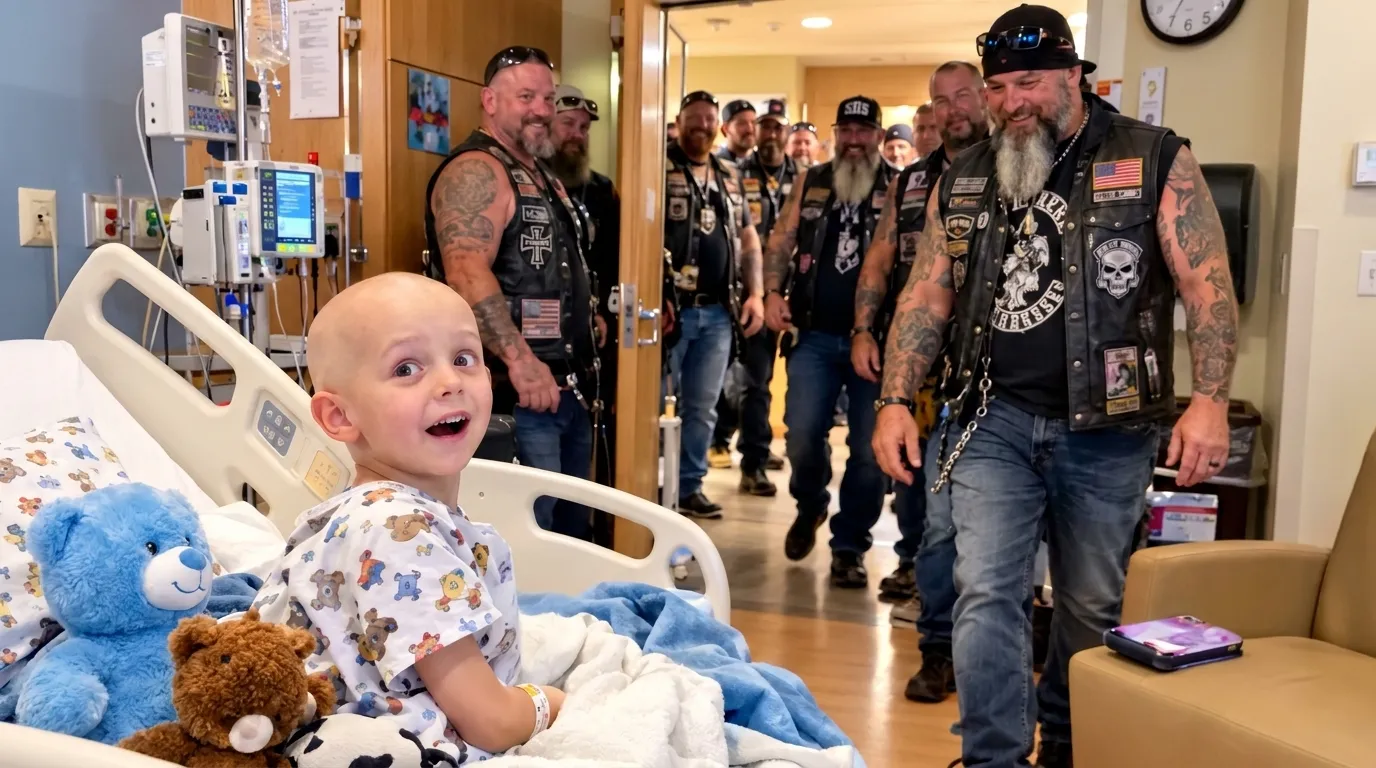
The following morning, Wade returned alone with photographs from the motorcycle club.
Drew was sleeping, so we sat in the family waiting area.
I thanked Wade for everything, then asked about Dr. Harris.
Wade stared at his coffee.
“Harris used to be one of our most dependable riders.”
“What happened?”
“His younger brother died. After that, he stopped coming around.”
I glanced toward the hallway.
“His brother was a biker?”
“They both were. Those two were inseparable before his brother got sick.”
Wade explained that Dr. Harris had been working long shifts while his brother’s health deteriorated.
“He kept saying he’d take a few days off when things settled down. Trouble was, things never settled down.”
“Did his brother blame him?”
“Not once. But Harris blames himself enough for both of them.”
I thought about the doctor’s patience with Drew and the way he remembered every little detail.
Suddenly, his attention made more sense.
Later that day, I found Dr. Harris sitting beside Drew while he slept.
“Why didn’t you tell me about your brother?” I asked quietly.
He looked surprised.
“Wade mentioned him,” I explained.
Dr. Harris watched Drew for a moment.
“My brother was nineteen when he died. I was older, already working at the hospital. I kept thinking there’d be more time.”
“I’m sorry.”
“He loved riding. We used to take trips together whenever I could get away.”
“Why did you stop?”
“I couldn’t enjoy it anymore. Every time I saw the guys, all I could think about was the person who wasn’t there.”
I sat in the chair opposite him.
“My son has spent years missing somebody who’s still alive,” I said. “And I’ve spent years pretending that didn’t hurt him.”
Dr. Harris looked at me.
“I don’t know how to fix that.”
“Neither do I.”
For a while, we sat listening to Drew breathe.
Then I asked, “Did your brother ever want you to stop riding?”
Dr. Harris shook his head.
“No. He would’ve hated it.”
He looked toward the window.
“I know that. Doesn’t make going back easy.”
I didn’t push him.
But I finally understood why Drew had been so disappointed about that old vest.
Or at least I thought I did.
Two days later, the hospital approved a brief outdoor gathering.
Drew’s condition was stable enough that morning, and a nurse agreed to accompany us.
Before we went outside, Wade quietly pulled me aside.
“There’s something you should know.”
He showed me the old leather vest.
“Your boy asked me to bring this.”
“I thought Dr. Harris arranged everything.”
“He arranged Drew’s surprise. Drew arranged this part.”
I stared at him.
Wade explained that Dr. Harris had told Drew about his brother after Drew asked about a small tattoo on his wrist.
The tattoo showed two motorcycle wheels with a date under them.
Drew had wanted to know why someone who loved motorcycles so much didn’t ride anymore.
Eventually, Dr. Harris told him.
“And then your boy asked me whether we could get Harris back into the club,” Wade said.
“How did Drew even contact you?”
“Harris introduced us on a phone call while we were planning the visit. When he stepped out for a minute, Drew asked me to keep one extra surprise.”
I looked at the folded vest.
All this time, I’d believed Dr. Harris was the one giving my son something extraordinary.
I hadn’t realized Drew was trying to return the favor.
“He told me the doctor made him feel like he still had something to look forward to,” Wade continued. “Said he wanted Harris to feel that way again.”
I had to turn away.
My son, who knew he was dying, was worrying about a grown man who’d forgotten how to enjoy his life.
Outside, the motorcycles were parked in two neat rows near a quiet hospital entrance.
Drew stared at them from his wheelchair, wearing his honorary vest.
Wade introduced each rider, then invited Drew to choose his favorite motorcycle.
He picked a dark blue one with polished chrome.
“That one’s yours?” he asked Wade.
“Sure is.”
“Good choice.”
“Thank you. I was hoping you’d approve.”
Everyone laughed.
Then Wade presented Drew with a small patch bearing the club’s emblem.
The bikers stood around his wheelchair for a group photograph.
I thought the ceremony was finished.
But Drew looked toward Dr. Harris.
“Hey, Doc?”
“Yeah, champ?”
“There’s something else.”
Wade handed my son the older vest.
Dr. Harris immediately recognized it.
“Drew…”
“You told me bikers don’t leave their brothers behind,” Drew said.
“That’s right.”
“Then why did you leave yours?”
Nobody spoke.
Dr. Harris crouched beside the wheelchair.
“It’s not that simple, buddy.”
“I know.”
Drew looked at the vest.
“But you still remember your brother, right?”
“Every day.”
“So putting this on won’t make you forget him.”
Dr. Harris lowered his head.
For a moment, I thought he’d refuse again.
Then he carefully took the vest.
“You know,” he said, his voice rough, “my brother would’ve liked you.”
Drew smiled.
“Would he have let me join?”
“He would’ve made you president.”
The men laughed softly.
Dr. Harris stood and slipped his arms into the leather vest.
Wade stepped forward and straightened the collar.
Then the bikers made room for him in their circle.
Drew looked up at me with the biggest smile I’d seen in months.
“Mom, there are fourteen of us now.”
I kissed the top of his head.
“You’re counting yourself, aren’t you?”
“Obviously.”
Over the following weeks, Drew’s condition worsened.
There were days when he barely had the strength to speak, but Dr. Harris kept coming to see him. Sometimes he brought photographs from rides. Sometimes they simply sat together.
The bikers sent postcards and short messages. Wade visited when Drew felt up to company.
My mother came one afternoon and found two enormous men sitting beside Drew, listening while he explained his favorite game.
Afterward, she pulled me aside.
“I suppose we were wrong about those tattoos.”
I smiled.
“Very wrong.”
Drew lived almost three months after the day we received his prognosis.
Near the end, he asked me to hang his vest where he could see it.
One evening, he looked at me and said, “Mom, are you going to be okay?”
I wanted to tell him yes.
Instead, I told him the truth.
“I’m going to miss you more than anything.”
He nodded.
“But you have friends now.”
“I do.”
“And Wade said I can always be part of the club.”
“You always will be.”
He smiled faintly.
“Good.”
Drew died peacefully a few days later, with me holding his hand.
Nothing about losing him was easier because of what Dr. Harris had done.
But when the funeral was over, and the quiet became unbearable, I discovered I wasn’t as alone as I’d feared.
Wade called regularly.
The bikers invited me to their gatherings, never pressuring me to attend.
Dr. Harris checked in, too, no longer as Drew’s physician, but as someone who had loved him.
Six weeks later, I attended a memorial ride organized in Drew’s honor.
The motorcycles lined up under a clear blue sky.
Dr. Harris stood beside Wade, wearing his old leather vest.
When he saw me carrying Drew’s smaller one, his eyes filled.
“I thought the club should keep this,” I said.
Wade shook his head gently.
“Bridget, he was one of us. But that belongs with his mother.”
He showed me a photograph mounted inside their meeting room.
It was Drew on the day of the ceremony, grinning between Dr. Harris and the other bikers.
Under it were the words “Our Brother, Always.”
I touched the photograph.
For years, I’d worried that I couldn’t give Drew everything he needed.
I’d been so afraid of failing him that I’d forgotten love was never something one person had to provide alone.
The tattooed doctor I’d once wanted to avoid had given my son a family of men who kept their promises.
And my boy had helped that doctor find his way back to the people he’d lost touch with.
As the engines started, Dr. Harris stepped beside me.
“Ready?” he asked.
I looked down at Drew’s vest, folded carefully in my arms.
Then I looked at the twelve bikers waiting for us.
“Yeah,” I said. “I think Drew would want us to go.”
For the first time since losing my son, I wasn’t afraid to let someone walk beside me.
Latest Posts
- My Husband Mocked My Postpartum Appearance in His Brothers’ Group Chat—I Stayed Quiet for Five Days
Four months after giving birth, I thought my husband understood why I hardly recognized myself. Then I discovered the cruel joke he'd been sharing with his brothers, along with photos I never knew he'd taken. I kept my discovery secret for five days, determined to make him regret every word. “Dude, you weren't exaggerating 😂” …
- My Stepdaughter Called Me the Help Until My Envelope Changed Everything
The insult came before I’d even finished setting down the peach cobbler. I’d baked it at five that morning in the kitchen of the lake cabin we’d rented, and it was still warm under the foil. The smell of cinnamon followed me across the grass toward the pavilion tables, where thirty-two members of the Cole …
- My In-Laws Gave Their Other Three Children $20,000 for Houses and Gave Us Only a Card Two Years Later, We Bought the Old Miller Place for $41,500
The envelopes were tucked under the Easter plates. Each had a name written on it in my mother-in-law’s round schoolteacher handwriting. Kim opened hers first. She’s the oldest. Divorced two years. Raising two boys in a rented trailer behind the grain elevator. She looked at what was inside the envelope and put her hand flat …
- My Mother-in-Law Told Me to Lose Weight After Giving Me a Dress That Didn’t Fit, but Minutes Later, She Regretted Everything
I couldn’t get it over my hips. I stood in my bedroom in my underwear with the dress bunched around my thighs like a deflated balloon. Midnight blue silk. A designer label I’d only ever seen in magazines. Tiny pearl buttons down the back. Beautiful. And four sizes too small. I pulled. I tugged. I …
- Teen Wore a Dress to His Best Friend’s Funeral—The Family Nearly Had Him Removed Before He Reached the Microphone
My son’s best friend read the eulogy at his funeral in a red dress. I almost had him removed before he reached the microphone. My son Jack died 17 days after his 18th birthday. Cancer. Fourteen months from diagnosis to funeral. We found out late. Too late, as it turned out, and the treatment never …