I read the letter twice.
Then I stopped at one sentence.
He doesn’t know how much he’s already healed in me.
For three months, I’d been replaying the worst moment of our marriage. The moment I thought I’d failed her.
And all that time, Mary had been carrying a completely different memory.
A night in our bed.
A question I hadn’t understood.
An answer I’d almost forgotten giving.
I pressed my hand against my mouth.
She’d spent years wondering whether she was wanted.
And somehow, without knowing it, I’d helped her stop wondering.
“She trusted me?”
Her mother nodded.
“Even knowing what might happen?”
“She wasn’t expecting to die. She was afraid because she knew what it was like to grow up around grief.”
I looked at the sentence again.
Tell him I trusted him.
At the hospital, I’d watched Mary’s face while the doctors talked. I’d waited for someone to offer another answer.
Then she’d squeezed my hand.
“The girls. Obviously the girls.”
I’d thought the squeeze was goodbye.
Now I wondered if she’d been telling me something else.
I trust you.
Not to choose for her.
To believe the choice she’d already made.
I pressed the paper flat.
“She told you not to disappear.”
“I know.”
“You promised her.”
“Yes.”
“And when I sent you pictures of her daughters, you wrote two words. That’s all you had for them?”
She started crying.
I didn’t reach for her.
“I saw Mary every time I looked at them,” she said. “And all I could think was that she should be holding them.”
“They’re here.”
“I know.”
“Mary isn’t. But they are.”
“I know.”
“You knew what your silence did to her.”
Her mother nodded.
“And you left us alone anyway.”
“Yes.”
I wanted her to argue.
To give me something I could be angry at besides the truth.
Instead, she whispered, “Mary spent her childhood waiting for me to come back. And I’ve made her daughters wait for me, too.”
I stood and walked to the sink.
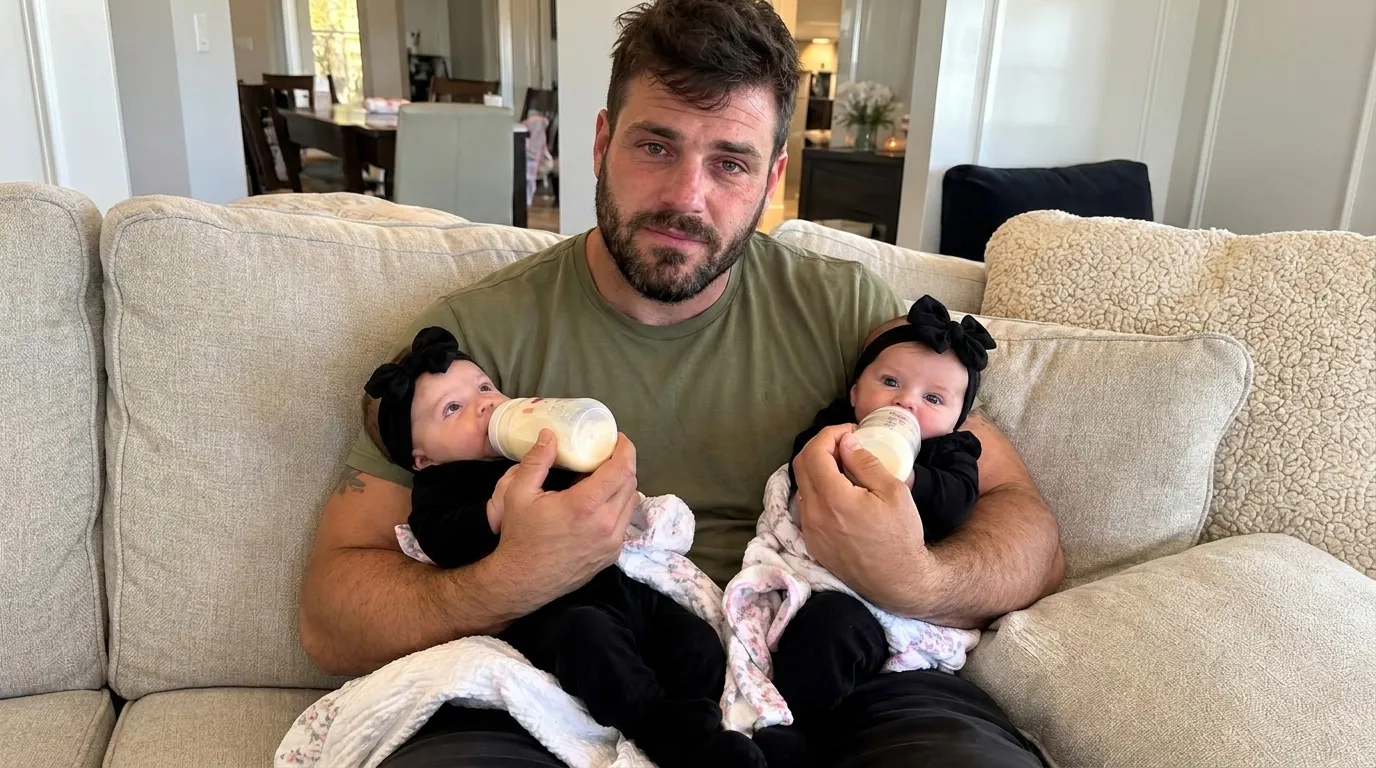
The bottles were drying on a towel. Four of them.
I remembered Mary teasing me about how organized I’d become during the pregnancy.
Now I wrote feeding times on scraps of paper because some nights I couldn’t remember which daughter I’d just fed.
“I thought you hated me,” I said.
Her mother looked up.
“I thought you hated yourself for saying yes.”
I looked away.
“I did.”
Then I faced her again.
“But why didn’t you come?”
She wiped her face.
“I was afraid I’d look at those girls and wish Mary were here instead. I was ashamed of the thought. So I stayed away.”
“The very thing Mary asked you not to do.”
“I know.”
I gripped the counter.
“Why come today?”
“Yesterday, you sent a photograph.”
Both girls on their blanket.
One smiling.
The other grabbing her sister’s sleeve.
Underneath, I’d written, “They’ve started smiling when I sing.”
“I read that message,” her mother said. “And I remembered how Mary used to sing when she was little.”
She paused.
“Then I realized I couldn’t remember the last time I’d sung with her.”
She’d opened the drawer containing Mary’s letter.
Read it again.
Found two dresses she’d bought before the birth.
Still wrapped.
She’d driven to our house that morning and sat outside for nearly an hour.
“I almost left.”
“What stopped you?”
“I imagined them getting old enough to ask why Grandma never came.”
I looked at the nursery door.
“And what would you have said?”
She shook her head.
“Nothing that wouldn’t have hurt them.”
For a long time, we sat without speaking.
Then I told her something I hadn’t admitted to anyone.
“Sometimes I wish Mary were here so badly I feel guilty looking at the girls.”
Her mother listened.
“I’ll be holding one, and I’ll think Mary should be doing this. She should be here for the first smiles. She should know which one hates a cold bottle.”
My throat closed.
“And then I think about what I said at the hospital.”
“Mary asked you.”
“I agreed.”
“Because you trusted her.”
I shook my head.
“I keep thinking I traded her for them.”
Her mother reached across the table.
I pulled my hand away.
Not because I hated her.
Because I needed to say the rest.
“I’ve never wished they weren’t born. Not once.”
“I believe you.”
“But I wish she hadn’t died.”
“Of course you do.”
I stared at her.
She was crying too.
“Those aren’t the same wish,” she said.
I thought about Mary’s question in bed.
Even if you missed me?
I’d answered without hesitating.
I’d miss you every day.
But I’d still love them every day.
Mary had believed me.
Somewhere in the nursery, a baby began crying.
I went to her.
Her sister woke as I lifted her.
Of course.
I tucked one against each shoulder.
Their grandmother appeared in the doorway. She watched me rock them.
“Mary would’ve laughed at this,” I said.
“Why?”
“She said I couldn’t hold a grocery bag without dropping something.”
Her mother laughed.
A small sound.
“Could I hold one?”
I hesitated.
She lowered her eyes.
“I understand.”
“These girls can’t spend their lives waiting for you to be ready.”
“I know.”
“I won’t tell them you’ll come if you might disappear.”
She nodded.
“I’ll earn it. If you’ll let me.”
I handed her the smaller twin.
She held the baby close.
“Hello, sweetheart,” she whispered. “I’m your grandma.”
The baby grabbed her collar.
Mary’s mother smiled through tears.
We didn’t fix everything that day.
I didn’t forgive three months of silence because she’d cried in my kitchen.
But she came back the next morning.
And the next.
She washed bottles. Learned their different cries. Held them while I slept.
One afternoon, she was feeding the smaller twin when the baby curled her fingers around Grandma’s thumb.
She froze.
“Mary used to do that,” she whispered.
Her eyes filled.
For a moment, she looked toward the door.
I recognized that look. I’d seen it when she first arrived.
The urge to get away before remembering hurt too much.
Then the baby made a small, impatient noise.
Her grandmother looked down.
“I’m here,” she whispered.
She wiped her face with her free hand.
And kept feeding her.
This time, she stayed.
A week later, she brought an old album.
Mary with missing front teeth.
Mary in a crooked birthday hat.
Mary on her father’s shoulders.
Her mother touched that photograph.
“I couldn’t look at this for years.”
Then she told me where they’d taken it. How Mary had demanded another ride. How her father had pretended his legs were tired.
We laughed.
I hadn’t expected that.
Later, I opened the bag from the hospital.
I took out Mary’s sweatshirt.
It still smelled faintly like her soap.
I held it for a long time.
Then I folded it beside the album.
Not hidden.
Not forgotten.
Before she left, Mary’s mother noticed the sweatshirt beside the album.
“She wore that the day she went in,” she said.
I nodded.
“She bought it on our first trip together. It rained that weekend. She insisted the weather made everything romantic.”
Her mother smiled.
“She did that. Found something good in whatever went wrong.”
I looked at the sleeves. They were stretched from years of Mary pulling them over her hands.
“I thought taking it out of the bag meant I was letting her go.”
“No,” she said. “It means the girls can know her.”
That evening, I sat between the cribs.
I told the girls about their mother arguing over names.
About her terrible singing.
About how she’d laughed that morning when I couldn’t find her water.
One daughter waved her fist.
The other watched my face.
“Your mother wanted you,” I whispered. “Both of you.”
I touched their hands.
“And I do too.”
I still missed Mary.
Every day.
I always would.
But one day, when the girls asked why their mother wasn’t here, I wouldn’t tell them they’d cost me her life.
I’d tell them she loved them before she’d seen their faces.
I’d tell them about her laugh.
And I’d tell them that when she asked me to trust her, I did.
I kissed their foreheads.
Then I switched off the light.
Tomorrow, they’d wake hungry.
Their grandmother would come.
And we’d keep telling them about Mary.
Latest Posts
- My Husband Mocked My Postpartum Appearance in His Brothers’ Group Chat—I Stayed Quiet for Five Days
Four months after giving birth, I thought my husband understood why I hardly recognized myself. Then I discovered the cruel joke he'd been sharing with his brothers, along with photos I never knew he'd taken. I kept my discovery secret for five days, determined to make him regret every word. “Dude, you weren't exaggerating 😂” …
- My Stepdaughter Called Me the Help Until My Envelope Changed Everything
The insult came before I’d even finished setting down the peach cobbler. I’d baked it at five that morning in the kitchen of the lake cabin we’d rented, and it was still warm under the foil. The smell of cinnamon followed me across the grass toward the pavilion tables, where thirty-two members of the Cole …
- My In-Laws Gave Their Other Three Children $20,000 for Houses and Gave Us Only a Card Two Years Later, We Bought the Old Miller Place for $41,500
The envelopes were tucked under the Easter plates. Each had a name written on it in my mother-in-law’s round schoolteacher handwriting. Kim opened hers first. She’s the oldest. Divorced two years. Raising two boys in a rented trailer behind the grain elevator. She looked at what was inside the envelope and put her hand flat …
- My Mother-in-Law Told Me to Lose Weight After Giving Me a Dress That Didn’t Fit, but Minutes Later, She Regretted Everything
I couldn’t get it over my hips. I stood in my bedroom in my underwear with the dress bunched around my thighs like a deflated balloon. Midnight blue silk. A designer label I’d only ever seen in magazines. Tiny pearl buttons down the back. Beautiful. And four sizes too small. I pulled. I tugged. I …
- Teen Wore a Dress to His Best Friend’s Funeral—The Family Nearly Had Him Removed Before He Reached the Microphone
My son’s best friend read the eulogy at his funeral in a red dress. I almost had him removed before he reached the microphone. My son Jack died 17 days after his 18th birthday. Cancer. Fourteen months from diagnosis to funeral. We found out late. Too late, as it turned out, and the treatment never …