I Worked for My In-Laws for Free for 5 Years—The Weekend I Stopped, Everything Fell Apart
I fixed my in-laws’ cars and mowed their lawn every weekend for five years. Never asked for a penny.
One day, my father-in-law looked at me and said, “If you left tomorrow, we’d just pay someone better.”
My wife laughed.
I just nodded.
The next weekend, I stayed home.
By Thursday, my wife was furious after seeing a photo of me having lunch with her boss.
My name’s Nathan. I’m thirty-four years old, and until all of this happened, I thought I had built the perfect life.
My wife, Claire, is thirty-two, and we’ve been married for six years—six years that should have been filled with partnership and mutual respect, but somewhere along the way became something else entirely.
Her family lives just across town, a twenty-minute drive that I made every single Saturday morning like clockwork. I thought I was building bridges when really I was laying down a welcome mat for people to walk all over me.
I was raised by parents who believed that family meant everything. You pitch in, you help where you can, and you never, ever keep score.
My dad spent countless weekends helping his siblings move, fix their cars, and repair their homes. He did it with a smile and never expected anything in return.
That mindset, that deeply ingrained belief in family obligation, is exactly how I ended up being the unpaid handyman, mechanic, and landscaper for my in-laws for five years.
Every Saturday morning, my alarm would go off at seven. I’d roll out of bed while Claire slept in, grab a quick breakfast, load my tools into the truck, and head over to Jim and Carol’s place.
The routine never varied.
Mow the lawn, trim the hedges, edge the driveway. Check the gutters, fix whatever needed fixing—leaky faucets, broken steps, loose railings, loose boards on the deck, sticking doors, squeaky hinges, cracked tiles.
You name it, I fixed it.
Jim, my father-in-law, is one of those old-school types who talks constantly about how manual labor builds character and how the younger generation doesn’t understand the value of hard work.
But conveniently, his character-building philosophy never seemed to involve his own two hands.
He’d stand on the porch with his coffee, watching me work, occasionally calling out instructions like I was hired help rather than his daughter’s husband.
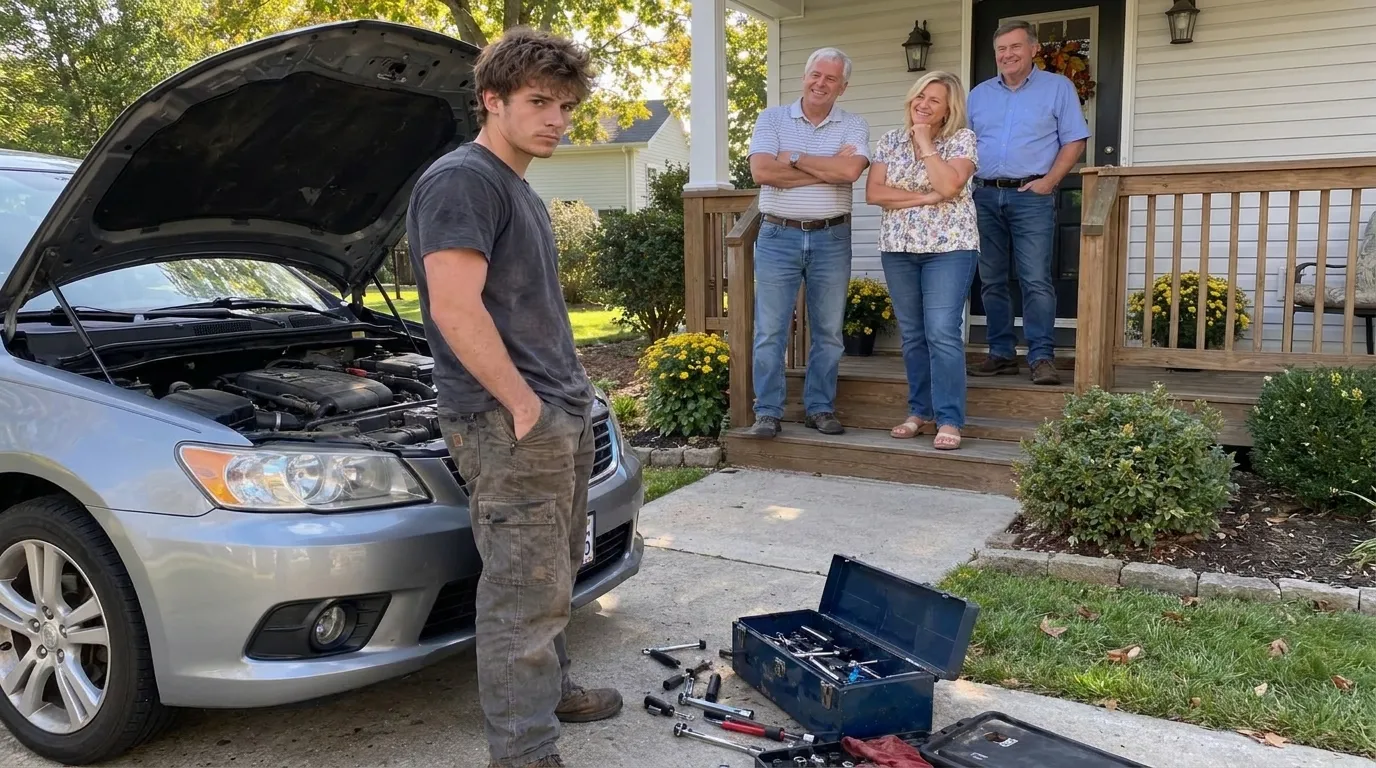
When their cars had issues—and they always had issues—I’d spend hours under the hood in their driveway.
Brake pads, oil changes, batteries, alternators, timing belts, spark plugs. If it could be done in a residential driveway with standard tools, I did it.
I never asked for a penny. Not once. I never even asked them to cover my gas.
It wasn’t about money. Money was never the point.
I wanted to be a good son-in-law, a good husband, someone Claire could look at with pride.
I figured that one day, maybe after enough weekends, enough fixed problems, enough sweat and effort, they’d see me as part of the family. Not just the guy who married their daughter, but an actual member of their inner circle.
Someone they valued.
But with every passing year, I started to notice something that gnawed at me in quiet moments.
The thank-yous disappeared. Eventually, there was no gratitude. No acknowledgment whatsoever.
It wasn’t just that they took my help for granted—plenty of families fall into comfortable routines where please and thank you get lost in familiarity.
This was different.
This was entitlement.
They felt entitled to my time, my skills, my entire weekend. It was written in every expectation, every request that wasn’t really a request at all.
One Saturday morning, about four months before my breaking point, I pulled up to their house at my usual time and found a piece of paper taped to the garage door.
I got out of my truck, walked over, and read it.
“Things to do today” was written in Carol’s neat, precise handwriting.
Under that heading was a bulleted list:
Fix squeaky screen door.
Replace two light bulbs in living room.
Check car battery.
Mow lawn.
Clean gutters.
Organize tools in garage.
No greeting. No “Hi Nathan, thanks for coming.” No cup of coffee.
Just a to-do list, waiting for me like I was a contractor they’d hired and forgotten to pay.
I stood there in the morning sun, staring at that list, feeling something cold settle in my chest.
I carefully peeled it off the door and folded it into my pocket.
Then I spent the next six hours completing every single task on it, plus a few more I noticed along the way.
That night, I brought it up to Claire. We were sitting on our couch, and I pulled out the folded paper and showed it to her.
“Look at this,” I said, trying to keep my voice level. “Your mom left me a to-do list. Taped it to the garage door like I’m hired help.”
Claire barely glanced at it. She shrugged, her eyes already drifting back to her phone.
“You know how they are,” she said dismissively. “They appreciate what you do. They’re just not good at expressing it.”
I wanted to argue.
I wanted to say that appreciation requires actual expression, that silence and assumption aren’t the same as gratitude.
But I swallowed those words like I’d swallowed so many others over the years, forcing them down into that growing pit of resentment I pretended didn’t exist.
The real breaking point came on an ordinary Saturday morning.
I had just finished changing the oil in Jim’s pickup truck—a beat-up old Chevy that leaked like a sieve and should have been retired years ago.
I was crouched by the front wheel, wiping the grease and oil off my hands with an old rag, when Jim came out onto the porch.
Claire and Carol were there too, sitting in the wicker chairs, drinking iced tea and chatting about something.
Jim looked down at me from the porch, and our eyes met. He had this expression on his face, something between amusement and disdain.
“You know, Nate,” he said, his voice carrying that casual authority he always used, “if you left tomorrow, we’d just pay someone better to do this stuff. Probably get it done faster too.”
The words hung in the air for a moment.
I waited for Claire to say something, to defend me, to acknowledge how insulting that was.
Instead, she laughed.
It wasn’t a nervous laugh or an uncomfortable laugh. It was genuine amusement, like her dad had told a good joke at my expense and she was in on it.
Something in me went very, very quiet.
Not angry. Not hurt.
Just quiet, like a switch had flipped and all the noise in my head suddenly stopped.
I didn’t yell. I didn’t argue. I didn’t defend myself or demand an apology.
I just nodded slowly, finished wiping my hands, and packed up my tools.
That night, lying in bed next to Claire, I stared at the ceiling for hours. I kept replaying that moment—Jim’s words, Claire’s laugh, the casual cruelty of it all.
By the time the sun came up, something fundamental had shifted inside me.
I had spent five years trying to earn a place in a family that would never see me as anything more than free labor.
At breakfast, I told Claire I wasn’t going over the next weekend.
She didn’t even look up from her phone.
“Fine,” she said, scrolling through something. “But you know Dad can’t clean those gutters himself. He’s going to be annoyed.”
“Then he can hire someone better,” I said quietly.
She glanced up then, a flicker of surprise crossing her face, but she didn’t say anything else.
That Saturday, I stayed home.
I woke up at my usual time out of habit, but instead of loading my truck with tools, I made myself a real breakfast.
Eggs, bacon, toast, fresh coffee.
I ate slowly at our kitchen table, savoring every bite.
Then I settled onto the couch with a book I’d been trying to read for months and spent the entire morning in blissful peace.
For the first time in five years, my Saturday belonged to me.
Around noon, my phone buzzed with a text from Claire.
“Dad says the grass looks awful.”
I read it, set my phone down, and went back to my book.
An hour later:
“Mom’s asking when you’re coming over.”
I didn’t reply to that one either.
By Sunday night, the messages were getting snippier, more urgent.
“You’re really going to let them sit there with broken stuff all week? They need your help, Nathan. This is childish.”
I ignored every single message.
Monday morning, the tension in our house was thick enough to cut. Claire moved around the kitchen with sharp, angry movements, slamming cabinet doors just a little too hard, setting her coffee mug down with just a little too much force.
Tuesday, she barely spoke to me at all.
Wednesday was worse—cold silence punctuated by heavy sighs and pointed looks.
Then Thursday came.
I was sitting in a quiet little café downtown, halfway through lunch with someone I never expected to be having a business meeting with: Mark Stevenson, Claire’s boss.
We were discussing a potential consulting arrangement. He had connections with several small business owners who needed someone reliable to maintain their equipment and handle basic repairs, and he thought I’d be perfect for it.
My phone buzzed in my pocket.
I glanced down and saw Claire’s name on the screen. I ignored the call, but a second later, my screen lit up with a text message.
“What are you doing having lunch with Mark?”
I looked across the table at Mark, and he smiled slightly, like he’d been expecting this exact moment.
That’s when I realized two things simultaneously.
First, Claire had somehow found out where I was and who I was with.
Second, she didn’t seem confused or curious. She seemed to be panicking.
Mark, being the observant person he is, noticed my expression change.
“Looks like she saw us,” he said calmly, taking a sip of his coffee. “Are you okay with that?”
I nodded slowly.
“Yeah,” I said. “I think this was overdue anyway.”
See, Mark isn’t just some random guy. He owns the company where Claire has worked for eight years and serves as its general manager. He’s also well-connected in our community.
I’d only met him a handful of times at company parties and holiday gatherings, where he’d always been friendly and professional.
A few weeks earlier, purely by chance, I’d run into him while getting gas.
We got to talking, and I mentioned offhandedly that I did mechanical work on the side. He’d seemed genuinely interested and asked if I’d ever considered consulting for small businesses, helping them save money by maintaining their own equipment rather than outsourcing everything.
I’d thought about it on and off for a while.
But after what Jim said that Saturday—after being told I was replaceable and hearing my wife laugh about it—I decided to take Mark up on his offer.
This lunch wasn’t just lunch.
It was an informal business meeting to discuss me leaving my dead-end warehouse job and starting something new.
Something that might finally give me independence and self-respect.
But to Claire, all she saw was a photograph of me sitting across from her boss, smiling and talking without her knowledge, without her permission.
By the time I got home that evening, she was pacing in the kitchen.
“What was that?” she demanded the second I walked through the door.
“What was what?” I asked, keeping my tone deliberately calm and even.
“Lunch with Mark!” Her voice had that sharp, incredulous edge that I’d heard too many times before. “Do you have any idea how that looks? People at the office saw you. They’re talking, Nathan. They’re wondering what’s going on.”
“We were having lunch,” I said simply.
“Why?”
“Business.”
I set my keys on the counter and met her eyes.
“That’s exactly what we were doing—discussing business.”
She blinked, thrown completely off balance.
“Business? What business?”
“I’ve been thinking about leaving my job,” I said. “Mark thinks I could make something real out of my skills. Consulting. Helping local businesses maintain their equipment. He’s introducing me to some people who might be interested in hiring me.”
Claire’s face changed, but not in the way I’d hoped.
Not to pride or excitement or support.
To anger. Pure, undiluted anger.
“You didn’t tell me about this,” she snapped, her voice rising.
“No,” I agreed calmly. “I didn’t.”
For a long moment, we just stared at each other across our kitchen. The silence between us was heavy with years of unspoken resentment and unmet expectations.
And in that silence, the truth became crystal clear.
For five years, I had been an extension of her family, an extra pair of hands to fix what they wanted fixed whenever they wanted it fixed.
My time, my effort, my entire weekends—all of it was assumed to belong to them.
And now, suddenly, I was doing something for myself, something that might pull me out of their control, and she couldn’t stand it.
That night, she called her mom. I heard her whispering urgently in our bedroom, her voice low and strained.
A little while later, my phone buzzed with a text from Jim.
“So you’re too good for us now? You think you’re better than this family?”
I stared at the message for a long moment, then set my phone down without responding.
The next day, when I came home from work, I found Jim’s beat-up pickup truck parked halfway up my driveway, blocking my garage.
He was sitting on the hood with his arms crossed, waiting for me like some kind of intimidating sentinel.
“We need to talk,” he said as I got out of my truck.
I walked right past him toward my front door.
“I don’t think we do.”
“Don’t get smart with me, Nathan,” he said, following me up the walkway. “You think just because you had one fancy lunch with Mark, you’re big stuff now? You owe this family more than you think.”
That stopped me.
I turned around slowly, deliberately, and looked him straight in the eye.
“I owe this family?” I repeated, my voice very quiet.
“You certainly do,” he said, his face already turning red. “All the meals we’ve fed you, all the holidays we’ve included you in—”
“All the free work I’ve done for you,” I interrupted, my voice growing sharper. “All the weekends I gave up. All the oil changes, the lawns, the gutters, the repairs. Five years’ worth.”
“That’s what family does,” Jim cut in dismissively. “You think you’re special? You think anyone’s going to thank you for doing what you were supposed to do?”
I just stared at him, feeling something inside me go cold and hard.
“You’re right,” I said finally. “No one’s going to thank me. Which is exactly why I’m done.”
Jim’s face turned an alarming shade of crimson.
“You don’t get to just be done, Nathan,” he snapped. “You’re married to Claire. That means you’re part of this family. We take care of each other.”
I didn’t say anything.
I just walked to my front door, went inside, and locked it behind me, leaving him standing on my walkway, sputtering with rage.
That night, Claire told me she was going over to her parents’ house.
She didn’t ask me to come. She didn’t even look at me when she left, just grabbed her purse and keys and walked out.
After the door closed behind her, the house fell into a profound silence.
For the first time in years, I felt a strange sort of peace settle over me.
And yet, deep down, I knew this was only the beginning.
Jim and Claire wouldn’t just let this go.