“Mom… I’m cold.”
My eight-year-old son, Brandon, barely had enough strength to say the words.
I turned toward him from the tiny kitchen and felt something inside me break.
He was lying beneath two thin blankets on a stained mattress we had dragged into the living room because the bedroom window no longer closed properly.
Rainwater leaked through the cracked ceiling and landed rhythmically inside a plastic bucket beside him.
Drip.
Drip.
Drip.
The sound had become the soundtrack of our lives.
“I know, sweetheart,” I whispered.
I walked over and touched his forehead.
Still burning.
His fever had been coming and going for three days.
I needed to take him to a doctor.
I knew that.
But knowing something and being able to afford it were two completely different things.
There were twenty-three dollars in my wallet.
Six dollars in loose change.
And half a loaf of bread.
That was everything.
Across the room, my five-year-old daughter, Emma, sat quietly on the floor brushing the hair of a doll someone had thrown away years ago.
The doll was missing one eye.
Its dress was torn.
But Emma treated it like treasure.
“Mommy,” she asked softly, “are we having chicken tonight?”
My throat tightened.
I had told her yesterday that maybe we would.
The day before that too.
“Maybe,” I said.
She smiled.
Children believe you when you lie because they love you.
That was the cruelest part.
My name is Sarah Collins.
Three years earlier, I had a small apartment, a husband, a car, and enough money to believe life would always remain stable.
Then my husband disappeared.
Not died.
Not divorced me.
Disappeared.
One morning, Daniel left for work and never came home.
Police searched.
His company claimed he had stolen money.
His bank accounts were frozen.
His name became connected to an investigation I didn’t understand.
Within six months, everything we owned was gone.
The house.
The car.
My savings.
Even my wedding ring.
I spent years trying to understand what happened to the man I married.
Eventually, I stopped asking.
Because survival required all my energy.
And survival became more difficult every day.
That morning, after leaving Brandon with my elderly neighbor and taking Emma upstairs to play with her granddaughter, I walked through downtown Chicago searching for work.
Restaurants.
Stores.
Hotels.
Cleaning services.
Everywhere.
The answer was always the same.
We’ll call you.
Nobody called.
By noon, my feet hurt so badly I could barely walk.
I stopped outside an expensive café near Michigan Avenue.
Through the window, I saw two elegantly dressed women talking.
“I need someone immediately,” the older woman said.
The younger woman sighed.
“For Mr. Bennett again?”
“Yes.”
“Didn’t he fire another caregiver last week?”
“Three this month.”
“What’s wrong with him?”
“Nothing that wasn’t already wrong before. He simply refuses to let anyone help him.”
“And the salary?”
The woman leaned closer.
“More than enough to convince someone to try.”
My heart began pounding.
I stood outside for almost thirty seconds.
Then I opened the door.
“I’m sorry,” I said. “I couldn’t help overhearing.”
Both women looked at me.
“I heard you’re looking for a caregiver.”
The older woman studied me.
“This is a private position.”
“I understand.”
“Do you have nursing experience?”
“No.”
“Medical training?”
“No.”
“Have you ever cared for a paralyzed patient?”
I swallowed.
“No.”
Her expression hardened.
“Then why exactly are you applying?”
Because my children were hungry.
Because my son was sick.
Because I had reached a point where dignity meant nothing compared with keeping them alive.
But I didn’t say any of that.
Instead, I looked directly into her eyes.
“Because I won’t quit.”
For several seconds, neither woman spoke.
Finally, the older woman reached into her handbag and removed a business card.
EVELYN HARTMAN
PERSONAL ESTATE MANAGER
BENNETT RESIDENCE
“Four o’clock,” she said.
“Today?”
“If you’re serious.”
“I’ll be there.”
“One warning, Ms…?”
“Collins. Sarah Collins.”
“One warning, Ms. Collins. Mr. Bennett doesn’t trust people.”
I smiled weakly.
“Neither do I.”
For the first time, something almost like amusement appeared in her eyes.
“Perhaps you’ll survive longer than the others.”
I had no idea how wrong she was.
Because surviving the job would be the easiest part.
Surviving the truth behind it would nearly destroy me.
THE MAN IN THE WHEELCHAIR
The Bennett estate sat behind enormous iron gates on the outskirts of Chicago.
The driveway curved through acres of manicured gardens.
A fountain stood before the mansion.
Stone walls.
Tall windows.
Balconies.
More rooms than my entire apartment building probably had.
A woman in a dark uniform opened the door.
“You must be Ms. Collins.”
“Yes.”
“I’m Margaret. House manager.”
She led me inside.
Polished marble.
Portraits.
Expensive wood.
Fresh flowers.
“Mr. Bennett is upstairs.”
“What happened to him?”
She stopped.
“His accident?”
I nodded.
“Car crash. Two years ago.”
“Was he alone?”
“I wasn’t here at the time.”
The answer came too quickly.
I noticed.
But said nothing.
At the end of the hallway, Margaret opened a large bedroom.
“Mr. Bennett, your new applicant is here.”
A male voice answered:
“I didn’t ask for another one.”
Margaret sighed.
“You never do.”
And there he was.
Nicholas Bennett.
Forty years old.
Billionaire.
Owner of Bennett Technologies.
One of Chicago’s most powerful businessmen.
He sat in a motorized wheelchair beside the window.
Lean.
Broad-shouldered.
Dark hair slightly too long.
A faint scar along his jaw.
His face looked tired.
Not weak.
There was a difference.
His gray eyes moved toward me.
“So,” he said. “They found another one.”
“Apparently.”
“I need this job,” I told him.
His eyebrows lifted.
“Honesty. That’s new.”
“I don’t have enough energy to lie.”
Something flickered across his face.
Then disappeared.
“Do you know what this job involves?”
“Not completely.”
“Good. Then you haven’t been frightened away yet.”
Margaret handed me instructions.
Medication schedules.
Daily routines.
Emergency contacts.
Physical therapy.
Personal care.
I read everything.
Then Nicholas spoke.
“You can leave now.”
“I thought this was an interview.”
“It was.”
“Did I get the job?”
He looked toward Margaret.
“Did she?”
Margaret almost smiled.
“You’re starting tomorrow.”
My heart jumped.
“Thank you.”
Nicholas turned toward the window.
“I didn’t say thank you.”
“No,” I replied. “But I did.”
For the first time, I saw something close to a smile.
Then it disappeared.
The next few days were harder than expected.
Nicholas was difficult.
Not exactly cruel.
But distant.
He rejected help.
Argued about medication.
Refused therapy.
Treated every question like an interrogation.
“Do you always ask so many questions?” he asked one morning.
“Only when someone refuses to answer simple ones.”
He stared at me.
I stared back.
Then, unexpectedly, he laughed.
For a moment, he didn’t look like the cold billionaire everyone feared.
He looked like someone who had forgotten how to be happy.
Gradually, I learned his routines.
His favorite coffee.
The books he pretended not to enjoy.
The classical music he listened to when he couldn’t sleep.
And the fact that he hated thunderstorms.
One night, I found him awake beside the window as lightning flashed outside.
“You should sleep,” I said.
“So should you.”
“I’ll sleep when my children become millionaires.”
He looked at me.
“You have children?”
“Two.”
“Where is their father?”
The question hit harder than expected.
“Gone.”
“Dead?”
“I don’t know.”
Nicholas went quiet.
Then said:
“I’m sorry.”
It was the first genuinely kind thing he had said to me.
And suddenly I felt something dangerous.
Trust.
I looked away.
Trust had ruined my life once.
I wasn’t going to let it happen again.
THE MARK THAT DESTROYED MY WORLD
Three weeks after I began working at the estate, Brandon’s fever returned.
Nicholas noticed immediately.
“You’ve checked your phone six times.”
“My son is sick.”
“Then why are you here?”
“Because if I leave, I don’t get paid.”
His expression changed.
“You need money.”
I laughed bitterly.
“Congratulations. You solved the mystery.”
Nicholas pressed a button on his wheelchair.
Margaret entered.
“Get Ms. Collins an advance.”
I stared at him.
“I can’t accept that.”
“Yes, you can.”
“I’ll pay it back.”
“I didn’t say you had to.”
“I don’t want charity.”
His expression hardened.
“Neither did I when I became paralyzed.”
The room became quiet.
Then I understood.
This wasn’t charity.
It was pride recognizing pride.
“Thank you,” I whispered.
That afternoon, Brandon saw a doctor.
By evening, he had medication.
For the first time in months, I could breathe.
Two nights later, I was assigned to help Nicholas with his evening bath.
Normally, a male assistant handled the more personal aspects of his care.
But the assistant had left unexpectedly.
Margaret asked me to stay.
I hesitated.
Then agreed.
Work was work.
Nothing more.
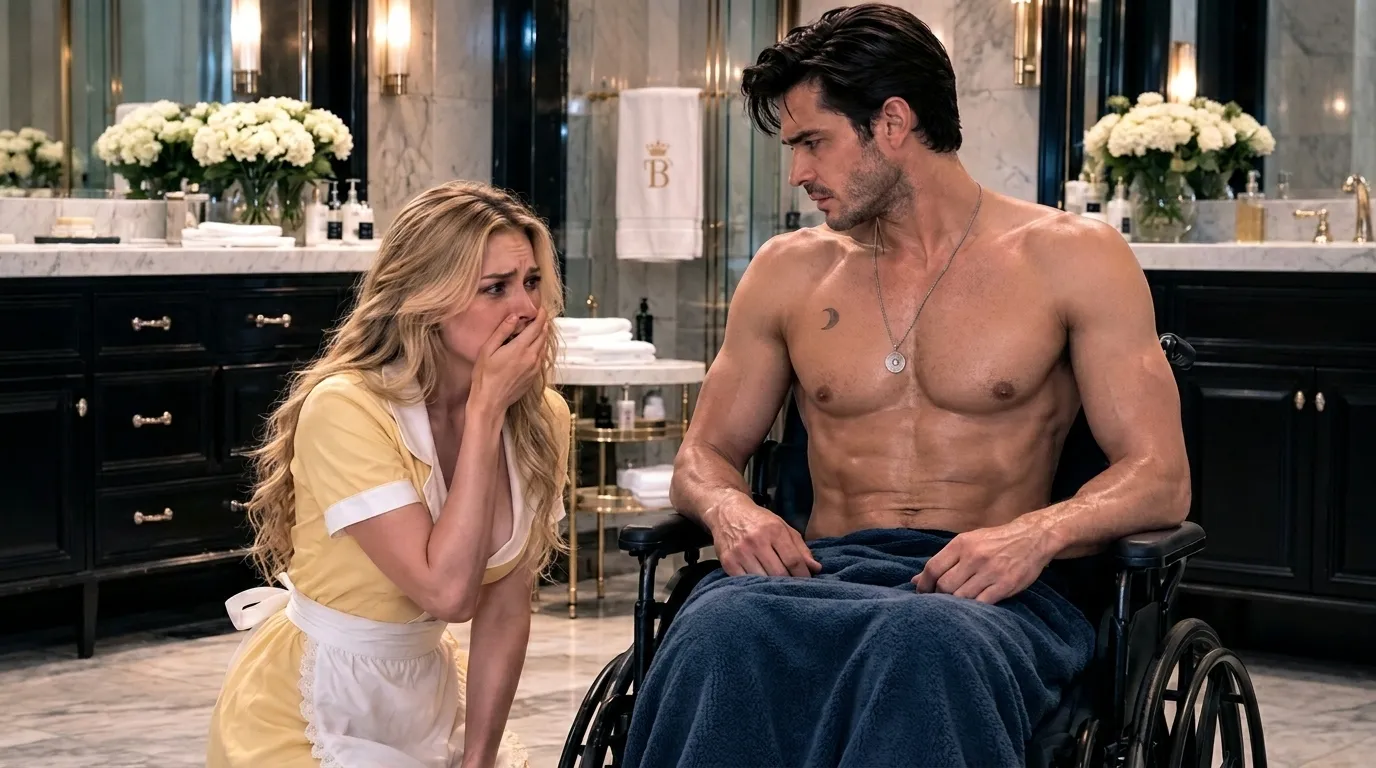
The bathroom was enormous.
White marble.
Soft light.
Steam rising from the water.
Nicholas looked uncomfortable.
“So,” he said.
“So?”
“Apparently, this is embarrassing for both of us.”
I almost laughed.
“Good. At least we agree on something.”
He nodded toward his shirt.
I began unbuttoning it carefully.
One button.
Then another.
Then everything changed.
Just beneath his collarbone was a dark crescent-shaped birthmark.
My breath disappeared.
Around his neck was a worn silver chain.
Attached to it was a small metal compass.
My knees weakened.
I knew that compass.
I had held one like it twenty years earlier.
I had watched a boy wear it every day.
My vision blurred.
The bathroom vanished.
Suddenly I was nine again.
Standing in the rain.
Screaming for my father.
Watching someone disappear into darkness.
I stumbled backward.
“Sarah?”
My legs gave out.
I hit the floor.
Nicholas stared at me.
“What happened?”
I looked at the birthmark.
The necklace.
His face.
Then whispered the name I had barely spoken since childhood.
“Daniel.”
Nicholas froze.
“What did you say?”
“Daniel Mercer.”
His face turned white.
“How do you know that name?”
Because Daniel Mercer was not only the boy who disappeared twenty years ago.
He was connected to the man I had married.
And Nicholas Bennett was somehow connected to both.
THE NIGHT OF THE STORM
After Margaret helped settle Nicholas back into his wheelchair, he ordered everyone else out.
“Stay,” he told me.
I stood near the door.
He stared at the compass.
“Tell me everything.”
So I did.
Twenty years earlier, I had lived in a small town outside Chicago.
My father was a mechanic.
My mother had died when I was young.
Our neighbor was Thomas Mercer.
Thomas had a son.
Daniel.
Daniel was eleven.
I was nine.
We grew up together.
He was my best friend.
And he always wore a silver compass necklace.
“It belonged to my grandfather,” he once told me.
“Does it point somewhere?”
“No.”
“Then why wear it?”
“Because my grandfather said everyone needs something to remind them where they came from.”
Daniel also had a crescent-shaped birthmark below his collarbone.
I used to tell him it looked like a crooked moon.
He told me I looked like a frog when I laughed.
Then came the storm.
My father received a phone call.
He became pale.
He told me to lock the door.
Then Daniel arrived.
Terrified.
His father was missing.
Someone was looking for him.
My father told Daniel to hide.
Before we could understand what was happening, three men arrived.
Shouting.
Breaking glass.
Rain blowing through the open doorway.
My father fought one of them.
Daniel was dragged toward a black car.
Then Dad screamed:
“RUN, SARAH!”
I ran into the woods.
I didn’t stop until I heard a gunshot.
Then silence.
The next morning, my father was gone.
Daniel was gone.
Police claimed my father had been involved in criminal activity.
They said Thomas Mercer had stolen money from someone dangerous.
They said Daniel probably died.
No bodies were found.
My entire childhood disappeared in one night.
Nicholas listened without interrupting.
When I finished, his hands were trembling.
“That’s impossible.”
“Why?”
He looked toward the window.
“Because Daniel Mercer was my brother.”
My heart stopped.
“What?”
Nicholas slowly removed the necklace.
“I was adopted.”
“When I was six, I was taken from a hospital after my biological parents died.”
“Taken?”
“Kidnapped.”
He remembered almost nothing.
A woman raised him for several years under another name.
Then he was abandoned outside a church.
The Bennett family adopted him when he was eight.
“But Daniel?”
“I didn’t know about Daniel until years later.”
He looked down.
“I found documents after my adoptive father died.”
“My original name was Nicholas Mercer.”
“Daniel Mercer was your brother?”
“Older brother.”
I sat slowly.
“But Daniel survived.”
Nicholas looked at me sharply.
“What?”
“My husband.”
The room seemed to spin again.
“My husband was named Daniel Collins. But when we married, he told me his original surname was Mercer.”
Nicholas gripped the wheelchair.
“Where is he?”
Tears filled my eyes.
“He disappeared three years ago.”
THE MAN WHO VANISHED TWICE
For the next week, Nicholas and I searched through every memory I had.
Daniel had never spoken much about childhood.
I had always assumed it hurt too much.
Now I wondered whether he had been hiding.
Or protecting me.
Nicholas investigated.
And the truth became increasingly disturbing.
Daniel had not stolen money from his company.
Police records had been manipulated.
Evidence against him was incomplete.
Someone had deliberately erased large parts of his history.
Nicholas hired a private investigator named Michael Ross.
Within forty-eight hours, Michael discovered Daniel had been searching for information about the Bennett family before disappearing.
“Why?” I asked.
Nicholas stared at the documents.
“Because he discovered who I was.”
He showed me a photograph.
His adoptive father, Richard Bennett, stood beside another man.
My father.
The photograph was dated twenty-one years earlier.
And beside them stood Thomas Mercer.
Three men.
One photograph.
One secret.
Michael uncovered the story slowly.
Richard Bennett had built his fortune through a technology company.
But decades earlier, he worked with Thomas Mercer and my father.
Together, they created a financial tracking system.
The company became successful.
Then something went wrong.
Richard wanted complete control.
Thomas and my father wanted their share.
Old records suggested Richard had moved company money illegally.
Thomas discovered it.
My father helped him collect evidence.
They planned to expose Richard.
The night of the storm, men came looking for that evidence.
Richard himself was not there.
But men connected to him were.
My father disappeared.
Thomas disappeared.
Daniel was taken.
Nicholas had already been kidnapped years earlier.
And Richard eventually adopted Nicholas.
Not out of kindness.
The adoption gave him control over the surviving Mercer child and anything that might someday be tied to Thomas.
I looked at Nicholas.
“You grew up inside the house of the man who destroyed your family.”
His face emptied.
“I called him Father.”
That night, Nicholas barely spoke.
I found him in the library after midnight.
Only one lamp was on.
“You should sleep,” I said.
“So should you.”
I sat across from him.
After several minutes, he whispered:
“Do you think Daniel knew?”
“I don’t know.”
“Did he ever mention me?”
“No.”
Nicholas closed his eyes.
“I had a brother.”
His voice cracked.
“And I didn’t know.”
I didn’t know how to comfort him.
So I simply stayed.
Sometimes that is all a broken person needs.
Not answers.
Not advice.
Just someone willing to remain when everything becomes unbearable.
THE ACCIDENT WAS NOT AN ACCIDENT
Two weeks later, Michael returned with another discovery.
Nicholas’s car crash had not been an accident.
The brakes had been deliberately damaged.
Someone had tried to kill him.
“Who?” Nicholas asked.
Michael placed another file on the table.
Daniel Mercer.
My heart stopped.
“No.”
“His name appears in the investigation,” Michael said carefully. “He was suspected of tampering with the vehicle.”
“No.”
Nicholas looked at me.
“Sarah.”
“He wouldn’t do that.”
“You don’t know.”
“Yes, I do.”
“You haven’t seen him in three years.”
The words hurt.
But the timing looked terrible.
Daniel disappeared two weeks after Nicholas’s accident.
Everything seemed to point toward him.
Still, I remembered the man I had married.
The man who stayed awake all night when Brandon was born.
The man who taught Emma to ride a bicycle.
The man who kissed my forehead every morning before work.
Could that man have tried to murder his own brother?
I refused to believe it.
That night, I searched through Daniel’s remaining belongings.
There was one box beneath my bed.
Letters.
Photographs.
Receipts.
Birthday cards.
And a sealed envelope.
Daniel had given it to me one week before disappearing.
“If anything happens,” he had said, “open this.”
I never had.
I was too afraid.
For three years, it remained hidden.
Now I tore it open.
Sarah,
If you are reading this, something has gone wrong.
I wanted to tell you everything, but the less you know, the safer you are.
My name is Daniel Mercer.
I know you remember that name.
I know you remember the storm.
I remember it too.
I survived.
And for years, I believed everyone I loved had died.
Then Daniel wrote that he had discovered Nicholas was alive.
That was why he began searching.
And that search led him to Richard Bennett.
Sarah, Richard Bennett destroyed our families.
Your father did not disappear because he was a criminal. He disappeared because he tried to protect evidence.
My father died because he knew too much.
And Nicholas has spent his entire life living with the enemy.
Then came the warning.
If something happens to me, don’t trust anyone connected to Bennett Technologies.
Especially Charles Bennett.
I read the name three times.
Charles Bennett.
Nicholas’s adoptive cousin.
Current vice president of Bennett Technologies.
And the man who had taken control of most company operations after Nicholas became paralyzed.
Suddenly, the accident looked different.
The missing evidence looked different.
Daniel’s disappearance looked different.
Someone had framed him.
And that someone was still inside the Bennett family.
THE ENEMY INSIDE THE HOUSE
Nicholas didn’t want to believe Charles could be involved.
Charles had grown up beside him.
They attended school together.
Worked together.
Built the company together.
But Michael kept investigating.
The evidence grew.
Charles had access to Nicholas’s car.
Charles transferred millions from company accounts after the crash.
Charles had been present around the time Daniel disappeared.
And Charles hired the detective who originally investigated Daniel for theft.
The story had been manufactured.
But proving it was another matter.
Then Charles came to the estate.
Tall.
Well-dressed.
Always smiling.
The kind of man who made everyone comfortable.
Now his smile made me sick.
“Sarah,” he said warmly.
“Mr. Bennett.”
“Please. Charles.”
“No, thank you.”
His smile tightened.
Later, Nicholas asked me to remain nearby while he met Charles.
The office door stayed partially open.
“You’re making a mistake,” Charles said.
“Possibly,” Nicholas replied.
“Hiring strangers. Asking questions about the past.”
Silence.
Then Charles’s voice changed.
“Some things are better left buried.”
Nicholas answered:
“My brother was buried.”
Another silence.
Then Charles laughed.
“Your brother?”
The word sounded poisonous.
“You don’t even know if he’s alive.”
“No,” Nicholas said.
“But apparently, you know more than I do.”
The door opened.
Charles walked out.
His eyes met mine.
And I understood immediately.
He knew.
That night, I returned home and found my apartment door open.
“Brandon?”
Nothing.
“Emma?”
I ran inside.
Furniture overturned.
Drawers emptied.
And Daniel’s box was gone.
Police found no useful fingerprints.
No witnesses.
The next morning, Nicholas insisted I move the children into the Bennett estate.
“I can’t bring my problems into your house.”
“Sarah.”
His voice was firm.
“Someone broke into your apartment because of me.”
I looked toward Brandon and Emma.
For the first time in months, they had eaten a full meal.
“Just until we figure this out.”
Nicholas looked away.
“Stay as long as you need.”
Neither of us knew then how long that would become.