My name is Margaret Briggs. I’m seventy-one years old.
At exactly 6:18 on a Thursday evening in October, at a dinner table in Scottsdale, Arizona, my only son looked across a roast chicken I had cooked and asked me when I was finally going to leave.
But that’s the middle of the story.
Let me start where it started.
On a porch.
With a cup of tea.
Harold and I were married for forty-four years.
We met at a church picnic in Flagstaff in 1979. He was twenty-six. I was twenty-five. He was a high school shop teacher with sawdust in his hair and a laugh you could hear across a parking lot. I was a bookkeeper at a lumber company.
He came to buy two-by-fours for his students and stayed an hour arguing with me about the price.
He asked me to dinner. I said no.
He came back the next week for more two-by-fours he didn’t need.
I said yes.
We moved to Tucson in 1984. Harold got a job teaching woodshop at Catalina High School. I got a job doing the books for a plumbing company.
We bought a little house on East Linden Street. Two bedrooms. A carport. A front porch with a ceiling fan that wobbled.
We paid fifty-eight thousand dollars for it.
We lived there for thirty-eight years.
I painted the kitchen yellow the first week.
Harold said it looked like the inside of a lemon. I said that was the point. He painted the cabinets white to match. He built a breakfast nook by the window out of oak he salvaged from an old church in Bisbee. He carved our initials into the underside of the table where nobody could see.
H.B. + M.B. 1984.
I planted roses along the front walk. Six bushes. Mister Lincoln. Double Delight. Peace. Harold teased me that roses didn’t belong in the desert. I watered them every morning at six before the heat came.
They bloomed for thirty-eight years.
Every morning, Harold drank tea on the porch.
Not coffee. Tea. Earl Grey, with honey and a splash of milk, in a blue mug I bought him at a craft fair in Tubac in 1986. He sat in the same wooden rocker he built himself. He drank one cup before he left for school.
On weekends, he drank two.
The second cup was the important one.
He told me that once, early on. One Saturday, I asked why he always made a second cup on weekends when he drank only one on weekdays.
“The first cup,” he said, “is for waking up.”
“And the second?”
He looked at me over the rim of the blue mug.
“The second cup is for staying,” he said. “It’s for when you’re not in a hurry to be anywhere else. When the place you are is the place you want to be.”
That week, in his garage workshop, he made a sign from a piece of mesquite. He wood-burned the letters himself and hung it on the porch above the rocker.
EVERY HOUSE NEEDS A PORCH FOR THE SECOND CUP.
It hung there for thirty-seven years.
Daniel grew up under it.
Daniel was born in 1987.
Our only child. We tried for more. It didn’t happen.
He was a sweet boy. Serious. Curious. He sat on the porch steps next to Harold’s rocker on Saturday mornings with a juice box while Harold drank his second cup. He asked questions about everything.
Why is the sky blue? Why do roses have thorns? Why does Daddy drink two cups on Saturday?
Harold would point at the sign.
“Read it, Danny,” he’d say.
And Daniel would sound it out slowly. Six years old.
“Ev-er-y house needs a porch for the sec-ond cup.”
“What does it mean?” Daniel asked.
“It means,” Harold said, “that home isn’t the house. It’s the place you don’t want to leave.”
Daniel read that sign every Saturday for twelve years.
Then he grew up.
And I don’t think he ever looked at it again.
Daniel went to Arizona State. He studied business. He met Renee there. She was in nursing. Pretty. Organized. Ambitious. She kept a planner with colored tabs.
They married in 2012. They moved to Scottsdale. Daniel got a job in commercial real estate. Renee became a nurse manager at a hospital.
They had two children.
Chloe, who was twelve now. Long dark hair. Her grandfather’s laugh. She read everything.
And Caleb, who was nine. Freckles. Missing a front tooth. Obsessed with lizards.
They bought a big house in north Scottsdale. Stucco. Tile roof. A pool. A three-car garage. A community gate with a guard.
We visited at Christmas. Easter. Birthdays.
Harold didn’t like it much. He said the house was nice, but it didn’t have a porch.
“Where do you sit in the morning, Danny?” he asked once.
“I don’t sit in the morning, Dad,” Daniel said. “I go to work.”
Harold looked at him for a long time.
He didn’t say anything.
Harold died two years ago.
In March. A stroke. On a Saturday morning.
On the porch.
In his rocker. With his blue mug.
I found him at seven-fifteen when I came out with the honey he’d forgotten.
The mug was still warm.
It was his second cup.
Daniel came down from Scottsdale that afternoon.
He stayed for the funeral. He handled the arrangements. He was good at it. Efficient. Calm. He made a spreadsheet.
After the funeral, he sat at the yellow kitchen table with me, in the breakfast nook his father had built.
“Mom,” he said. “You shouldn’t live alone.”
“I’m fine, Daniel.”
“You’re seventy. This house is old. The roof needs work. The air conditioning is twenty years old. What if you fall? What if something happens and nobody’s here?”
I didn’t say anything.
“Move in with us,” Daniel said. “For a while. Just until you’re ready.”
He took my hand.
“Renee agrees. The kids would love it. We have the room. The casita by the pool. It has its own bathroom, its own entrance.”
He squeezed my hand.
“Just until you’re ready, Mom.”
I believed him.
I sold the house on East Linden Street.
I sold my yellow kitchen.
My six rose bushes.
The porch with the wobbly ceiling fan.
The breakfast nook with our initials carved underneath.
The rocker. I couldn’t bring the rocker. Renee said there wasn’t room.
I packed an entire lifetime into fourteen boxes.
The last thing I took down was the sign.
EVERY HOUSE NEEDS A PORCH FOR THE SECOND CUP.
I wrapped it in a bath towel and put it in the back seat of my Buick, next to Harold’s blue mug, wrapped in newspaper.
I drove to Scottsdale.
Renee put the sign in the garage.
“We don’t have a porch, Margaret,” she said kindly. “There’s nowhere to hang it. I’ll keep it safe in here.”
She put it on a metal shelf between a box of Christmas decorations and a case of bottled water.
At first, they treated me like a guest.
Renee made up the casita with new sheets. Daniel put a little television on the dresser. Chloe made me a welcome sign out of construction paper and taped it to the door.
WELCOME HOME GRANDMA!!!
They took me to dinner at a nice restaurant the first Saturday. Daniel ordered wine. Renee asked me about Harold. The kids drew pictures on the paper tablecloth.
I cried in the bathroom afterward.
Good tears.
Then life settled into a routine.
And slowly, I became useful.
It started small.
Renee worked twelve-hour shifts at the hospital. Daniel worked late. The kids got out of school at three.
“Margaret,” Renee said during the second week, “would you mind picking up the kids from school on Tuesday? I’ve got a late meeting.”
“Of course.”
Then Thursday.
Then every day.
“Margaret, would you mind making dinner tonight? I’m exhausted.”
“Of course.”
Then three nights a week.
Then four.
“Margaret, would you mind driving Caleb to soccer? Daniel has a client dinner.”
“Of course.”
Soccer was Monday and Wednesday. Chloe’s piano lessons were Tuesday. Caleb’s tutoring was Thursday. Chloe’s swim team was Saturday mornings at six.
I drove all of it.
I packed lunches. Turkey and cheese for Chloe, crusts off. Peanut butter and honey for Caleb, crusts on.
I folded laundry. Four people’s laundry, plus mine.
I watched the kids every time Daniel and Renee wanted a weekend away. Sedona. San Diego. Las Vegas. Cabo once, for their anniversary. Nine days.
I made Caleb’s birthday cake. I sewed Chloe’s Halloween costume. I sat with them when they had the flu.
Nobody asked me to do everything.
It just happened.
One thing. Then another. Then another.
Useful people have a strange way of becoming invisible.
The change came gradually. So gradually, I didn’t notice it at first.
Renee stopped saying, “Would you mind?”
She started saying, “Can you?”
Can you get the kids today? Can you make dinner? Can you run to Costco?
Then, eventually, she said, “I need you to.”
I need you to take Caleb to the dentist at two. I need you to pick up my dry cleaning. I need you to be here Saturday because we’re going to Scottsdale Fashion Square.
Daniel stopped thanking me.
He started assuming.
He’d come home at seven, walk into the kitchen, and look at the stove.
“What’s for dinner, Mom?”
Not thank you.
Not you didn’t have to.
What’s for dinner.
I told myself it was fine.
I told myself this was what family did.
I told myself I was earning my keep.
Earning my keep.
I’d never thought about it that way until I heard myself think it.
I was seventy years old. A widow. Living in a casita by a pool. Earning my keep.
One afternoon in July, I overheard something.
I was walking down the hall, carrying a basket of folded towels to the linen closet outside Daniel and Renee’s bedroom.
Their door was partly open.
I heard Renee.
“She lives here for free, Daniel.”
I stopped walking.
“We’re covering everything,” Renee said. “The mortgage. The utilities. Groceries. Her phone. The water bill went up forty dollars a month since she moved in.”
I stood in the hallway with the towels.
“She’s been here eighteen months,” Renee said. “You said a while. You said until she’s ready. When is she going to be ready?”
I waited.
Surely my son would say something.
Surely he would remind her that I picked up their children every single day. That I cooked four nights a week. That I drove to soccer and piano and swim and tutoring. That I watched their kids for nine days while they were in Cabo.
That I sold my house. My yellow kitchen. My roses.
Because he asked me to.
Just until you’re ready, Mom.
I waited.
Daniel sighed.
“I know,” he said.
Nothing else.
No defense.
No, she takes care of the kids, Renee.
No, she cooks for us.
No, she’s my mother.
Just agreement.
I know.
I put the towels in the linen closet.
Very quietly.
Then I went back to the casita, closed the door, and sat on the edge of the bed.
I looked at Harold’s blue mug on the nightstand.
That silence stayed with me.
A few months later, Daniel and Renee became obsessed with a house.
An old Craftsman on Willow Creek Lane in Arcadia, the old part of Phoenix near Camelback Mountain, where streets were lined with citrus trees and houses had been built in the 1920s and 1930s before anyone had air conditioning.
Four bedrooms. Two stories. A big front porch with square columns and a swing. Huge shade trees: a pecan, two sycamores, and an orange grove in the back with twelve trees.
The kind of house that made people imagine holidays before they had even moved in.
Every evening, they talked about it over roast chicken, tacos, or spaghetti that I made.
The kids picked imaginary bedrooms.
“I want the one with the window seat,” Chloe said.
“I want the one by the orange trees,” Caleb said. “So I can catch lizards.”
Renee made color-coded spreadsheets with tabs.
Daniel ran mortgage calculations on his phone over and over.
They toured it three separate times.
I didn’t go.
Nobody asked me.
On the third tour, Renee came home with pictures. She showed them at dinner.
The front porch. The swing. The pecan tree.
“Look at this porch,” she said. “Isn’t it beautiful? You could sit out here every morning.”
I looked at the picture.
A wide wooden porch, painted white, with a ceiling fan and a swing hanging on chains.
And a perfect empty spot on the wall above the swing.
Where a sign would go.
“It’s lovely,” I said.
Nobody heard me.
Then they lost it.
A cash buyer submitted an offer before they could. Twenty thousand over asking. Closed in ten days.
An investor, the realtor said. A company that bought old houses, fixed them up fast, and flipped them.
For weeks, they talked about nothing else.
“It’s not fair,” Renee said. “We were going to put in an offer on Monday. Monday!”
“Cash buyers,” Daniel said. “They always win.”
“They’re going to gut it,” Renee said. “Granite countertops. Gray floors. They’ll cut down the pecan tree for a pool.”
Chloe cried.
Caleb asked if the lizards would be okay.
What they never noticed was what happened to me during the same period.
Three months before that dinner, I stopped at a gas station.
It was a Tuesday in July, after a routine appointment with my cardiologist in Phoenix. My blood pressure was fine. My heart was fine. The doctor said I would probably live to be ninety.
I drove back to Scottsdale on the 51. I needed gas, so I stopped at a Circle K on Shea Boulevard.
Inside, there was a lottery machine by the register.
Harold used to buy one ticket a year on my birthday. Powerball. He called it his present to me: a two-dollar chance at a different life.
He never won.
He always said, “Maybe next year, Maggie.”
I hadn’t bought one since he died.
The young man behind the counter was maybe twenty. His name tag said JOSÉ.
“Anything else, ma’am?”
I looked at the lottery machine.
“One Powerball,” I said. “Quick pick.”
He printed it.
I put it in my purse.
I forgot about it.
Two days later, I was folding laundry in the casita. Caleb’s soccer shorts. Chloe’s swim towels. Renee’s scrubs.
The local news was playing on the little television.
They read the Powerball numbers.
I wasn’t paying attention.
Then I heard that a single winning ticket had been sold at a Circle K on Shea Boulevard in Scottsdale.
I stopped folding.
I went to my purse and took out the ticket.
I looked at the numbers.
I looked at the television.
The numbers were still on the screen.
I compared them.
Once.
Twice.
Five times.
Powerball 12.
I had won eighty-nine million dollars.
The lump sum, after taxes, was a little over forty-one million.
I remember staring at the ticket on my kitchenette counter, beside the little two-burner stove where I kept Harold’s blue mug and a box of Earl Grey tea.
I didn’t celebrate.
I didn’t scream.
I didn’t call anyone.
I just stared at it.
Then I thought about the hallway.
The towels in my arms.
She lives here for free.
I know.
The first thing I did was call an attorney.
Not Daniel’s attorney. Not anyone he knew.
I found a woman in downtown Phoenix who specialized in estate planning and asset protection. Her name was Lorraine Vega. She was sixty-two and had been practicing for thirty-four years.
I called her from the casita with the door locked.
I told her.
She was quiet for a long time.
“Mrs. Briggs,” she said. “Have you told anyone?”
“No.”
“Don’t. Not yet. Not your son. Not your friends. Not your pastor. Nobody.”
The second thing I did was call another attorney.
Lorraine recommended a tax attorney named Harvey Chen and a financial advisor named Diane Okafor.
Within days, I had a legal team.
They helped me claim the ticket anonymously through a trust.
Lorraine asked what I wanted to call it.
I thought about a porch. A blue mug. A wobbly ceiling fan. A piece of mesquite with letters burned into it.
“Second Cup,” I said.
Lorraine wrote it down.
The Second Cup Trust.
Under it, we created a company to hold property.
Second Cup Holdings, LLC.
Most meetings happened by video call while Daniel and Renee were at work and the children were at school. I sat at the little desk in the casita with the door locked and the blinds closed.
My attorneys advised me to change nothing.
“Don’t buy anything,” Lorraine said. “Don’t move out. Don’t quit doing whatever you’re doing. Not until everything is secured. Not until you know what you want.”
“What do I want?” I asked.
Lorraine looked at me through the screen.
“That’s what you need to figure out, Margaret. Before anybody finds out you have forty-one million reasons to give them whatever they want.”
So I kept making lunches.
Kept driving the kids.
Kept folding laundry.
Kept cooking four nights a week.
Nobody suspected anything.
Why would they?
I was useful.
Useful people are invisible.
Then came the dinner.
For months, there had been hints.
Small comments. Suggestions.
“Margaret, my friend Linda’s mother just moved into Sun City Grand. She loves it. They have a pool and a golf course and bingo.”
“Mom, have you thought about what you want to do long-term? You know, for your own independence?”
“Margaret, the kids are getting older. Chloe needs her own space. Maybe we could use the casita as a teen room.”
Questions about retirement communities.
Brochures left on the kitchen counter.
Encore at Desert Ridge.
Vi at Silverstone.
The Palms at Scottsdale.
Remarks about needing more space as the children grew older.
Every conversation pointed in the same direction.
I noticed.
I’m not stupid.
But I didn’t say anything.
I was waiting to see if my son would say it to my face.
That night, the conversation finally arrived.
It was a Thursday in October.
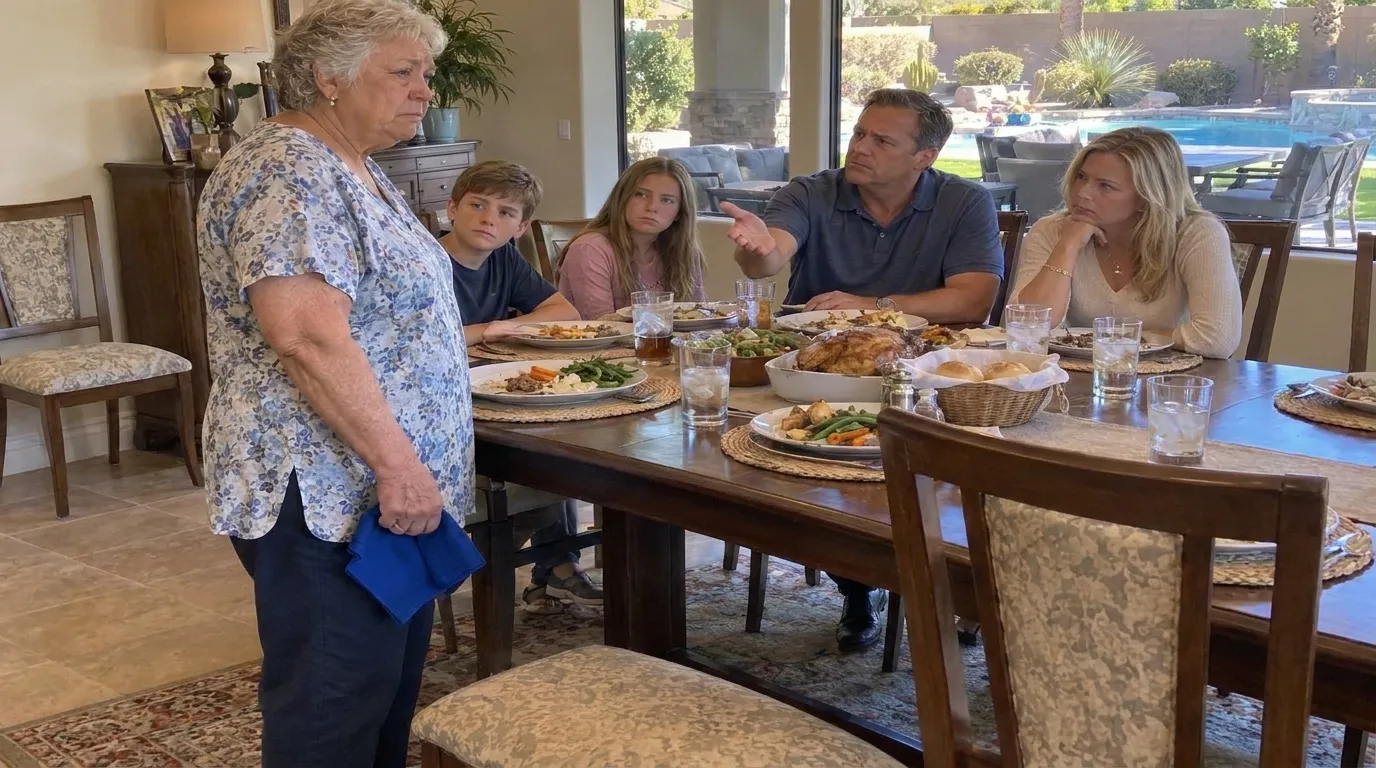
I had made roast chicken, Harold’s favorite, with lemon and rosemary and little red potatoes around the edges, the way his mother used to make it.
I set it in the middle of the table.
Daniel carved.
Renee poured wine for herself and Daniel. Not for me. She had stopped offering me wine months before.
The kids were unusually quiet.
Chloe kept looking at her plate.
Caleb kept looking at his father.
I noticed, but I didn’t understand.
At exactly 6:18 p.m., Daniel pushed back his chair.
I remember the time because the microwave clock was right behind his head. Green numbers. 6:18.
“Mom?” he said.
I looked up.
He glanced at Renee before he spoke. Just for a second.
She nodded very slightly.
“When are you finally planning to get your own place?” Daniel said.
The room went silent.
My granddaughter lowered her fork.
My grandson stared at his plate.
Neither of them looked surprised.
That hurt more than the question itself.
They had heard this conversation before. In the car. At bedtime. Through the walls.
When Grandma moves out, Chloe, you can have the casita.
When Grandma moves out, Caleb, we can get a dog.
I suddenly realized that everyone at that table had known this was coming.
Everyone except me.
When are you finally?
Like I had overstayed. Like I had been told and had not listened. Like I was a houseguest who could not take a hint.
I looked at my son.
Thirty-eight years old. In a polo shirt with his company logo. A glass of wine in his hand.
The little boy who had sat on the porch steps with a juice box, sounding out:
Ev-er-y house needs a porch for the sec-ond cup.
I thought about the sign on a metal shelf in the garage, between Christmas decorations and bottled water.
I folded my napkin carefully, placed it beside my plate, and stood.
“Excuse me,” I said.
No speech.
No argument.
No tears.
I walked out of the dining room, through the kitchen, and out the sliding glass door to the patio.
Outside, the Arizona evening smelled like dust and freshly watered grass. The sprinklers had just gone off. The lawn was wet. The pool lights glowed blue.
The sun was going down over Camelback Mountain, pink and orange, with the saguaros on the hill behind the house dark against it.
I sat at the patio table under the string lights Renee had hung for Caleb’s birthday party.
I had a small spiral notebook in my cardigan pocket. I always carried it for grocery lists, soccer schedules, and doctor’s appointments.
I took it out.
I took out a pen.
I opened to a clean page.
I wrote five things.
Move out.
Stay calm.
Protect assets.
Buy a home.
Remember this feeling.
I looked at number five for a long time.
Remember this feeling.
Not because I wanted to hold on to the hurt.
Because I never wanted to make anyone else feel it.
Daniel came outside about twenty minutes later.
He stood in the doorway with his hands in his pockets.
“Mom,” he said. “Renee thinks I said it wrong.”
I didn’t say anything.
“I didn’t mean it like that,” he said. “I just meant we’ve been talking about the future. About what’s best for everybody. You’d be happier somewhere with people your own age. Activities. Independence.”
“Daniel,” I said. “Do you remember the sign on the porch, on Linden Street?”
He blinked.
“What sign?”
I looked at him for a long time.
“Never mind,” I said.
He waited.
“I’ll be out by the end of the month,” I said.
He looked relieved.
He tried not to, but he did.
“You don’t have to rush, Mom. Take your time. We’ll help you look at places. Renee has a list.”
“I know,” I said. “I’ve seen the brochures.”
He went back inside.
I sat on the patio until the stars came out.
The next morning, I called my attorney.
Then I called a realtor.
Not Renee’s realtor. Not anyone Daniel knew.
Lorraine gave me a name. Celeste Moreno, an Arcadia specialist who had been selling houses in the old part of Phoenix for twenty-six years.
I met her that afternoon at a coffee shop on Indian School Road.
I told her what I wanted.
“Willow Creek Lane,” I said. “The Craftsman with the porch and the pecan tree.”
Celeste looked at me.
“That one sold six weeks ago,” she said. “To an investor. Desert Flip Partners. They’re gutting it.”
“Have they started?”
Celeste checked her phone.
“Permits were filed two weeks ago. Demo starts next month.”
“Why that house?” she asked.
I thought about it.
“Because my son wanted it,” I said. “And my grandchildren picked out their bedrooms. And my daughter-in-law made a spreadsheet.”
Celeste waited.
“And because it has a porch.”
Celeste looked at me for a long moment.
“Mrs. Briggs,” she said carefully, “Desert Flip paid nine-forty for it. They’re going to want a lot more than that before they have even done the work.”
“How much?”
“If I had to guess, one-two. Maybe one-three. Cash. Fast. They don’t like to wait.”
“Make them an offer,” I said.
Celeste stared at me.
“Mrs. Briggs, I don’t mean to be rude, but do you—”
“Have the money?” I said.
I took out Lorraine’s business card.
“Call my attorney. She’ll confirm.”
Celeste called Lorraine that afternoon.
She called me back an hour later. Her voice was different.
“Mrs. Briggs,” she said, “I’ll have an offer to Desert Flip by tonight.”
Six days after that dinner, I quietly bought the one house my son’s family wanted more than anything.
One million, two hundred and fifty thousand dollars.
Cash.
Desert Flip accepted in four hours. They had not started demolition. They made three hundred and ten thousand dollars without lifting a hammer.
We closed eight days later at a title company on Camelback Road.
I signed the papers not as Margaret Briggs, but as the authorized signatory for Second Cup Holdings, LLC.
I moved out on October twenty-ninth.
I didn’t tell Daniel where I was going.
I told him I had found a place in Phoenix, near old friends from church.
That was true.
Mostly.
Renee helped me pack. She was kind about it, kinder than she had been in a year. She bought boxes. She wrapped my dishes in newspaper. She asked whether I needed help with movers.
“I’ve got it handled,” I said.
“Are you sure? Daniel can rent a truck.”
“I’m sure.”
On the last day, I went to the garage.
To the metal shelf.
Between the Christmas decorations and bottled water.
I took down the sign, still wrapped in the bath towel.
Renee saw me.
“Oh,” she said. “That old thing. I forgot that was in there.”
“It was Harold’s,” I said.
“What does it say?”
I didn’t unwrap it.
“It says what home means,” I said.
Chloe came into the driveway while I loaded the last box into my Buick.
Twelve years old, still in her school uniform, backpack on her shoulders.
She stood there for a long time.
“Grandma,” she said. “I’m sorry.”
I looked at her.
“For what, sweetheart?”
“For not saying anything. At dinner. When Dad asked.”
Her eyes filled.
“I knew. They talked about it for weeks in the car. Mom said when you moved out, I could have the casita.”
She wiped her nose on her sleeve.
“I wanted the casita,” she said. “I’m sorry. I wanted it, and I didn’t say anything.”
I put down the box.
I knelt in the driveway. My knees were not what they used to be, but I did it anyway.
I took my granddaughter’s face in my hands.
“Chloe,” I said, “you’re twelve. It’s not your job to speak up for grown-ups.”
“But you always speak up for me,” she said. “When Mom yells about my room. When Dad says I’m on my phone too much. You always say, ‘She’s a good girl. Leave her be.’”
She was crying now.
“Nobody says that about you,” Chloe said. “Nobody says, ‘She’s a good grandma. Leave her be.’”
I held her on the driveway next to my Buick.
For a long time.
“Chloe,” I said, “will you do something for me?”
“Anything.”
“Remember this feeling. The one you have right now, when you knew something was wrong and you didn’t say anything.”
She nodded.
“Remember it,” I said. “So next time, you will.”
I drove to Willow Creek Lane.
The house was empty. Desert Flip had already pulled out the old carpet and some of the cabinets. There was a dumpster in the driveway.
But the porch was still there.
The swing.
The square columns.
The ceiling fan.
The pecan tree. The sycamores. The orange grove in back. Twelve trees.
I parked in the driveway and sat in my car for a long time.
Then I got out.
I walked up the porch steps and sat down on the swing.
It creaked.
I took Harold’s blue mug from my purse, wrapped in newspaper, and unwrapped it.
I didn’t have tea. The kitchen was gutted. No stove. No kettle.
I just held the mug.
I sat on the porch of the house on Willow Creek Lane, holding an empty blue mug, watching the sun go down over Camelback Mountain.
For the first time in two years, I didn’t want to be anywhere else.
I spent four months restoring the house.
Not gutting it.
Restoring it.
I hired Tomás Herrera, a sixty-four-year-old finish carpenter who had restored Craftsman homes in Arcadia for forty years. He knew who had built my house: Oliver Pratt, a railroad engineer, in 1928.
Tomás found the original oak floors beneath the carpet and refinished them by hand.
He rebuilt the kitchen cabinets in white to match the originals.
He fixed the porch ceiling fan so it did not wobble.
Then I asked him to make it wobble a little.
He looked at me as if I were crazy.
I told him about Harold.
He made it wobble.
I painted the kitchen yellow myself, on a stepladder, seventy-one years old.
Tomás offered to do it.
I said no.
It took me three days.
It looked like the inside of a lemon.
That was the point.
I planted roses along the front walk.
Six bushes.
Mister Lincoln.
Double Delight.
Peace.
The same varieties I had planted at Linden Street.
Then I hung the sign on the porch, above the swing, in the perfect empty spot on the wall.
Tomás drilled the holes with brass screws. He said mesquite that old deserved brass.
I stood on the front walk, between the rose bushes, and looked at it.
EVERY HOUSE NEEDS A PORCH FOR THE SECOND CUP.
Harold’s letters, burned into mesquite in 1984.
Hanging on a porch on Willow Creek Lane.
Where my son had wanted to live.
I did not tell Daniel.
Not right away.
He called every Sunday for about a month. Polite. Short.
“How’s the new place, Mom? You settling in? You need anything?”
“I’m fine,” I said. “I’m settling in.”
He never asked where it was.
He never asked to visit.
Then the calls stopped.
Not because he was angry.
Because he was busy.
Because I was not there anymore, making dinner, driving the kids, folding laundry.
Because I was not useful.
Lorraine asked me in December whether I was going to tell him.
“About the house?” I asked. “Or the money?”
“Either.”
I thought about it.
“Not yet,” I said.
“What are you waiting for?”
I looked out the window of my yellow kitchen, toward the porch, the swing, and the sign.
“For him to come,” I said. “Not because he needs something.”
I looked at the blue mug on the windowsill.
“Because he wants to.”
He came in March.
Not because he wanted to.
Because he found out.