When I woke up, my head felt heavy.
Like it was full of wet sand. My mouth was dry. Everything ached in a dull, faraway way.
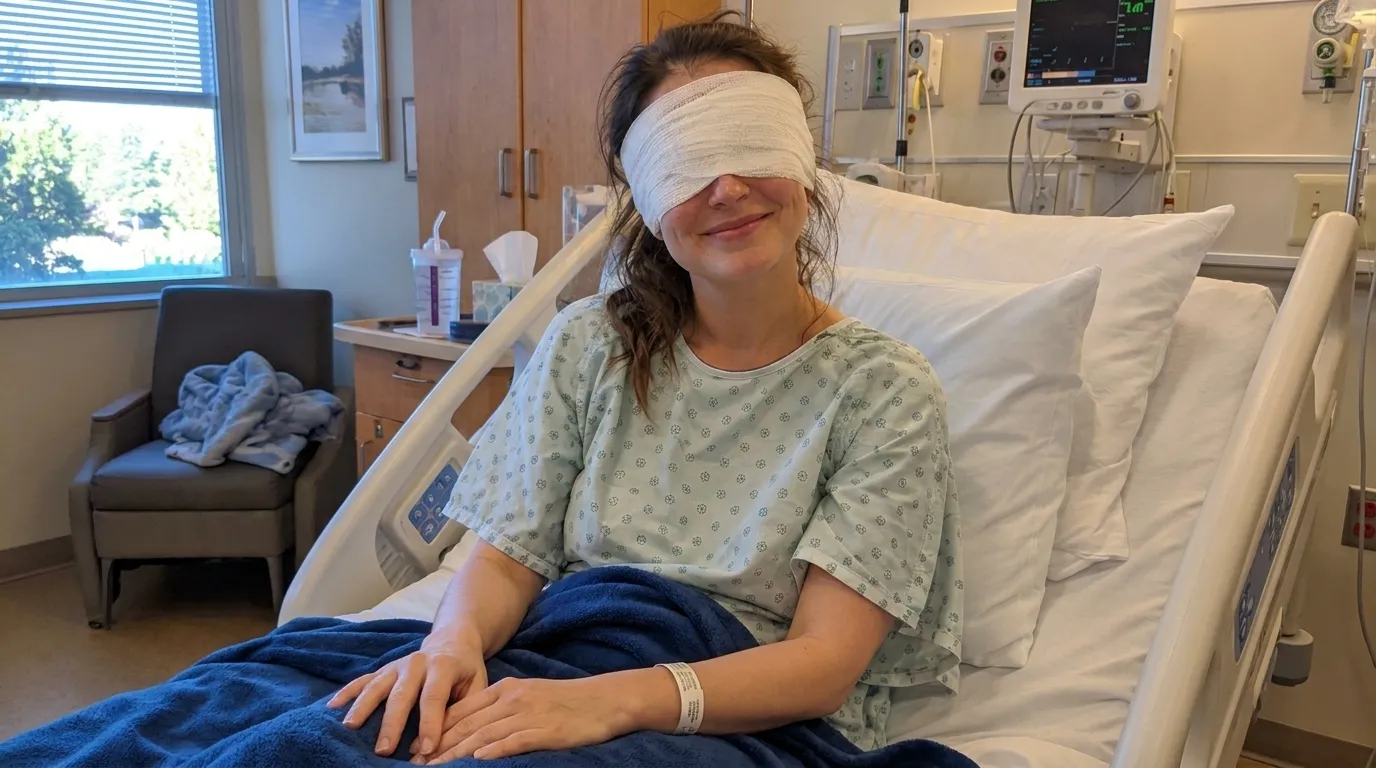
My eyes were wrapped in thick bandages. I could feel the pressure of them all the way around my head.
Machines beeped softly around me.
“Nigel?”
My voice sounded small. Like a little girl’s.
“I’m here,” he said immediately.
He was right beside me. He must have been sitting there the whole time.
But something in his tone was wrong.
There was no excitement in it. No triumph. Nothing.
My stomach dropped.
“Was the surgery unsuccessful?” I asked.
“It was successful,” he said. “Everything went perfectly. Your scans look better than we hoped. You’ll finally be able to see.”
But there wasn’t any joy in his voice.
None.
I’d waited thirty-eight years to hear those words, and the man saying them sounded like he was at a funeral.
My stomach twisted.
They kept the bandages on for two days. Dr. Osei said my eyes needed time to rest.
Nigel stayed with me the whole time. He slept in the chair beside my bed. He fed me Jell-O with a plastic spoon.
Rose came and held my hand and talked nonstop about what she was going to wear when I could see her.
Ethan drove in from college and sat at the foot of the bed and didn’t say much, but he rubbed my feet through the blanket like he used to do when he was a little boy.
And every time I reached for Nigel, I felt him flinch, just a little, before he took my hand.
On the morning of the third day, Dr. Osei said it was time.
“Do you want me to do it?” she asked. “Or Nigel?”
“Nigel,” I said.
There was a pause.
“Of course,” Dr. Osei said. “I’ll be right here.”
I heard her step back. I heard a nurse move closer, near the window.
Nigel sat on the edge of the bed. I felt the mattress dip.
“The light will hurt at first,” he said quietly. “It’ll be blurry. Your brain hasn’t processed visual information in a very long time. It might take a while to make sense of anything. Don’t panic. Just breathe.”
“Okay.”
He began unwrapping the bandages from my head.
I felt each layer loosen. Cool air brushing my eyelids.
Then, suddenly, his hands stopped.
“Don’t hate me,” he said. “Before you see me, I need to tell you that things aren’t the way you think.”
I let out a nervous laugh.
“What does that even mean?”
But my heart was racing.
He didn’t explain.
His hands started moving again. Slower now. Shaking so badly I could feel it through the gauze.
The last layer came away.
Light pierced through my eyelids.
I gasped.
At first, everything was a blur of white and gold.
It felt like staring straight into the sun. It hurt. It was the most beautiful pain I’ve ever felt.
Tears streamed down my cheeks, and I blinked, and blinked, and blinked.
Shapes began to form. Soft at first. Then the edges started to come.
Lines sharpened.
And then colors flooded in. All at once. Like someone had knocked over every can of paint in the world.
I could see.
I could see the world for the first time in thirty-eight years.
A blue curtain. Gray machines with little green lights. A pale ceiling with a water stain in one corner shaped like a kidney bean. A window with white blinds, and through it, a slice of sky.
A nurse in pink scrubs, crying.
A tall woman in a white coat, Dr. Osei, with her hand over her mouth.
And then, in front of me, a face.
He looked older than I’d imagined.
That was my first thought. Isn’t that strange? After all those years of tracing his face with my fingertips, I’d still imagined him young.
The age he was when we met.
But the man sitting in front of me was in his late forties. Dark hair streaked with silver at the temples. Deep lines around his mouth. Brown eyes, rimmed with exhaustion and red from crying.
A crooked nose. Just like Ethan’s.
And a thin scar near his left eyebrow.
My breath caught.
That scar.
The memory slammed into me.
Not a memory I’d thought about in years. A memory I’d put away somewhere so deep I’d forgotten it was there.
A hot August afternoon. Cicadas screaming. A skinny boy with a bad haircut, standing behind the swings.
A fresh pink scar over his left eyebrow. Four stitches. Frankenstein, I’d called him.
Bet you can’t go higher than that!
Watch me!
Two hands, flat on my back.
A shove.
A fall.
A rock.
I clapped my hands over my mouth.
I couldn’t move. I couldn’t breathe.
I just stared at him. At the brown eyes. At the crooked nose. At the scar.
It was the same face. Older. Much older. Lined and tired and silver at the edges.
But it was the same face.
“How,” I whispered through my fingers. “How is it possible that it’s you?”
He didn’t say anything. He just looked at me with tears running down his face.
“Why didn’t you tell me sooner?”
“Let me explain, my love,” Nigel said. His voice was trembling.
I shook my head. My vision kept sharpening around him, every second, like a camera coming into focus.
Every second, he got clearer.
And every second, it got worse.
“Don’t call me that,” I said. “You pushed me. You’re the reason I lost my sight!”
His face went pale. Gray, almost. Like all the blood had drained out of it at once.
He didn’t deny it.
He touched the scar above his eyebrow. Just for a second. Like he couldn’t help it.
That confirmed everything.
“I was nine,” he whispered. “I didn’t mean for you to fall like that.”
“But I did!” I shot back. My voice cracked. “I did fall like that! And you disappeared after that day. You never came to the hospital. Your family just left. And then you came back, and you pretended we’d never met?”
“Hannah—”
“I asked you! The first day! I asked you if we knew each other! And you said no!”
He closed his eyes.
“You let me marry you,” I said. “You let me have your children. Without telling me who you were!”
The nurse stepped closer. Her voice was gentle but firm.
“Ma’am, please stay calm. Your eyes need—”
“I want to leave,” I said. “Right now!”
“Hannah, please,” Nigel said.
He reached for my hand on the blanket.
I pulled it away so hard I hit the bed rail.
“Don’t touch me!”
He pulled his hand back like I’d burned him.
Dr. Osei stepped forward. She looked at Nigel. She said something to him, very quietly. He nodded and stood up and backed away from the bed.
He looked so small, standing by the blue curtain.
A tall man, and he looked small.
Within minutes, I was in a wheelchair.
Everything was overwhelming. The lights were so bright. Everything was moving.
People’s faces went by in the hallway, and I couldn’t make sense of them. Eyes, noses, mouths, all of them strangers. The floor was shiny, and it looked like it was moving.
A sign on the wall said something in big red letters, and it took me a full five seconds to realize it said EXIT, because I hadn’t read printed letters since I was eight.
I closed my eyes to make it stop.
Then I opened them again, because I couldn’t stand not seeing.
Nigel followed as they rolled me down the hallway.
“Please,” he said. “Just hear me out.”
“I can’t,” I replied.
I didn’t look at him.
Dr. Osei came with me to the hospital entrance. She knelt beside my wheelchair.
“You shouldn’t leave,” she said quietly. “You should stay at least one more night for observation.”
“I can’t stay here.”
She looked at me for a long time. She had kind, tired eyes, very dark brown.
“I didn’t know,” she said. “Whatever this is. I want you to know that. He never told me.”
“Did he tell anyone?”
“I don’t think so.”
She handed me a bag with eye drops and dark glasses and a sheet of instructions.
“Wear the glasses outside. The drops every four hours. Call me if anything hurts, anything at all. Not him. Me.”
She wrote her cell phone number on the sheet.
Outside, the sky stretched wide and blue.
I put on the dark glasses, but I took them off again almost immediately. I couldn’t help it.
I had to see it.
It was the first sky I’d seen in thirty-eight years.
It was enormous. I’d forgotten how big it was. I’d forgotten that it went all the way across, from one side of the world to the other.
There were clouds, white and thick, moving slowly.
Not one of them looked like a sheep.
It was the most beautiful thing I’d ever seen.
And it felt cruel.
It felt so cruel that the man who’d given it back to me was the same man who’d taken it away.
A cab that the nurse had called pulled up to the curb.
Yellow.
I knew yellow. I remembered yellow from crayons.
I didn’t look at Nigel again.
I knew he was standing just inside the glass doors behind me. I could feel him there. After twenty years, I could always feel him.
I got into the cab and didn’t turn around.
The ride home was a blur of color and motion.
Trees. So many trees. So many shades of green. I’d forgotten green came in that many kinds.
Traffic lights, red and yellow and green. Storefronts with signs I couldn’t read fast enough. People walking dogs. A little boy on a bike.
The world felt too big. It felt too loud and too bright and too fast.
I pressed my forehead against the cool car window and cried the whole way home.
The driver didn’t say a word.
He just turned the radio down.
When I stepped inside our house, everything looked foreign.
I knew this house. I’d lived here for sixteen years. I knew it was fourteen steps from the front door to the kitchen. I knew the third stair creaked. I knew the bathroom sink dripped when you didn’t turn it off all the way.
But I’d never seen it.
The couch was gray. I’d thought it was brown. Nigel said once it was “kind of a mushroom color.”
I guess it was.
The walls in the hallway were pale yellow. Like butter.
Family photos lined the hallway.
I’d never looked at them before. I’d always known they were there. Nigel had hung them. The kids had picked some of them out.
But they’d just been flat rectangles under my fingertips.
Now I stopped and looked.
Ethan as a baby, on Nigel’s shoulders. Rose in a Halloween costume, dressed as a bumblebee, missing her two front teeth. Ethan at his high school graduation in a blue gown. Rose at the beach.
My children.
My actual children.
I touched Rose’s face in the bumblebee photo with one finger, and I cried, and I couldn’t stop.
Then I stopped at one of our wedding pictures.
It was in the middle of the hallway, in a silver frame. Bigger than the others.
I was wearing a simple white dress. My hair was longer then. My eyes were closed, and I was smiling, and I had one hand raised, touching his face.
My fingers were on his jaw.
You feel steady.
He was looking at me. Down at me.
And the way he was looking at me…
He was looking at me as if I were his entire world.
My chest tightened.
I’d never seen that look. In twenty years of marriage, I’d never once seen how he looked at me.
I walked down to his office at the end of the hall.
I’d never been in there much. It was his space. He kept the door closed when he was working. I’d respected that.
I thought it was just the work.
Now I opened the door.
It was small. Messy. A wooden desk covered in papers. Two tall bookcases. A window looking out at our backyard, where I saw, for the first time, the vegetable garden Rose and I had planted last spring.
I sat down in his chair.
It creaked.
I opened the top drawer of his desk with shaking hands.
If he’d lied about this, what else had he hidden?
I found stacks of research.
Medical journals, hundreds of them, with pages folded down and notes scribbled in the margins. Surgical sketches, drawn in pencil, of eyes and nerves and things I didn’t understand.
Notebooks full of dates and numbers and handwriting I couldn’t read yet. My eyes weren’t good enough for small handwriting.
But I could read the names on the folders.
They were all labeled in thick black marker.
CASE STUDIES — OPTIC NERVE.
SWISS TRIAL DATA.
GRAFT V.7.
And in the bottom drawer, under everything else, one old, worn folder. The cardboard was soft and faded. The corners were bent.
It had my name on it.
My maiden name.
HANNAH REEVES.
I opened it.
Inside was a photocopy of a newspaper article. Very small. From our town paper, thirty-eight years ago.
LOCAL GIRL INJURED IN PLAYGROUND FALL.
Under that, a stack of notes. The first page was dated twenty-seven years earlier. Long before we met. It was written in a young man’s handwriting, big and messy.
At the top of the page, it said:
First year. Neuro-ophthalmology. Find out everything.
There were more pages after that. Dozens. Every year, a few more. Notes from lectures. Notes from conferences. Names of doctors. Names of studies.
And at the very bottom of the folder, folded into a small square, there was a piece of paper.
Lined paper, torn out of a child’s notebook.
Yellowed. Soft.
I unfolded it.
It was written in pencil, in the big, wobbly handwriting of a little kid. Some of the letters were backward. It took me a long time to read it, sounding out each word like I was eight again.
Dear Hannah,
I am sorry I pushed you. I did not mean it. I wanted you to go hire. My mom says you cant see now. I am going to be a docter and fix your eyes. I promise. I am sorry. I am so sorry.
From Niye.
P.S. You can call me Frankenstien if you want.
I sat in his chair and held that piece of paper and didn’t move for a very long time.
He’d written it at nine years old.
He’d never sent it.
And he’d kept it. Through the move. Through school. Through medical school. Through twenty years of marriage.
In the bottom drawer, under everything else, where I’d never find it.
I picked up the phone on his desk and called my best friend, Lydia.
She answered on the second ring.
“Hannah? Oh my God. How did it go? I’ve been dying to hear. Nigel said he’d call me, but he—”
“You won’t believe this,” I said.
“What happened? Are you okay?”
“I can see,” I said. “The surgery worked.”
She gasped. A huge, loud gasp. I heard something fall over on her end.
“That’s incredible! Hannah! That’s—oh my God. Can you see right now? What are you looking at?”
I looked down at the yellowed piece of notebook paper in my hand.
“It was Nigel,” I said flatly.
“What do you mean? Of course it was Nigel. He did the surgery.”
“No. I mean it was Nigel. He’s the boy, Lyd. The boy who pushed me off the swing. He’s the reason I lost my sight. And he knew. He knew the whole time. For twenty-two years.”
There was silence on the other end. A long, stunned silence.
“I feel betrayed,” I said. My voice was shaking. “I’m thinking of divorce. I can’t trust this man.”
Lydia didn’t say anything for a while.
I’d known her for twenty-eight years. I knew her silences. This one was the kind where she was thinking very carefully about what to say next.
Then she asked, “Has he ever treated you badly?”
I closed my eyes. I opened them again. I looked at the folder on the desk.
“No.”
“Not once? In twenty years?”
“No.”
“Has he been a good father?”
I thought about Ethan reading the comics in funny voices. About Rose on Nigel’s shoulders at the beach, in a picture I’d just seen for the first time. About Nigel sitting on the edge of Rose’s bed every night for years, reading her chapter books.
“Yes,” I said.
“A good husband?”
My throat closed up.
“Yes.”
Lydia let out a long breath.
“Then maybe,” she said gently, “you need to listen to him.”
“Lyd—”
“I’m not saying forgive him. I’m not saying anything. I’m saying listen. You walked out of the hospital without letting him explain. That’s not like you, Hannah. You always listen. It’s your whole job.”
I stared at the evidence spread across his desk.
“I knew him as Niye when we were kids,” I said. “Just Niye. His little sister couldn’t say Nigel. I never knew his last name. When he walked into that exam room and said Dr. Pruitt, Nigel, I never put two and two together. I never connected it. Why would I?”
“Of course you didn’t.”
“He’s been working on fixing my eyes for more than twenty-five years, Lyd. Since before he met me again. I’m looking at his notes. He wrote me a letter when he was nine. He promised he’d become a doctor and fix my eyes.”
Lydia didn’t say anything.
“He kept that promise,” I said. “He actually kept it.”
I heard the front door open.
Footsteps. Fast. Hurrying down the hall.
The same footsteps I’d been listening to for twenty years. I’d know them anywhere.
Then Nigel was standing in the office doorway.
I saw him. Standing there. In the doorway of his own office. Still in his scrubs, wrinkled and stained. His hair sticking up on one side. His face blotchy from crying.
He looked at the open drawers. At the folder in front of me. At the yellowed piece of notebook paper in my hand.
He went completely still.
“Lyd,” I said into the phone, not taking my eyes off him. “I need to go. He’s here. I’ll update you.”
“Listen to him,” she said quickly. “Promise me.”
I ended the call without promising.
And I glared at my husband.
“I didn’t follow you to pressure you,” he said.
He stayed in the doorway. He didn’t come in.
“I swear. I just needed to know you were safe. You left the hospital two days after major eye surgery, Hannah. Alone. In a cab. I was terrified.”
“You hid your true identity from me.”
“I know.”
“For twenty-two years.”
“I know, love. I’m so sorry.”
He said it so simply.
I know. I’m so sorry.
No excuses. Not yet.
He looked down at the letter in my hand.
“You found it,” he said quietly.
“Why did you keep it?”
“Because I never got to give it to you.”
He took a breath.
“The thing is,” he said, “I recognized you that first day. At the practice. Before I even walked into the room.”
“How?”
“Your name. On the chart. Hannah Reeves. Date of birth. Cause of injury, playground trauma, age eight.”
His voice cracked.
“I stood outside that door for a whole minute, Hannah. I almost didn’t go in. I almost asked someone else to see you. And then I went in, and you were sitting there on the table, and you looked exactly the same. Older. But the same. And then you said my voice sounded familiar.”
He closed his eyes.
“I knew. I knew right then.”
“And you lied.”
“I lied.”
He opened his eyes again.
“I’ve carried that guilt since we were kids. Every day. Every single day of my life.”
He leaned against the doorframe. Like he didn’t have the strength to stand on his own.
“Becoming an ophthalmic surgeon wasn’t random,” he said. “I did it because of you.”
I just stared at him.
“After the accident, my dad got transferred. We moved to Ohio three weeks later. My parents thought it was better. A fresh start. Nobody would look at me like the boy who blinded the Reeves girl.”
He laughed, a broken little sound.
“My mom told me never to talk about it. Ever. So I didn’t. Not to anyone. Not one person. Not for thirty-eight years.”
“Your mom came to the hospital,” I said. “Every day. She held my hand.”
He nodded. His eyes filled with tears.
“She told me. She came home every night and cried in the kitchen when she thought I was asleep. I’d sit on the stairs and listen.”
He wiped his face.
“I begged her to take me with her. She wouldn’t. She said it would upset your mom.”
He paused before continuing.
“I searched for your name for years. Every year, I’d look. When I was in college, I found your name in a university newsletter. Social work honors list. I sat in the library and cried, I was so happy. You’d made it.”
“You were watching me?”
“No. No. I never contacted you. I never came near you. I swear. I just… I needed to know you were all right. And then I’d go back to studying.”
He gestured at the bookcases. At all the folders.
“I went to medical school. I did my residency in neuro-ophthalmology. I picked my fellowship because of the optic nerve research they were doing. I took the job at that practice downtown because I knew—”
He stopped.
“Because you knew I went there,” I said slowly.
“Because I knew it was the best practice in the state for your kind of injury,” he said. “And yes. Because I’d seen your name on a donor list for their charity fundraiser once. I knew you were a patient there.”
I was stunned.
I sat in his chair and just looked at him. At this man I’d been married to for twenty years. This man I’d thought I knew down to the bone.
I’d never known him at all.
Or maybe I’d known him exactly right.
I couldn’t tell anymore.
“Then why hide it?” I asked. “Why not just tell me? That first day? Or the second day? Or the day you asked me out? Or the day you married me?”
He looked down at his shoes.
“Because I was ashamed,” he said.
His voice was barely above a whisper.
“I was so ashamed, Hannah. I was ashamed when I was nine, and I was ashamed when I was twenty-five, and I’m ashamed right now, standing here. Every time I looked at you, I saw that rock. I heard that sound. I’ve heard that sound in my sleep my whole life.”
He looked up at me.
“And because I fell in love with you,” he said. “I didn’t expect that. I didn’t plan that. I swear to God I didn’t. I just wanted to help you. I wanted to be your doctor and fix it and disappear again. But then you laughed at the sheep cloud, and I…”
He shook his head.
“I was terrified you’d refuse both me and the surgery if you knew. I thought, if she knows, she’ll never let me near her. She’ll never let me fix it. And I couldn’t stand that. I couldn’t stand the idea of having the answer and not being allowed to give it to you.”
“So you just never told me,” I said.
“Every year, I told myself I’d tell you. On our anniversary. On your birthday. After Ethan was born. After Rose was born.”
His voice broke completely.
“Every year, it got harder. Every year, there was more to lose.”
“The night before the surgery,” I said. “When I asked what you were afraid of.”
“I was afraid of this,” he said. “Of this exact moment. Of you opening your eyes and seeing my face and remembering.”
“That’s why you didn’t sound happy at the hospital.”
“I gave you back your sight,” he said. “And I knew it would cost me you.”
I looked down at the research spread across his desk again.
Twenty-seven years of work. Twenty-seven years of notes and sketches and failed trials. Rats and journals and sleepless nights.
Crying in this room at three in the morning, and telling me it was nothing.
Years of regret.
Years of trying.
I picked up the little folded letter again. The wobbly pencil. The backward letters.
I am going to be a docter and fix your eyes. I promise.
“You should have told me,” I said quietly.
“I know,” he whispered. “I was wrong.”
He didn’t argue. He didn’t say but. He didn’t explain why it was understandable.
He just said it.
I was wrong.
I stood up.
My legs were shaky. My head was pounding. My eyes ached from all the light, from all the crying.
Dr. Osei would have been furious with me.
I walked around the desk.
I stepped closer to him.
And I looked at his face.
Really looked at it. For the first time.
Not the scar. Not the nine-year-old boy behind the swing.
Him.
My husband.
I saw the exhaustion. The deep shadows under his eyes from twenty-seven years of two a.m. mornings. The lines around his mouth from all the times he’d laughed at my burned dinners. The gray in his hair that I’d never known was there.
I saw the fear.
And under the fear, somewhere, I saw the hope. Small, and scared, and still there.
“You took my sight,” I said.
He flinched. He didn’t look away, though.
“But you spent your whole life trying to give it back.”
Tears filled his eyes. They spilled over and ran down his face, and he didn’t wipe them.
“Every single day,” he said.
My anger didn’t vanish. I want to be honest about that.
It didn’t go anywhere.
It’s still there, some days. Some mornings I wake up and look at him sleeping beside me, and I see the scar, and I feel it again. The cold, hot rush of it.
You lied to me. For twenty-two years, you let me trace that scar with my fingers and kept the truth from me.
But it shifted that day. Standing in his office.
It turned into something I could hold. Something I could look at, instead of something that was looking at me.
“No more secrets,” I said.
“Never again,” he promised.
“I mean it, Nigel. Not one. Not about anything. If you’re tired, you tell me. If a trial fails, you tell me. If you’re scared, you tell me. If you burned my toast, you tell me.”
He laughed. A wet, broken laugh.
The first time I’d ever seen him laugh.
His whole face changed when he laughed. Little lines crinkled up around his eyes.
I hadn’t known they did that.
“Never again,” he said.
I didn’t forgive him that day.
Not all the way.