The instructions were plain.
An attorney’s office.
A telephone number.
A request to bring identification, our marriage certificate, and a copy of Larry’s death certificate.
Underneath, in smaller writing, Larry had added one more sentence.
“The woman I promised was your grandmother.”
I lowered the page.
For a moment, I could not make the two people fit inside the same thought.
My grandmother belonged to childhood visits, careful handwriting, and envelopes she sent on birthdays.
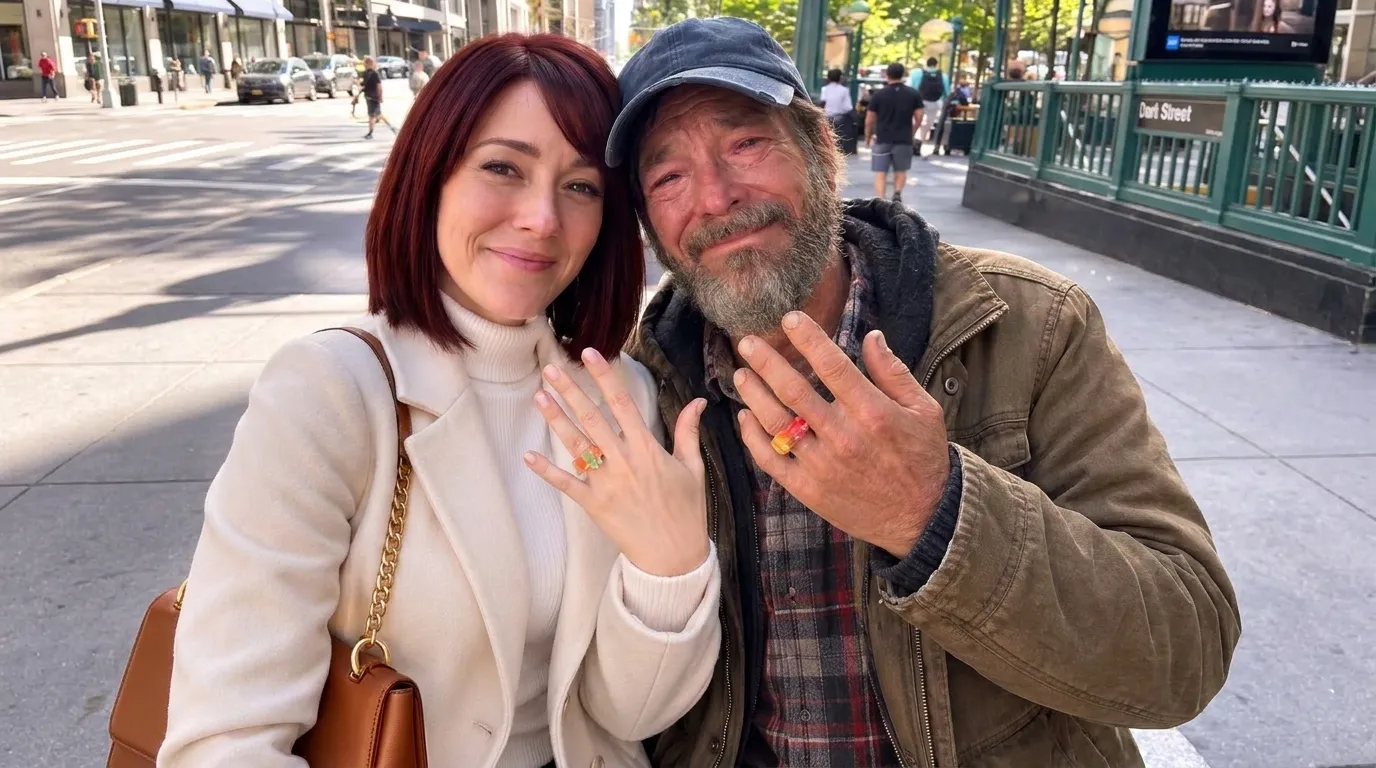
Larry belonged to the subway station.
I had never imagined their lives touching.
She had died years earlier.
By then, I was living away from home. We had spoken less often than either of us intended.
There had always seemed to be time for another visit.
Until there wasn’t.
I read the sentence again.
Then I looked at the black coffee cooling across the table.
“Why couldn’t you just tell me?” I asked.
The apartment gave me no answer.
The next morning, I called the office.
“Yes,” the woman who answered said after checking Larry’s name. “We’re holding a packet for you.”
“For me specifically?”
“Yes.”
“Do you know what’s in it?”
“Personal papers. There’s an appointment available this afternoon if you’d like to collect them.”
I almost asked her to tell me everything over the telephone.
Instead, I wrote down the time.
At work, I opened the same document three times without reading a word.
By afternoon, I had our marriage certificate inside a folder beside Larry’s letter.
The certificate still looked strange.
Our names together.
Something I had called a technical arrangement.
Something that had carried more weight than I understood.
The attorney’s office was quiet and ordinary.
No grand room. No dramatic announcement.
A desk, two chairs, and a thick sealed envelope.
The attorney checked my papers before setting the envelope between us.
“Larry left written instructions for these to be released to you after his death,” she said. “He identified you as his wife and the intended recipient.”
I kept my hands in my lap.
“Was marrying him the only way I could receive them?”
She paused.
“No.”
The answer was gentle.
It still landed hard.
“He arranged this particular release around your legal relationship,” she continued. “But a person can make other arrangements for personal papers. He could also have given his own papers to you while he was alive.”
I stared at the envelope.
“So it wasn’t necessary.”
“It was the way he chose.”
For several seconds, I said nothing.
Larry had written about certainty.
About paperwork.
About making sure nothing went missing.
I understood now that those were his reasons.
They were not the same as having no choice.
“Did he leave me any obligations I don’t know about?” I asked.
“Not in this packet. These are personal records, not an agreement asking you to take on something for him.”
She turned the envelope so my name faced me.
“You don’t have to open it here.”
“I think I do.”
She gave me the room.
I broke the seal.
Inside were notebooks, folded letters, several photographs, and one last note from Larry.
I picked up the photograph on top.
My grandmother sat at a table beside a man I almost recognized.
He was younger. His face was fuller. His clothes were clean and neatly pressed.
But the eyes were Larry’s.
In front of him lay an open exercise book.
My grandmother was pointing at a line on the page.
On the back, in her familiar handwriting, were four words.
“Larry’s first finished story.”
I covered my mouth.
Then I opened the notebook beneath it.
The earliest pages held letters of the alphabet.
Careful rows.
Words copied again and again.
Later came sentences.
Then paragraphs.
Corrections appeared in the margins in handwriting I had known all my life.
My grandmother’s.
I reached for Larry’s final note.
“When I met your grandmother, I could get through a workday without anyone realizing how little I could read.
“I had learned how to remember labels. How to make excuses. How to say I’d forgotten my glasses.
“She was teaching adults at a community program.
“I nearly walked out before the first lesson.”
I looked at the photograph again.
My grandmother had taught before she retired.
I knew that.
I had not known how much of her teaching continued afterward.
“She didn’t ask me why I hadn’t learned sooner,” Larry wrote.
“She asked me what I wanted to be able to read.
“I told her a newspaper.
“That wasn’t the whole truth. I wanted to stop being afraid of any envelope with my name on it.”
I pressed my fingers against the edge of the desk.
For twelve years, he explained, my grandmother had remained in his life.
First as a teacher.
Then as a friend.
The lessons had become conversations. He helped carry things she could no longer manage easily. She gave him books and insisted that finishing slowly still counted as finishing.
She showed him photographs of her family.
Of me.
“She had a photograph of you from when you first started working,” he wrote. “You looked so pleased with yourself, and so uncomfortable in those shoes.
“That was the picture I remembered at the station.
“I wasn’t certain at first. Then you told me where you grew up. Later, you mentioned your grandmother teaching.
“After that, I knew.”
I let out a small, broken laugh.
Even the shoes.
He had been carrying that connection all along.
The letters beneath his note were not all addressed to him.
Several were addressed to me.
My grandmother had written them during the last part of her life.
Not instructions.
Not a confession of some terrible wrongdoing.
Stories.
Things she had never found the right moment to say.
There were memories of being young and frightened. Of decisions she regretted. Of days when being a wife and mother had exhausted her, though she had rarely admitted it aloud.
There was a letter about my first visit without my parents.
Another about a disagreement we had both pretended to forget.
And one about the way she sometimes sounded disapproving when she was really worried.
“I wanted you to have a larger life than mine,” she had written.
“Then, when you went out and made one, I missed you and did not always behave generously about it.”
I bent over the page.
That sounded so much like her that, for a moment, grief felt new.
Larry’s note explained that she had asked him to help organize the pages.
By then, her sight was failing. Some passages were in his handwriting, taken down as she spoke.
She kept saying she would send them when they were finished.
Then she became too ill.
“She asked me to make sure you got them,” he wrote.
“She knew you had moved. The address she had wasn’t current. She told me that if I found you, I should explain first.
“‘Don’t hand a stranger my whole heart and expect her to know what to do with it,’ she said.”
I could hear her saying that.
It was almost unbearable.
After her death, Larry had tried the address she had given him.
He had failed to reach me.
Then his own life had begun coming apart.
The papers went with him.
Through lost work.
Through leaving his home.
Through places where he could keep little more than what he could carry.
Eventually, he placed them in safekeeping rather than risk losing them.
“I kept telling myself that protecting them counted as keeping my promise,” he wrote.
“It wasn’t enough.
“When I found you, I knew that.”
I turned the page.
There was no careful excuse left in the next paragraph.
“I was ashamed, Sarah.
“I had waited too long. I had failed her. Then you were kind to me before you knew any of it.
“I liked being someone you chose to sit beside.
“I was afraid that once I told you, every coffee would feel like an obligation.”
My eyes moved back to the photograph.
“And when the clinic told me I was dying, I panicked.
“I made a plan that looked certain on paper and asked you to agree to it without telling you everything.
“I could have told you the truth.
“I should have.”
I sat back.
There it was.
Not a legal explanation.
Not another reason I had to accept.
The truth he should have given me while I could still answer him.
“I didn’t know how to ask you to carry all of this,” he wrote.
“So I asked you to carry something else.
“That was unfair.”
For the first time since opening the envelope, I cried.
Not because the secret was beautiful.
Not because it made everything right.
Because he had finally stopped trying to explain away the part that hurt.
I could understand his fear.
I could love the mornings we had shared.
I could be grateful that my grandmother’s words had survived.
And I could still be angry that he had let me make a decision without knowing why he wanted it.
All of those things could be true.
At the bottom of the last page, he had written:
“You don’t owe me forgiveness for delivering something I should have delivered years ago.
“The letters belong to you.
“The notebooks are yours if you want them.
“Your grandmother taught me how to write a letter.
“You made me wish I had been brave enough to say these things out loud.”
I stayed in that room until I could fold the pages without shaking.
When the attorney returned, she brought a glass of water.
“Do you have any questions?”
“Not ones you can answer.”
She nodded.
I signed the receipt for the packet.
Then I carried it home.
That evening, I spread everything across my kitchen table.
The photographs.
The exercise books.
My grandmother’s letters.
Larry’s final note.
I read until the light outside disappeared.
There was no hidden fortune.
No grand life waiting to replace my own.
There was my grandmother, less perfect and more human than memory had allowed her to be.
There was Larry before the worn coat.
Larry struggling to write a sentence.
Larry proud enough of his first finished story to sit for a photograph.
And there was the knowledge that someone could fail badly at one thing without every kindness between us becoming false.
The next morning, I went to the cemetery.
I brought his letter.
For a while, I stood without speaking.
Then I said the thing I had wanted to say since opening the envelope.
“You should have trusted me.”
A breeze moved through the grass.
“I might have said no to the marriage. I don’t know.”
That was the hardest part to admit.
I could not promise a kinder version of myself just because he was gone.
“But I would have listened.”
I sat down.
For years, sitting beside him had required no preparation.
Now I had so much to say that I could barely begin.
I told him I had the papers.
I told him I had recognized my grandmother’s handwriting before reading a single complete sentence.
I told him that his first finished story was about an ordinary man missing a bus and discovering that being late had not ended the world.
“That sounds like you,” I said.
Then, after a while, I added, “I’m keeping the notebooks.”
I did not announce that everything was forgiven.
I was not ready to make grief tidy.
But when I left, I no longer felt as though the letter had taken Larry away from me a second time.
It had made him more complicated.
That was different.
Over the following weeks, I put my grandmother’s pages in order.
I kept Larry’s notes alongside the passages he had helped her write.
I did not separate his part from hers.
On some evenings, I read one letter.
On others, I opened one of the exercise books and followed the slow change in his handwriting.
The letters grew steadier.
The sentences grew longer.
Eventually, the corrections became fewer.
Near the end of one notebook, my grandmother had written a small comment in the margin.
“You have something worth saying. Stop apologizing before you say it.”
I touched the words.
Then I laughed through tears.
She had known him well.
I still pass the subway station.
For a while, the empty corner hurt so much that I crossed the street before reaching it.
Eventually, I stopped doing that.
I buy one coffee now.
With cream.
I no longer pretend that setting a black cup across from me will bring him back.
But I have kept the photograph of him at my grandmother’s table.
It stands beside a picture of her on a shelf in my apartment.
Larry is smiling in it.
Not broadly.
Just enough to show that he knows he has accomplished something difficult.
When I think about our marriage now, I no longer call it merely paperwork.
It was a decision I made kindly, without knowing everything I should have known.
It brought hurt with it.
And tenderness.
And a responsibility I had not expected: to remember a whole person, rather than only the parts that were easy to understand.
I will always wish Larry had told me the truth beside the station, with two coffees between us.
We might have had time to talk about my grandmother.
Time for me to be angry.
Time for him to answer.
We did not get that.
What we had was nearly two years of mornings, three weeks of marriage, and a final letter he had taken too long to write.
I cannot change any of it.
But I can keep the pages safe.
I can remember that he was more than the man sitting on the pavement.
And when I remember his last words, I no longer argue with them.
“Thank you, Sarah.”
I am glad I was there to hold his hand.
Even now.
Even knowing.
The End.
Latest Posts
- My Husband Mocked My Postpartum Appearance in His Brothers’ Group Chat—I Stayed Quiet for Five Days
Four months after giving birth, I thought my husband understood why I hardly recognized myself. Then I discovered the cruel joke he'd been sharing with his brothers, along with photos I never knew he'd taken. I kept my discovery secret for five days, determined to make him regret every word. “Dude, you weren't exaggerating 😂” …
- My Stepdaughter Called Me the Help Until My Envelope Changed Everything
The insult came before I’d even finished setting down the peach cobbler. I’d baked it at five that morning in the kitchen of the lake cabin we’d rented, and it was still warm under the foil. The smell of cinnamon followed me across the grass toward the pavilion tables, where thirty-two members of the Cole …
- My In-Laws Gave Their Other Three Children $20,000 for Houses and Gave Us Only a Card Two Years Later, We Bought the Old Miller Place for $41,500
The envelopes were tucked under the Easter plates. Each had a name written on it in my mother-in-law’s round schoolteacher handwriting. Kim opened hers first. She’s the oldest. Divorced two years. Raising two boys in a rented trailer behind the grain elevator. She looked at what was inside the envelope and put her hand flat …
- My Mother-in-Law Told Me to Lose Weight After Giving Me a Dress That Didn’t Fit, but Minutes Later, She Regretted Everything
I couldn’t get it over my hips. I stood in my bedroom in my underwear with the dress bunched around my thighs like a deflated balloon. Midnight blue silk. A designer label I’d only ever seen in magazines. Tiny pearl buttons down the back. Beautiful. And four sizes too small. I pulled. I tugged. I …
- Teen Wore a Dress to His Best Friend’s Funeral—The Family Nearly Had Him Removed Before He Reached the Microphone
My son’s best friend read the eulogy at his funeral in a red dress. I almost had him removed before he reached the microphone. My son Jack died 17 days after his 18th birthday. Cancer. Fourteen months from diagnosis to funeral. We found out late. Too late, as it turned out, and the treatment never …