Over the following year, Taylor worked through the court’s requirements.
She attended therapy.
She moved away from Evelyn.
She found steady work and became less financially dependent on anyone else.
Her supervised visits with Lily gradually became longer.
Eventually, they moved to a neutral family center with fewer restrictions.
I did not make those decisions by myself.
Neither did Taylor.
The court, Lily’s therapist, and child-welfare professionals determined what was safe.
For once, every decision centered on one person.
Not me.
Not Taylor.
Not Evelyn.
Lily.
Two years later, I was standing in my kitchen making pancakes while Lily sat at the table drawing.
She was seven now.
Her stuffed rabbit sat beside her cereal bowl.
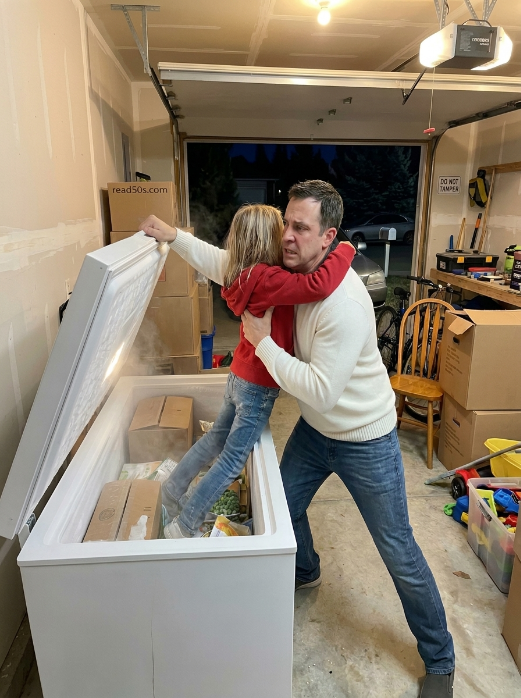
For months after that night, she had refused to enter the kitchen whenever I opened the freezer.
Then one Saturday morning, while I was putting away groceries, she walked over.
She stood beside me quietly.
I noticed immediately.
“You okay?”
She looked at the open freezer.
Then said:
“You can close it.”
I stopped.
“Are you sure?”
She nodded.
I slowly closed the door.
Lily watched it for several seconds.
Then she reached for my hand.
“It can’t lock me in?”
“No.”
“And you would open it?”
“Every single time.”
She smiled.
That moment meant more to me than any court ruling.
Healing did not arrive dramatically.
It came in tiny pieces.
A freezer door closing.
A night without nightmares.
A school field trip she attended without asking whether I would disappear while she was gone.
A birthday party where she laughed so hard she forgot to watch the exits.
Taylor eventually rebuilt part of her relationship with Lily under carefully controlled conditions.
It was not the family life any of us once imagined.
But it was safer.
And it was honest.
As for Evelyn, Lily never saw her again.
Almost three years after the night in the garage, Lily and I were driving home from a friend’s house.
It was autumn again.
Cold Colorado air moved outside the windows.
We passed Aspen Ridge Lane.
Lily recognized it.
Her hand tightened slightly around the edge of her seat.
“That was the old house.”
“Yes.”
She stared through the window for several seconds.
Then turned away.
“Can we go home?”
I smiled.
“We are going home.”
She rested her head against the seat.
A few minutes later, she fell asleep.
I drove through the dark with one hand on the steering wheel.
For years, I had believed divorce was the event that destroyed our family.
I had been wrong.
The real damage happened quietly.
Behind closed doors.
Whenever adults chose convenience, fear, or silence over protecting a child.
Finding Lily inside that freezer had not destroyed what remained of our family.
It exposed what was already broken.
And once the truth became visible, we finally had a chance to build something different.
A home where Lily never had to wonder whether she was good enough to be warm.
A home where punishment never meant terror.
A home where asking for help was never treated as weakness.
One evening, Lily climbed into my lap while we watched television.
“Daddy?”
“Yeah?”
“Do you remember when you found me?”
I held her a little tighter.
“Yes.”
“I called you.”
“I heard you.”
She thought about that.
Then asked:
“If I call you again, will you always come?”
I kissed the top of her head.
“As long as I’m able, every single time.”
Lily nodded, satisfied.
Then returned to her cartoon.
She did not need a dramatic promise.
She needed something much simpler.
To know that when she called for her father—
someone would come.
And this time, she knew it was true.
The End.
Latest Posts
- My Husband Mocked My Postpartum Appearance in His Brothers’ Group Chat—I Stayed Quiet for Five Days
Four months after giving birth, I thought my husband understood why I hardly recognized myself. Then I discovered the cruel joke he'd been sharing with his brothers, along with photos I never knew he'd taken. I kept my discovery secret for five days, determined to make him regret every word. “Dude, you weren't exaggerating 😂” …
- My Stepdaughter Called Me the Help Until My Envelope Changed Everything
The insult came before I’d even finished setting down the peach cobbler. I’d baked it at five that morning in the kitchen of the lake cabin we’d rented, and it was still warm under the foil. The smell of cinnamon followed me across the grass toward the pavilion tables, where thirty-two members of the Cole …
- My In-Laws Gave Their Other Three Children $20,000 for Houses and Gave Us Only a Card Two Years Later, We Bought the Old Miller Place for $41,500
The envelopes were tucked under the Easter plates. Each had a name written on it in my mother-in-law’s round schoolteacher handwriting. Kim opened hers first. She’s the oldest. Divorced two years. Raising two boys in a rented trailer behind the grain elevator. She looked at what was inside the envelope and put her hand flat …
- My Mother-in-Law Told Me to Lose Weight After Giving Me a Dress That Didn’t Fit, but Minutes Later, She Regretted Everything
I couldn’t get it over my hips. I stood in my bedroom in my underwear with the dress bunched around my thighs like a deflated balloon. Midnight blue silk. A designer label I’d only ever seen in magazines. Tiny pearl buttons down the back. Beautiful. And four sizes too small. I pulled. I tugged. I …
- Teen Wore a Dress to His Best Friend’s Funeral—The Family Nearly Had Him Removed Before He Reached the Microphone
My son’s best friend read the eulogy at his funeral in a red dress. I almost had him removed before he reached the microphone. My son Jack died 17 days after his 18th birthday. Cancer. Fourteen months from diagnosis to funeral. We found out late. Too late, as it turned out, and the treatment never …