Fourteen years earlier, Daniel had sat at this same kitchen table and cried.
He was thirty, and Claire was pregnant with Sophie, and the landscape design company he’d started with a college friend had just collapsed. The friend had walked off with the last of the business account. Daniel owed money to three suppliers and a bank.
He and Claire were about to lose the apartment.
Richard had been gone two years by then. I’d sold the hardware store. Richard’s life insurance, plus the store, plus thirty-one years of a school nurse’s careful savings, came to more money than I had ever imagined having in my life.
Not a fortune. But enough. Enough to live on simply until I died, if I was careful.
“I’m so sorry, Mom,” Daniel said, with his face in his hands. “I don’t know what to do. I’m going to be a father in four months, and I can’t even pay rent.”
I got up and got my checkbook.
I didn’t even think about it. He was my son. He was going to be a father. What kind of mother would I be if I let my grandchild come home to nothing?
I paid off the suppliers. I gave them money for a down payment on a little starter house in Union. I told him to pay it back when he could, and I didn’t expect him to.
He hugged me so hard that day.
He said, “You saved my life, Mom. I’ll never forget it.”
That’s how it started.
It didn’t stay at a down payment.
When the starter house got too small after Owen was born, they found the colonial in Maplewood. Beautiful house. Too much house. But Claire had her heart set on it, because her sister lived two streets over and Maplewood had “the right schools.”
The mortgage was more than Daniel’s new job could carry.
“Just for a little while,” he said. “Just until I get the promotion.”
So I set up an automatic transfer. Twenty-one hundred dollars a month toward the mortgage.
Then there was the tuition. When Sophie started kindergarten, Claire had decided the public school wasn’t good enough. There was a private academy in Short Hills with a waiting list and a uniform with a little crest on the pocket.
“Gordon and Patricia sent Claire there,” Daniel told me. “It means a lot to her. It’s just, the tuition…”
So I’d set up a transfer for that, too.
When Daniel started a new business, a consulting firm this time, he needed startup money. I gave it to him. Then the business needed help every month just to keep going.
Another transfer. Fifteen hundred.
Then there was the car insurance, when they leased the second SUV. And Claire’s dental work. And the summer camp. And the new roof. And the time Daniel called me crying from his car because a client hadn’t paid and the business account was overdrawn.
“It’s an emergency, Mom. A real one. I wouldn’t ask if it wasn’t.”
After the third or fourth of those, I set up a separate account. The Family Fund, I called it. I put money in it every month, and Daniel had access to draw from it whenever there was an emergency.
He drew from it a lot. I didn’t ask questions. I didn’t want to be the kind of mother who asks questions.
In my own house, the roof leaked over the back bedroom for three winters. I put a bucket under it. I drove a fourteen-year-old Corolla.
My friend Ruth from next door asked me every spring to go with her on a bus trip to see the tulips in Holland, Michigan, and every spring I said, “Maybe next year.”
My eye doctor told me I needed cataract surgery on my left eye. My insurance only covered part of it. I said I’d wait.
I didn’t mind. I want to be honest about that. I didn’t mind any of it.
Every time I thought about the leak in the roof, I thought about Sophie in her little uniform with the crest on the pocket. Every time I drove my old Corolla, I thought about Owen safe in the back of a brand-new SUV.
I thought, this is what Richard would want. This is what a mother does.
Over fourteen years, I never added it all up. I was afraid to.
That Christmas Eve, sitting in the dark, I opened my laptop and I added it up.
It took me almost an hour. I went back through every statement I could find online and then dug the old ones out of the shoeboxes in my closet.
The mortgage help. The tuition. The business. The insurance. The Family Fund.
When I saw the number at the bottom of my legal pad, I put my pen down and sat back.
Four hundred and twelve thousand dollars.
That was more than half of everything Richard and I had ever saved. More than half of everything I’d had in the world.
And the Hollisters, Gordon with his golf and his firm and his silver Mercedes, didn’t know any of it. I was sure of that now.
Daniel would have told them he was doing well. That the consulting firm was booming. That he paid for the academy and the house and the SUVs himself.
And his mother, with her old coat and her fourteen-year-old Corolla and her turkey, showing up uninvited on the porch?
That was a risk.
That was somebody who might say the wrong thing at the table. Somebody who might ask, in front of Gordon, how Sophie liked the school—the school her grandmother paid for.
Money can’t buy you a spot here.
No. It couldn’t. Apparently, it could only buy everything else.
I logged into my bank.
One by one, I looked at the automatic transfers. They were all lined up in a neat little list, like soldiers.
Mortgage assistance, D. Whitmore. Twenty-one hundred, monthly.
Tuition, Short Hills Academy. Thirty-four hundred, monthly.
Business support, Whitmore Consulting. Fifteen hundred, monthly.
Auto insurance, State Farm. Monthly.
Transfer to Family Fund. Monthly.
I sat looking at that list for a long time. My hand was on the mouse. My heart was pounding so hard I could hear it in my ears.
I want to tell you I felt powerful. That I clicked those buttons with a smile on my face.
I didn’t.
I felt sick. I felt like I was about to push my own child into cold water.
But I kept hearing it.
Wrong house.
I clicked on the first transfer. Mortgage assistance. A little window popped up.
Are you sure you want to cancel this recurring payment?
Yes.
Canceled.
I clicked on the next one.
Canceled.
And the next. And the next.
When I got to the Family Fund, I didn’t just stop the transfer. I closed the account. I moved every dollar back into my own savings, and I removed Daniel’s name from the access list.
The bank asked me three times if I was sure.
I was sure.
At sixteen minutes after midnight, I closed my laptop.
There was no phone call. No angry speech. No long text message explaining myself. Just a list of little decisions, one after another, the way you take apart a tower of blocks.
I went to bed. I lay there in the dark, listening to the wind push snow against the window. I thought I would cry. I’d been waiting all night to cry.
I didn’t. I just lay there, very still, and for the first time in fourteen years, I didn’t wonder what Daniel needed.
I fell asleep sometime after two.
When I woke up, it was Christmas morning.
The sun was out. The snow had stopped, and everything outside my window was white and clean and sparkling.
For about three seconds, I forgot.
Then I reached for my phone.
The screen was so full of notifications I had to scroll.
Twenty-five missed calls. All from Daniel. The first one at six forty-two in the morning. The last one at eight fifty.
Eleven text messages.
Mom call me.
Mom something’s wrong with the bank.
MOM. Call me NOW.
The mortgage bounced. What did you do??
Mom please.
And there was a voicemail. Two minutes and fourteen seconds long.
I put on my robe. I sat down on the edge of my bed. I played it.
His voice was completely different from the night before. The laughter was gone. The slur was gone. He sounded like he had when he was nine years old and broke Mrs. Kaminski’s window with a baseball and came home white as a sheet.
“Mom. Mom, please call me. Please.”
He took a shaky breath.
“The bank declined everything. The mortgage payment bounced. The school’s autopay bounced; they sent an email. My business card got declined at the gas station this morning. I had to put gas on Claire’s card, and hers is almost maxed. Claire is losing her mind. She’s crying in the bathroom. Gordon and Patricia are still here, Mom. They stayed over. They’re downstairs right now. What’s going on? What did you do?”
A pause. I could hear him breathing.
“Is this about last night? Is that what this is? Mom, I was drinking, okay? Claire’s family was there, it was a lot of pressure, I didn’t mean any of it. Just… please. Please call me back. Please fix it.”
The message ended.
I listened to it once. Just once.
Then I put the phone face down on my nightstand.
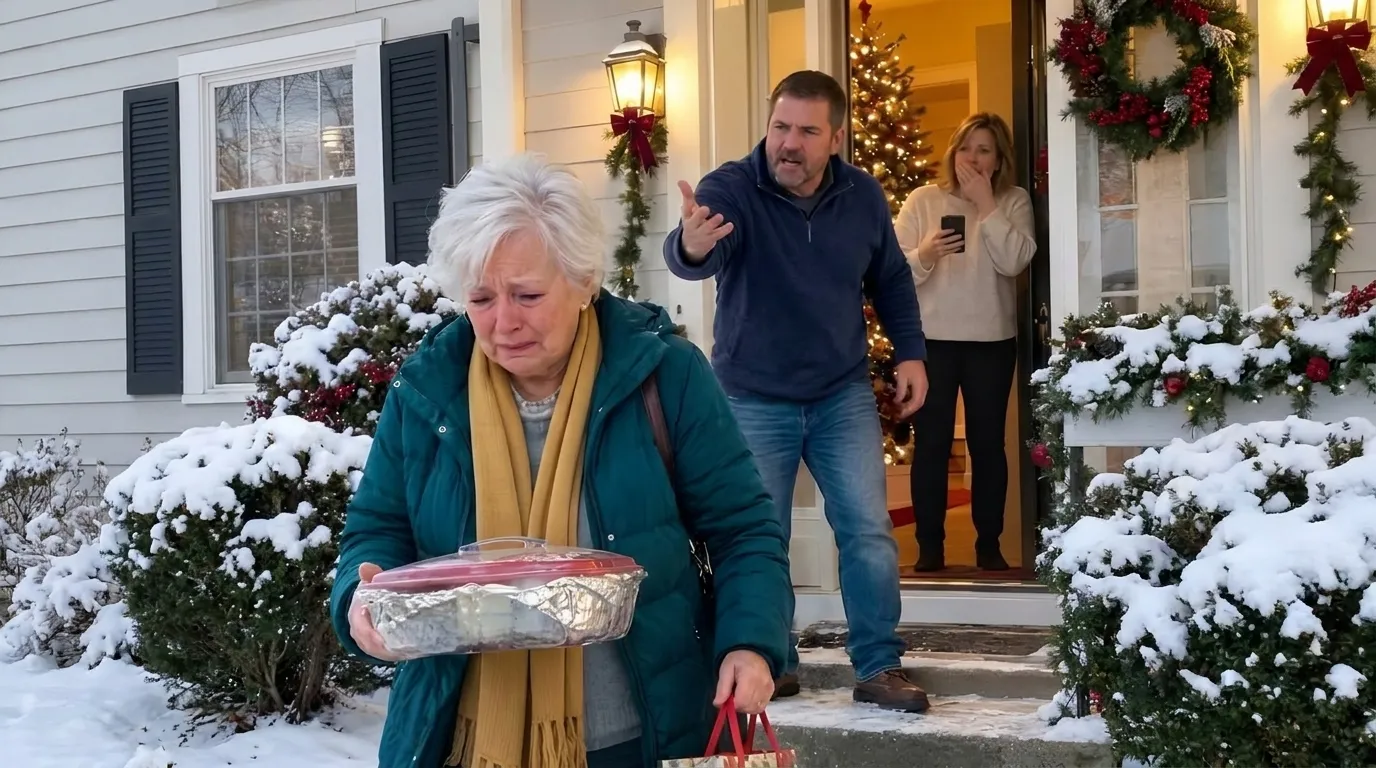
I thought about standing on that porch in the snow. About Sophie on the stairs with her cocoa. About fourteen plates on a white tablecloth. About Claire’s voice, so close to the phone, laughing about my turkey.
Please fix it.
He didn’t say he was sorry. Not really. He said he was drinking, and there was pressure, and he didn’t mean it.
But he didn’t say, I’m sorry I left you in the snow.
He didn’t say, I’m sorry I told my son you were a stranger.
He just wanted me to fix it.
I got up. I walked into my kitchen. The turkey was still sitting on the counter where I’d left it, still covered in foil. The red gift bag was still beside it.
I put the turkey in the refrigerator.
Then I made myself a cup of coffee, and I stood at my window and drank it slowly, and I watched the morning sun over the Hendersons’ snowman, which had fallen over in the night and was lying face down in the snow.
Ruth knocked on my back door around ten.
Ruth Abramowitz has lived next door for twenty-three years. She’s seventy-six, a retired court stenographer, five feet tall and fierce as a terrier. She was widowed the year before Richard died, and we’d held each other up through a lot of bad nights.
She was holding a plate of rugelach and wearing a sweatshirt that said I SURVIVED ANOTHER MEETING THAT SHOULD HAVE BEEN AN EMAIL.
“Merry Christmas,” she said. “I didn’t think you’d be home. Your car’s been here since last night. I figured you’d be at Daniel’s.”
“I’m not at Daniel’s.”
She looked at my face. Then she came inside without being asked and set the rugelach on the counter.
“Sit,” she said. “Tell me.”
So I told her. All of it. The porch, the plates, wrong house, the phone call. The legal pad with the number at the bottom. The twenty-five missed calls.
Ruth listened without interrupting, which for Ruth is a miracle. When I finished, she was quiet for a long moment.
“Four hundred and twelve thousand,” she said.
“Yes.”
“Dollars.”
“Yes, Ruth.”
“Margaret.” She took off her glasses and rubbed her eyes. “Your roof has been leaking for three years. You told me you couldn’t afford a new one.”
“I couldn’t. Not with everything else.”
“You’ve been putting off your eye surgery.”
“I know.”
“You’ve turned down the tulip trip four years running.” She put her glasses back on. “I thought you just didn’t like tulips.”
I laughed. I couldn’t help it.
Then, without any warning at all, the laugh turned into something else, and I put my face in my hands at my own kitchen table and cried the way I hadn’t cried since Richard’s funeral.
Ruth didn’t say anything. She got up and stood behind my chair and put her arms around my shoulders and held on.
When I was done, she handed me a dish towel because the tissue box was empty.
“What did he say on the voicemail?” she asked.
“He asked me to fix it.”
“Did he apologize?”
“He said he was drinking.”
Ruth made a sound in her throat.
“My Harold used to say that. ‘I was drinking.’ Like it was the weather. Like it just happened to him.”
“He’s my son, Ruth.”
“I know he is, honey.” She sat back down across from me. “And you’re his mother. Not his bank.”
I didn’t call Daniel back that day.
Instead, Ruth and I heated up my turkey in her oven, because she said mine ran cold. She made her sweet potato kugel. Her nephew Benjy came over with his wife and their new baby, and we all sat around Ruth’s little table with the plastic tablecloth that had cartoon reindeer on it.
Benjy had seconds of my turkey. Then thirds.
“Mrs. Whitmore,” he said, with his mouth full, “this is the best turkey I have ever eaten in my life.”
“Don’t talk with your mouth full,” Ruth said.
“I’m serious. What do you put on it?”
“Butter,” I said. “And sage. And thirty years of practice.”
I held the baby for an hour while everyone ate pie. She fell asleep on my shoulder with her little fist curled against my collar.
It was not the Christmas I’d imagined.
But I was warm. And I was wanted. And nobody at that table treated me as if I’d come to the wrong house.
My phone buzzed in my pocket nine more times that afternoon. I didn’t look at it until I got home.