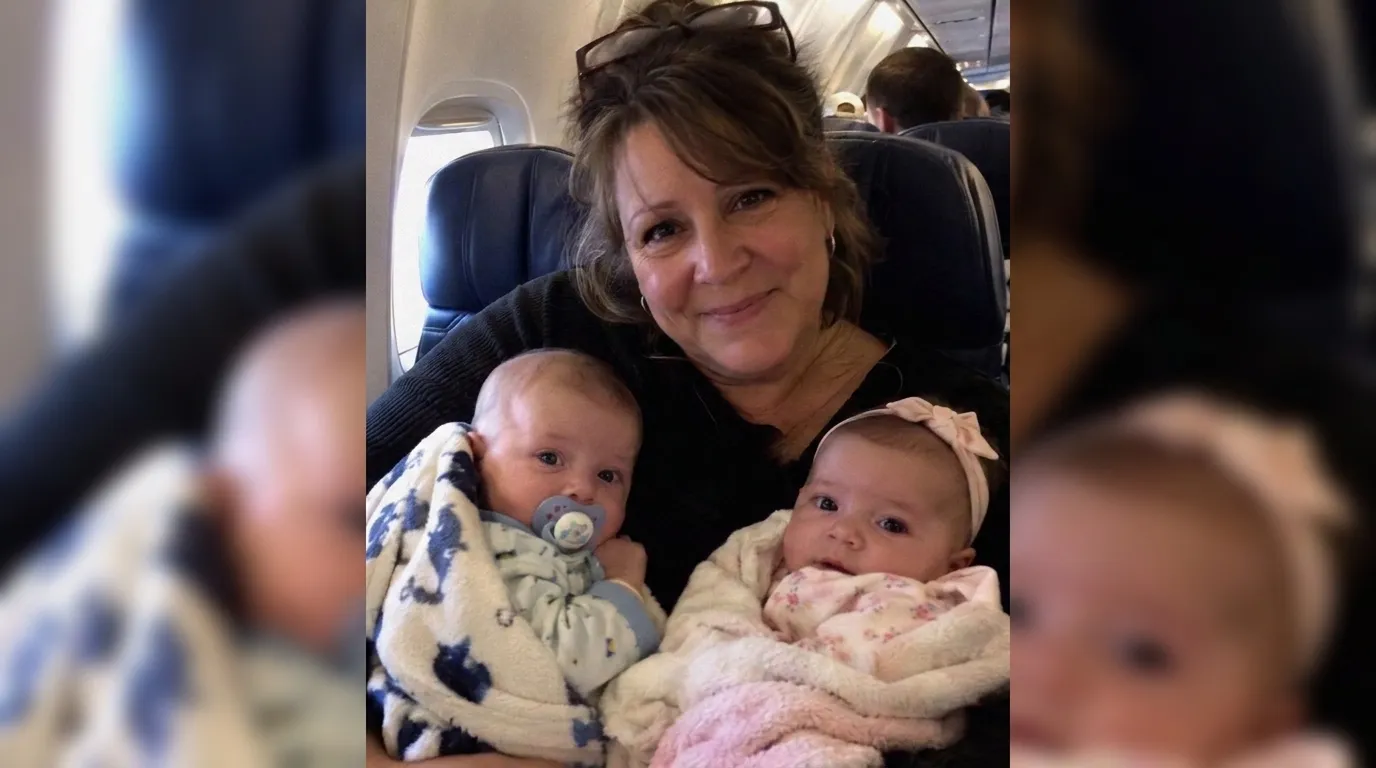
I adopted twins I found abandoned on a plane when I was fifty. I still can’t believe one flight changed my life forever.
I was supposed to be spending the weekend with Lily.
Instead, I was flying across the country to bury her.
My daughter was twenty-seven. Three days earlier, a driver had run a red light and hit her car. Her roommate called me from the hospital. By the time I arrived at the airport, I had replayed that conversation so often I could hear it over every announcement.
I hadn’t slept. I carried one small suitcase and wore the blue sweater Lily bought me last Christmas.
Before boarding, I checked my phone.
The last message Lily had sent me was still at the top of our conversation.
Mom, there’s something important I need to tell you when you get here.
She had sent it the morning she died.
I couldn’t read it without crying.
The man beside me offered a tissue before takeoff.
“Rough morning?” he asked.
“My daughter’s funeral.”
He whispered an apology and left me alone. I was grateful.
Across the aisle, a woman sat beside two infant carriers secured in their seats. She spent much of the flight trying to settle the babies, passing bottles and blankets between them.
Halfway through the flight, one baby started crying. Then the other joined in.
Several passengers began complaining.
“Somebody needs to do something,” a woman said.
A flight attendant stopped to help. She had a silver clip in her hair, and I watched her hold one of the babies while their companion searched through a diaper bag.
Eventually, the crying stopped.
I closed my eyes and tried to sleep.
When we landed, the babies started crying again. Passengers stood, reached for their bags, and began moving toward the front.
I noticed the woman from across the aisle hurry ahead with her coat over one arm.
At first, I assumed she was retrieving something.
But the line kept moving, and she didn’t return.
The flight attendant came back down the aisle. When she saw the two carriers, she stopped.
“Where’s the woman who was sitting here?” she asked.
A passenger pointed toward the front.
“She got off.”
The attendant looked at the babies, then hurried toward the galley to alert her colleagues.
Within minutes, airport security had been called.
The babies cried harder as the remaining passengers gathered their belongings.
“Can’t someone shut those kids up?” a man demanded.
“They’re disgusting,” someone muttered.
“Why didn’t anyone take them?” another passenger asked.
I stood to let the man pass.
Then I looked back again.
One baby had kicked off a sock. The other was red from crying. Both reached into the air with tiny, shaking hands.
I knew I should keep moving. My sister was waiting at arrivals, and the funeral was the following morning.
But I couldn’t walk away.
“Can I help?” I asked the attendant.
She looked exhausted.
“Do you have experience with babies?”
“I raised one.”
She nodded and helped me lift the smaller child. The baby stiffened at first, then pressed her face against my shoulder.
Her tiny fingers curled around the sleeve of Lily’s blue sweater.
I held her a little closer.
The other baby kept crying until I sat beside him and held his hand.
“Hello, sweetheart,” I whispered. “It’s been a terrible day, hasn’t it?”
I wasn’t sure whether I meant his day or mine.
People stared and shifted in their seats, but I didn’t care.
Grief had carved an empty space inside me, and somehow, those two little babies reached straight into it.
Police began checking records and security footage to find the woman.
An officer took my name, Margaret, and asked if we were related.
“No. I couldn’t leave them crying.”
“Child services is on the way,” he assured me.
When a social worker arrived, she gently took the little girl from my arms. Her fingers tightened around my blue sleeve before the worker carefully loosened them.
I missed my daughter so fiercely at that moment that I almost couldn’t speak.
“Will someone stay with them?” I asked.
“Yes,” the social worker promised.
I wrote down her office number before leaving.
My sister, June, found me near baggage claim.
“Margaret, where have you been?”
I told her.
She hugged me, but I barely felt it.
I couldn’t imagine simply walking away from those children and never thinking about them again. As I left the airport, I knew I wanted to do everything I could to give them a home.
At Lily’s funeral, people described her as generous, stubborn, funny, and impossible to rush.
Her best friend, Olivia, spoke about the food Lily brought to coworkers who forgot lunch.
I kept looking toward the church doors, expecting Lily to arrive late and apologize.
After the burial, June found me alone beside the reception tables.
“You’re thinking about those babies,” she said.
“Is that terrible?”
“Why would it be?”
“I’m supposed to be thinking about Lily.”
June squeezed my hand.
“You can grieve your daughter and worry about two children.”
That evening, I called the number the social worker had given me.
The twins were in emergency foster care. Investigators were working to establish their family circumstances and determine who could care for them.
“Can I visit?” I asked.
“Not right now,” the worker said. “But I can explain the process if you’re interested in becoming an approved foster parent.”
“Would they even consider me? I live in another state.”
“There would be a lot to work through,” she said. “And I can’t promise they’d be placed with you.”
I looked at Lily’s photograph on June’s mantel.
“Please tell me what I need to do.”
My return flight was scheduled for the following week. I canceled it and asked June if I could stay with her a little longer.
Within weeks, I’d found a small apartment nearby and started the foster-parent approval process.
There were background checks, classes, and home inspections. Nobody promised me the twins would ever come to live with me.
June helped me prepare the spare bedroom.
“Are you sure?” she asked one afternoon.
“No,” I admitted. “But I want to try.”
During the investigation, the authorities learned that the twins’ mother, Sofia, had died shortly before the flight. Their father couldn’t be located.
The woman who abandoned them was Sofia’s aunt, Valerie. She had agreed to care for the children temporarily but soon felt overwhelmed.
Valerie told investigators she’d boarded the flight intending to seek help in the city where Sofia had lived. Instead, she panicked after landing and walked away, assuming airline staff would take responsibility for the babies.
After the abandonment, she was ruled out as a safe placement. No other relative was approved and willing to take both children.
When a foster home was needed and I had completed my approval, the caseworker contacted me.
The twins were nine months old when they arrived at my home.
The little girl had learned to clap. Her brother liked pulling my glasses off.
I used the names Sofia had given them throughout foster care. They were part of their mother’s legacy.
My first night with them involved spilled formula, two diaper disasters, and less than an hour of sleep.
At three in the morning, I called June.
“I think I’ve made a mistake.”
“Are they hurt?”
“No.”
“Are you hurt?”
“Only my back.”
“Then you’re doing fine.”
She came over with coffee anyway.
As the months passed, our home filled with toys. The little girl started pulling herself up against the furniture, and her brother refused to sleep unless someone sang to him.
Sometimes I sang Lily’s favorite childhood song and cried halfway through.
The twins didn’t mind. They only wanted me to keep singing.
On difficult nights, after they were asleep, I sometimes opened Lily’s last message.
I’d never learned what she’d been so excited to tell me.
Eventually, I stopped trying to guess.
But I couldn’t stop wondering about the twins’ past.
Their caseworker had told me Sofia received help from a local community housing program before she died. Volunteers had brought groceries, helped with childcare, and supported her search for a better apartment.
“She had people looking out for her,” the caseworker said.
I was relieved to hear that. Until then, almost everything I knew about Sofia concerned her death and what happened afterward.
I wanted the children to have memories of their mother that weren’t tied to losing her.
I kept the housing program’s name, hoping I could one day ask whether anyone had photographs or stories about Sofia.
Meanwhile, the twins’ caseworker continued visiting. Their future remained uncertain, but I had begun to hope I might someday adopt them.
Near the flight’s first anniversary, the remaining legal requirements were resolved. Our adoption hearing was set for Friday.
Two weeks beforehand, I contacted Sofia’s housing program. I mentioned Lily’s funeral flight and asked for photographs or memories of Sofia that the twins might treasure.
The coordinator agreed to contact former volunteers and share my number with my permission. I also told her about Friday’s hearing.
That Friday, June accompanied us to the courthouse.
When the judge asked whether I understood the responsibility I was accepting, I looked at the two little faces beside me.
“I do,” I said.
I chose Nora and Ethan as their first names, keeping Sofia’s choices as their middle names. The judge approved both the adoption and name changes. They were officially my son and daughter.
Outside the courthouse, June took our first official family photograph.
“Now what?” she asked.
“Now we go home and make pancakes.”
Nora cheered.
Our first day as an official family was wonderful.
That evening, I looked at our courthouse photograph. Losing Lily still hurt, but I had a family again.
The next morning, someone knocked on my door.
A young woman stood outside holding a cardboard box.
She looked familiar, but I couldn’t place her.
“Mrs. Hayes? Did you adopt the twins from that flight?”
“Yes.”
I stared at her and blurted out the first thing that came to mind.
“Are you their mother?”
She began to cry and shook her head.
“I’m Hannah. I was a flight attendant.”
I remembered her silver hair clip.
She held the box out to me.
“It was important that you only learned the truth after you adopted the children. Please… look.”
“Is something wrong?”
“No. I volunteered at the housing program. I knew your daughter.”
I gripped the doorframe.
“Lily?”
She nodded.
I brought her inside and led her into the kitchen. She set the box on the table but kept her hands resting on the lid.
“I never knew you were Lily’s mother,” Hannah said. “We hadn’t met, and I didn’t recognize Sofia’s twins either. I recognized your story and Lily’s name when the coordinator forwarded your request Tuesday.”
She’d found the box among Lily’s volunteer materials on Friday.
“I didn’t want to interrupt your adoption hearing,” she said. “Lily was putting this together for you.”
She lifted the lid.
Inside were several photographs and an envelope with “Mom” written across the front in Lily’s handwriting.
I picked up the first photograph.
Lily sat on a couch with a baby in each arm.
For a moment, I couldn’t breathe.
I knew those faces.
Nora and Ethan.
“Lily volunteered with Sofia,” Hannah said. “She visited almost every weekend, helped with childcare and housing applications, and wanted you to meet them.”
In the photograph, Ethan’s tiny fist curled around Lily’s finger.
The sight of her holding them made my knees suddenly feel weak.
I stared at the photograph.
My daughter had held these children long before I ever knew they existed.
Then I remembered her last message.
Mom, there’s something important I need to tell you when you get here.
Hannah touched the envelope.
“She’d started putting together a little album for your visit. She left it at the office while she collected the last few photographs.”
I opened the envelope.
Mom, there’s a family I want you to meet, Lily had written. They’re having a hard time. I know you’d love them. You always told me family is something we build by showing up.
The letter was dated a week before Sofia died. Lily’s last text came afterward. Perhaps she’d meant to tell me about Sofia’s death; I’d never know for certain.
But I knew she had loved these children. She and Sofia had died within days of each other, and somehow I’d found the twins on my way to Lily’s funeral.
That evening, I showed June the photograph.
“Lily knew them?”
“She wanted me to meet them.”
“And you did.”
Ethan called from the other room. I went to him.
Two years later, on Lily’s birthday, I took Nora and Ethan to her grave.
I brought the photograph of her holding them.
“She knew you before I did,” I told them. “And she loved you very much.”
Ethan placed a flower beside the stone. Nora asked if Lily liked pancakes.
“She loved them,” I said.
We went home and made some.
Lily never got the chance to introduce us. But on my way to say goodbye to my daughter, I’d met the two children she’d wanted me to know.
Latest Posts
- A Woman’s Foster Son Came Down to Breakfast with a Packed Suitcase on His Eighteenth Birthday
I was thirty-six when I became a mother, although the boy who made that possible was already twelve. For years, I had dreamed of having a baby. But severe endometriosis and multiple surgeries made pregnancy impossible. Richard held my hand when the doctor told us. “We can still have a wonderful life, Emma,” he said. …
- Boy With Down Syndrome Started Mainstream School—On Day Five, the Principal Called His Parents and Said, “Come Immediately”
My 10-year-old son, Ethan, who has Down syndrome, had finally been allowed to attend a regular school. But on his fifth day, the principal called me. “Mrs. Parker? This is Principal Harris. I need you and your husband to come to school immediately.” “What’s happened? Is Ethan all right?” “He’s sitting here in my office.” …
- My Wealthy Ex Tried to Take Full Custody of Our 8-Year-Old Son, but What Our Boy Revealed in Court Left Him Speechless
Part One: The Cold Courtroom The family courtroom in Knoxville, Tennessee, felt colder than the January morning outside. I sat at a narrow wooden table beside my eight-year-old son, Nolan. His feet did not quite reach the floor. They swung back and forth whenever the room went quiet, which was often. Every few minutes, he …
- Bride Banned Her Niece with Vitiligo from Her Wedding—
Bride Banned Her Niece with Vitiligo from Her Wedding—So Her Sister Prepared an Unexpected Gift My sister told me not to bring my daughter with vitiligo to her wedding because she would “ruin the wedding pictures.” So I gave her a wedding gift she never expected. My eight-year-old daughter, Sophie, has vitiligo, a condition that …
- My Husband’s Best Friend Drove Our Daughter to Ballet—
My Husband’s Best Friend Drove Our Daughter to Ballet—Then Her Teacher Asked Me a Chilling Question My sixteen-year-old daughter used to beg me to watch her dance. Then she stopped practicing, barely spoke to me, and began acting as though I’d betrayed her. I couldn’t understand what had changed. Before that, Audrey practiced ballet in …