“I hear you and your dad watch a lot of football together,” the man said.
His voice was warm and ordinary.
Somehow, that made my husband’s expression even harder to understand.
Ethan nodded.
“Every game we can.”
“That sounds like a pretty good way to spend an afternoon.”
My husband let out a breath that sounded almost like a laugh.
“I used to watch you,” he said.
The man smiled.
Now I understood part of it.
He was a former player.
Not someone I recognized from the games that played in Ethan’s hospital room. Someone from earlier.
My husband’s earlier.
“I never missed a game when I was a kid,” my husband continued. “Not if you were playing.”
Ethan turned toward his father.
Then back toward the man.
His eyes narrowed slightly, the way they did when he was trying to remember a statistic.
“Wait.”
The man came down the last few steps.
Ethan pointed at him.
“You’re the one in Dad’s old games.”
That made the man laugh.
“I suppose I am.”
“The ones he keeps showing me.”
“Hopefully the good ones.”
“There’s one he’s shown me about a hundred times.”
My husband finally laughed properly.
“Not a hundred.”
“Close.”
The man held out his hand.
Ethan shook it.
My husband was still standing, still looking as though someone had opened a door into a room he had not visited for years.
“You were my favorite player,” he said quietly.
The man offered him his hand next.
“Thank you.”
For a moment, my husband could not seem to let go.
Then he stepped back, embarrassed.
“I’m sorry. I just wasn’t expecting—”
“You weren’t supposed to.”
The man glanced toward the volunteer.
She was smiling through her tears.
The screen still showed our section, but the camera had pulled back. The announcer thanked Ethan for joining everyone at the game.
Applause rose around us.
Ethan looked up and waved again.
I watched his face, searching for any sign that it had become too much.
He was tired.
I could see that now.
But he was smiling.
The former player noticed him shift his weight.
“Why don’t you sit down, Ethan?”
My son settled into his seat.
The volunteer came closer as the stadium’s attention returned to the field.
She leaned toward me.
“He’s happy to spend a little time with you, if Ethan feels up to it.”
I looked at Ethan.
He had heard her.
“Yes,” he said immediately.
Then, with the manners we had spent years teaching him:
“Please.”
The volunteer laughed softly.
We moved only far enough to talk without blocking the steps.
I stayed beside Ethan with the bag against my leg. My husband sat on his other side.
The man pulled his attention away from the people who recognized him and gave it to our son.
Not the screen.
Not the camera.
Ethan.
“So,” he said, “tell me what you think of the game.”
That was all the invitation Ethan needed.
He told him.
About a pass.
About a missed chance.
About the play he thought they should have tried instead.
My husband opened his mouth, perhaps to tell Ethan not to be so certain.
The former player held up a hand, smiling.
“No, let him finish. I want to hear this.”
So Ethan finished.
Then the man asked him why.
Not in a way that challenged him.
In a way that meant he was listening.
Ethan leaned forward.
His hands moved as he explained.
My husband joined in.
For several minutes, I understood almost nothing they were saying.
It was wonderful.
No one asked Ethan to rate his pain.
No one asked when he had last eaten.
No one talked about how brave he was.
He was a boy arguing about football with his father and a man who had once played it in front of crowds like this one.
I rested my hand lightly against his back.
Under my palm, I could feel him laughing.
Eventually, the man turned to my husband.
“Your son tells me you watch the old games together.”
My husband nodded.
“Some of them.”
“He knows them pretty well.”
“He remembers everything.”
“Not everything,” Ethan said.
“Anything involving football,” I added.
Ethan gave me a look.
All four of us laughed.
Then my husband looked down at his hands.
“When things got difficult,” he said, “sometimes putting a game on was the only thing I knew how to do.”
He stopped.
I knew that pause.
The effort it took to keep his voice steady.
“We could still do that together.”
The former player did not rush to answer.
He simply nodded.
“That sounds like it mattered.”
“It did,” Ethan said.
My husband looked at him.
“It does,” Ethan corrected.
I turned my face toward the field until I could trust it again.
A little later, while my husband and Ethan were still talking with their guest, I stepped close enough to speak quietly to the volunteer.
“How did you know?”
She glanced toward them.
“During the planning, I asked about the players they liked. Your husband mentioned him when we were talking about how Ethan became interested in football.”
I vaguely remembered one of those conversations.
I had been checking practical things.
Travel.
Medication.
How far we would need to walk.
My husband had been answering the football questions.
“I didn’t promise anything,” she said. “We asked whether a meeting might be possible. He wanted to come himself.”
I looked back.
My husband was smiling at something Ethan had said.
Not the careful smile he wore when our son searched his face.
A real one.
“That’s why you didn’t tell us.”
“We didn’t want you waiting for something that might not happen.”
I nodded.
I understood that better than she could have known.
Before the former player left us, he asked whether we would like a photograph.
Ethan answered before either of us could.
“All of us?”
“All of you.”
The volunteer took my phone.
I stood beside Ethan. My husband stood on his other side, and the man who had come down the stadium steps leaned close enough to fit into the picture.
Just before she took it, Ethan looked up at his father.
“You’re smiling weird.”
My husband laughed.
“I’m trying to look normal.”
“It’s not working.”
The volunteer caught the photograph then.
Not when we were ready.
Not when everyone was facing the right way.
While we were laughing.
Afterward, the former player shook Ethan’s hand again.
“Thank you for letting me be part of your first game.”
Ethan looked surprised.
“We should be thanking you.”
“You already have.”
My husband thanked him too.
This time, he managed to get the words out without stopping.
The man rested a hand briefly on his shoulder.
Then he made his way back up the steps.
People recognized him as he passed.
Some called out.
Some waved.
But Ethan was no longer looking at them.
He was looking at his father.
“Was that really your favorite player?”
“Really.”
“Your absolute favorite?”
“Yes.”
Ethan sat back, satisfied.
Then he looked at me.
“Dad’s more excited than I am.”
“I think you might be right.”
My husband shook his head.
But he did not deny it.
We returned our attention to the game.
That mattered too.
The surprise did not become the whole afternoon.
Ethan still wanted to know what happened on the field.
He still disagreed with his father about a call.
He still joined the crowd when everyone around us stood and cheered.
Eventually, though, his shoulders began to sag.
He stopped turning at every sound.
I offered him water, and he drank a little.
My husband saw what I saw.
“We can go whenever you need to, buddy.”
Ethan shook his head.
“Not yet.”
“Okay.”
There was no argument.
No demand that he enjoy every second because so much effort had gone into the trip.
We had come for him.
He did not owe anyone a performance.
A little later, he leaned against his father.
“Just tell me if I miss something.”
“I will.”
Ethan rested for a while with his eyes half closed.
The crowd kept rising around us.
My husband stayed still so our son could be comfortable.
I watched the field.
Then the two of them.
Then the field again.
For once, I did not try to imagine the next week.
Or the next month.
I let that afternoon be an afternoon.
When it was time for us to leave, Ethan looked back before we entered the concourse.
I waited beside him.
The field was still bright.
The seats still seemed to climb forever.
“Was it what you thought it would be?” I asked.
He shook his head.
For one terrible second, I thought something had disappointed him.
Then he smiled.
“Better.”
On the journey back, he talked until his voice became sleepy.
About the screen.
About the noise.
About the man who had watched part of the game with us.
About his father’s face.
Especially his father’s face.
“I thought you were going to fall over, Dad.”
“So did I,” I said.
My husband looked at me.
“You’re supposed to be on my side.”
“I was. I was ready to catch you.”
Ethan laughed.
Then, a few minutes later, he fell asleep.
My husband and I grew quiet.
Not the silence from the hospital room.
Not the silence after the doctor closed the door.
This one had something inside it besides fear.
When we were back at the hospital, the bag went into its usual place.
The medication schedule continued.
The familiar sounds returned.
Nothing about the afternoon had changed Ethan’s diagnosis.
We did not pretend it had.
But when someone asked him how the game had been, he pushed himself a little higher against his pillow.
“We were on the big screen,” he said.
Then he pointed at my husband.
“And Dad met his favorite player.”
His father shook his head.
“It was your surprise.”
“I know.”
Ethan smiled.
“I was there.”
Later, when the room had grown quiet, I opened the photograph on my phone.
My husband moved his chair closer.
Ethan was looking sideways in the picture.
My husband’s mouth was open in the middle of a laugh.
I was smiling at both of them instead of at the camera.
It was not a perfect photograph.
For that reason, it was exactly right.
“Send that to me,” my husband said.
“I will.”
Ethan stirred.
“Let me see.”
I held the phone where he could look at it.
He studied the picture carefully.
Then he smiled.
“That’s a good one.”
“It is.”
“Don’t delete it.”
“Never.”
In the time we had left with him, the game returned to us often.
Sometimes Ethan wanted to look at the photograph.
Sometimes he asked his dad to tell the story of turning around.
“You just stood there,” he would say.
“What was I supposed to do?”
“Talk.”
“I eventually did.”
“Eventually.”
Other days, Ethan was too tired for much conversation.
On those days, football played softly in the room.
My husband sat beside him.
Sometimes they watched.
Sometimes Ethan only listened.
The stadium visit did not erase what came afterward.
There were difficult days.
There were things we could not fix, no matter how carefully we packed a bag or how tightly we held his hand.
When Ethan died, my husband and I were beside him.
For a long time afterward, I could not look at the photograph without crying.
Neither could my husband.
We never deleted it.
One Sunday, much later, I found my husband sitting in front of the television with the sound turned low.
A football game was on.
His phone rested in his hand.
I sat beside him.
He showed me the picture.
“I keep thinking about what he asked for,” he said.
“A game.”
My husband nodded.
Then he looked at me.
“With Mom and Dad.”
I remembered Ethan sitting up in that hospital bed.
The instant answer.
The way he had looked at us to make sure we understood.
He had not asked to go alone.
He had asked for all three of us.
I leaned against my husband’s shoulder.
On the television, the crowd grew louder.
Neither of us reached for the remote.
For a little while, we watched together.
And when I looked at the photograph again, I could almost hear Ethan teasing his father.
You’re smiling weird.
It’s not working.
I cried.
Then, for the first time in a while, I laughed too.
We had gone to the stadium carrying medicine, worry, and the knowledge that we could not keep our son with us.
We came home carrying those same things.
But we also brought home an afternoon when Ethan was not only a patient, and we were not only frightened parents.
He was our ten-year-old boy.
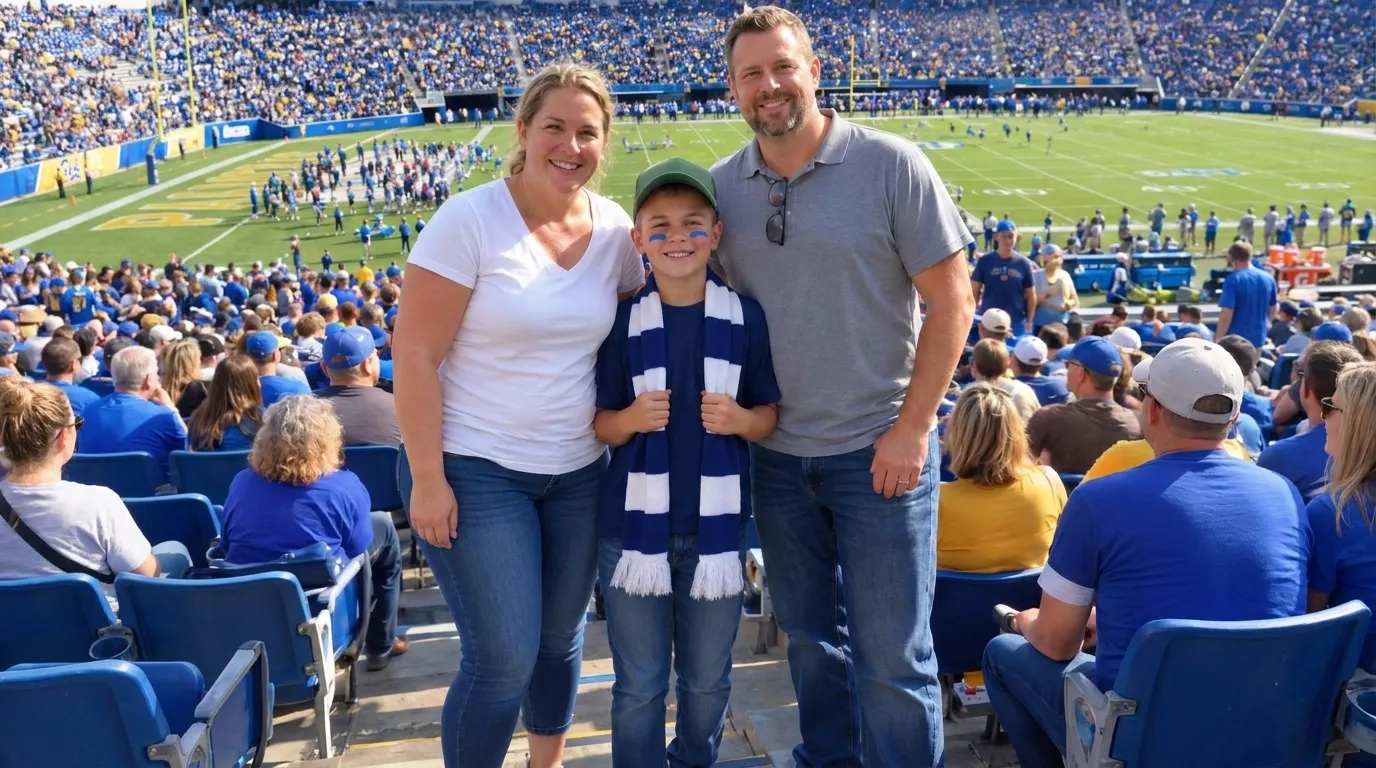
We were at a football game.
And all three of us were smiling.
The End.
Latest Posts
- My Stepdaughter Called Me the Help Until My Envelope Changed Everything
The insult came before I’d even finished setting down the peach cobbler. I’d baked it at five that morning in the kitchen of the lake cabin we’d rented, and it was still warm under the foil. The smell of cinnamon followed me across the grass toward the pavilion tables, where thirty-two members of the Cole …
- My In-Laws Gave Their Other Three Children $20,000 for Houses and Gave Us Only a Card Two Years Later, We Bought the Old Miller Place for $41,500
The envelopes were tucked under the Easter plates. Each had a name written on it in my mother-in-law’s round schoolteacher handwriting. Kim opened hers first. She’s the oldest. Divorced two years. Raising two boys in a rented trailer behind the grain elevator. She looked at what was inside the envelope and put her hand flat …
- My Mother-in-Law Told Me to Lose Weight After Giving Me a Dress That Didn’t Fit, but Minutes Later, She Regretted Everything
I couldn’t get it over my hips. I stood in my bedroom in my underwear with the dress bunched around my thighs like a deflated balloon. Midnight blue silk. A designer label I’d only ever seen in magazines. Tiny pearl buttons down the back. Beautiful. And four sizes too small. I pulled. I tugged. I …
- Teen Wore a Dress to His Best Friend’s Funeral—The Family Nearly Had Him Removed Before He Reached the Microphone
My son’s best friend read the eulogy at his funeral in a red dress. I almost had him removed before he reached the microphone. My son Jack died 17 days after his 18th birthday. Cancer. Fourteen months from diagnosis to funeral. We found out late. Too late, as it turned out, and the treatment never …
- My Mother Refused to Walk Me Down the Aisle—Then the Truth Surfaced
My mother had proudly escorted both of my sisters down the aisle as though they were miracles dressed in lace. On the morning of my own wedding, I stood in the bridal suite wearing my white gown, hoping for a single moment of family peace. Instead, she stared at me and said, “I refuse to …