Celeste cooperated fully with the investigation.
She returned property and money that investigators could connect to the girls’ accounts.
Through Miriam, she eventually sent me an apology.
She admitted that entering a relationship with a married man had been wrong.
She apologized for sitting outside Rose’s funeral.
She explained that Arthur had told her Rose’s family did not want outsiders present.
I did not forgive her.
But I accepted that her cooperation helped investigators uncover more of the truth.
I saved her letter with Rose’s documents.
One day, when the girls were older, they could decide whether they wanted to read it.
They owed Celeste nothing.
Just as they owed Arthur nothing.
The investigation into Arthur lasted almost a year.
Doctors could not say with certainty that Rose would have survived if Arthur had called immediately.
Her condition had been serious.
But medical experts agreed that the delay deprived her of crucial treatment opportunities and substantially worsened her chances.
The recordings proved she requested emergency care.
Phone records showed Arthur ignored calls after leaving.
Pharmacy records showed he collected medicine she apparently never received.
Then investigators recovered a message Arthur sent Celeste that night.
Rose is having another episode. I’m not letting her ruin tonight too.
He sent it while my daughter was struggling to remain conscious.
The evidence showed more than one terrible decision.
It showed a pattern.
Arthur isolated Rose.
Interfered with her medication.
Canceled appointments.
Told relatives she was confused.
Removed the children’s phones during a medical emergency.
Then told doctors Rose had refused help.
The financial investigation uncovered more.
Money taken from the girls’ education accounts.
Attempts to redirect insurance funds.
Rose’s electronic signature used on accounts when she was too ill to manage them herself.
Faced with the recordings, financial records, witness testimony, and Celeste’s cooperation, Arthur ultimately accepted a plea agreement.
He pleaded guilty to charges involving neglect, financial fraud, theft from the children’s accounts, obstruction, and abandonment.
He received a lengthy prison sentence.
He was ordered to repay money that could be traced.
Family court permanently removed his authority over the girls’ property and medical decisions.
After reviewing everything that happened, the court placed Lucy, Rachel, and April under my permanent guardianship.
Arthur was allowed to send letters through a court-appointed therapist.
The girls did not have to read them.
Lucy refused every one.
Rachel requested only the first.
Arthur wrote that he had been overwhelmed.
That Rose’s illness changed him.
That what he said at the funeral came from grief.
Rachel read the letter once.
Then placed it on the table.
“He still thinks everything happened to him.”
She never requested another.
April was younger.
She understood only that her father left after her mother died and that she now lived with me.
One night, while I tucked her into bed, she asked:
“Did Daddy send us away because we were bad?”
“No.”
“Because we cried too much?”
“No.”
“Because Mommy died?”
“No, sweetheart.”
“Then why?”
I thought carefully.
“Your father made selfish choices.”
I tucked the blanket around her.
“Those choices belonged to him. They had nothing to do with how good or lovable you are.”
“Did Mommy want us?”
“With every part of her heart.”
April stared at me.
“Do you want us?”
I smiled.
“You are not guests in this house.”
“This is your home.”
“Even when I’m big?”
“Even when you’re bigger than me.”
She smiled.
Then closed her eyes.
The girls did not heal all at once.
Lucy initially woke before sunrise every morning.
She prepared breakfast.
Checked Rachel’s homework.
Packed April’s school bag.
Counted every pill whenever one of them became sick.
She behaved as though the entire family would collapse if she stopped watching.
One morning, I found her ironing April’s school uniform at five-thirty.
I unplugged the iron.
“You don’t need to do this.”
“April needs it.”
“I can handle April’s clothes.”
“What if you forget?”
“Then she wears something else.”
Lucy stared at me.
Her eyes filled.
“Mom forgot things when she got sick.”
“Your mother was ill.”
“Dad said she was careless.”
“Your father lied.”
Her voice shook.
“If I don’t watch everything, something bad happens.”
I placed both hands on her shoulders.
“Something terrible already happened while you were watching everything.”
“That doesn’t mean you failed.”
Her face crumpled.
“I left Mom alone when I went for help.”
“You went to save her.”
“I should have stayed.”
“You were a child trapped inside a choice no child should ever have been forced to make.”
She cried against me for almost an hour.
Eventually, Lucy began working with a therapist who understood children forced into caregiving roles.
Slowly, she learned how to be twelve again.
She joined the art club.
Went to a birthday party.
Stayed until the end.
She let me pack the lunches.
The first time she forgot her homework, she called me crying.
I brought it to school.
Nothing terrible happened.
Rachel’s grief looked different.
For months, she barely spoke.
She communicated through drawings and little notes left around the kitchen.
One picture showed our family under a giant storm cloud.
Rose stood on one side.
The girls stood on the other.
Arthur was drawn walking away beneath a clear sky.
Eventually, Rachel spoke about the final night.
“I heard Mom calling him.”
She looked down.
“I thought if I stayed quiet, Dad would calm down and help her.”
She had learned to believe silence could control danger.
It took time for her to understand that silence had protected Arthur—
not the family.
April developed a fear of white vans.
Whenever one drove past our house, she ran toward me.
She remembered Celeste’s van outside the cemetery without fully understanding why it frightened her.
For months, I walked April to school.
We named the colors of passing vehicles.
Blue.
Red.
Black.
White.
Slowly, a white van became just a vehicle again.
Not the final image connected to her father abandoning her.
My once-quiet home filled with schoolbooks.
Shoes.
Half-eaten snacks.
Hair ribbons.
Arguments over the bathroom.
Rose’s old bedroom became Lucy’s.
Rachel chose the room facing the garden.
April slept across from me with her door open.
And for the first time, the noise inside that house felt like life.
On the first anniversary of Rose’s death, we visited the cemetery together.
The weather was warm.
Lucy carried white lilies.
Rachel brought a drawing.
April held the framed photograph Lucy had once clutched beside the grave.
We sat together on the grass.
For a while, nobody spoke.
Then Lucy reached into her pocket.
“I found this inside the back cover of Mom’s notebook.”
She unfolded a page.
“It’s for us.”
She handed it to me.
“Will you read it?”
I nodded.
Then began.
My beautiful girls,
If Grandpa is reading this, then I could not stay with you as long as I wanted. I am sorry. I fought to remain because being your mother was the happiest part of my life.
I swallowed.
Then continued.
Lucy, you are loving and responsible, but you are not required to carry everyone. Let adults do their jobs. You are allowed to be young.
Lucy lowered her eyes.
Rachel, your quiet heart notices everything. Never let anyone tell you that remaining silent is the same as being safe. Your voice matters, even when it shakes.
Rachel leaned against me.
Then came April.
April, you may not remember every day we had together. That is all right. Your sisters and Grandpa will remember for you. You were wanted before you were born, loved every day afterward, and never once a burden.
April began crying.
I continued.
Stay together. Be kind to one another. Do not measure your worth by the choices of someone who failed to see it.
Your father may tell you he needed freedom. Please understand that love is not a cage, and children are not chains. The people who truly love you will never describe caring for you as a wasted life.
I love you beyond every ending.
Mom
When I finished, the girls sat together beside Rose’s grave.
Lucy wrapped one arm around Rachel.
Rachel pulled April closer.
This time, the silent look they exchanged did not frighten me.
It was not the look of three children protecting a secret.
It was the look of three sisters who had survived the same storm.
April wiped her cheeks.
“Did Mom know we would live with you?”
“She hoped you would.”
“Did she know you’d say yes?”
I looked at Rose’s name carved into the stone.
“She knew me very well.”
We stayed until the shadows grew longer.
Before leaving, Lucy placed the purple cloth bag beside the flowers.
Then she picked it up again.
“We should keep it.”
“Yes.”
“Not because we’re scared.”
“No.”
“Because Mom told the truth.”
I nodded.
“That’s exactly why.”
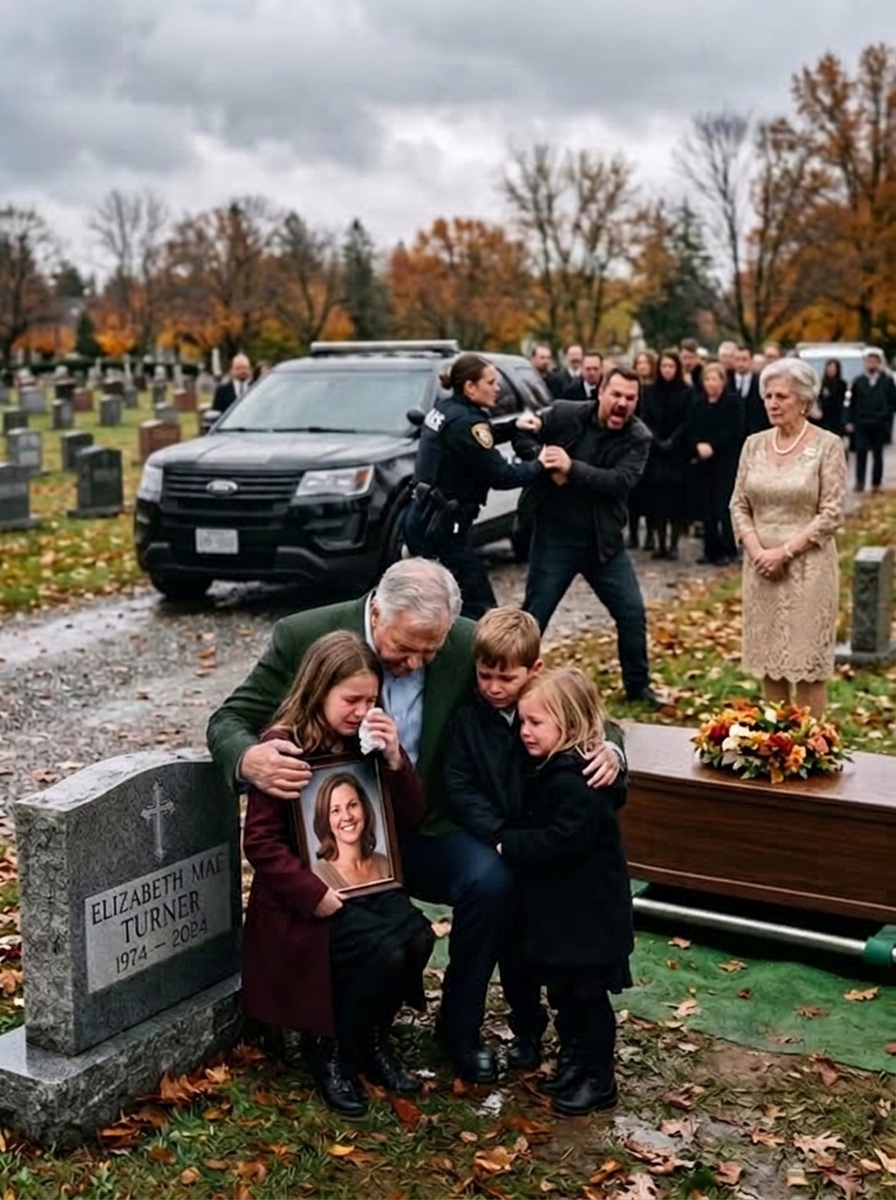
Arthur had announced beside Rose’s coffin that he deserved a fresh start.
To him, a fresh start meant erasing the people who depended on him.
Taking money that was not his.
And stepping into a new life before the old one had even finished grieving.
But he never reached the altar.
The woman he planned to marry learned the truth.
The girls’ money was protected.
Rose’s evidence continued speaking after Arthur believed her voice had been silenced forever.
And the daughters he called a burden remained together.
Arthur eventually received the life without them that he claimed he wanted.
But it was not freedom.
It was consequence.
The real fresh start belonged to Lucy, Rachel, and April.
It began inside a quiet house.
Warm soup on the stove.
Bedroom doors left open.
Schoolbags by the stairs.
Three girls slowly learning that they no longer had to protect one another from every adult in the room.
And a grandfather who never once made them wonder whether they were wanted.
Arthur walked away from his daughters beside their mother’s grave.
He thought that was the end of his responsibility.
Instead—
it was the moment the truth began following him.
The End.
Latest Posts
- My Mother-in-Law Made My Baby Shower About Herself—Then My Husband Stood Up #2
I wanted a small baby shower, but my mother-in-law ignored nearly every request and turned the day into a celebration of becoming a grandmother. I kept swallowing my frustration for one deeply personal reason, until she crossed a line neither my husband nor I could ignore. I was seven months pregnant with our first child, …
- My Son Grew His Hair for His Best Friend’s Wig—Then Her Father Called Me to School
A 14-Year-Old Boy Grew Out His Hair to Make a Wig for a Classmate Who Lost Hers to Cancer – The Next Day, His Mother Was Called to the School, Where the Girl's Father Said, 'You Have No Idea What Your Son Did, Do You?' The gum stuck in my son’s hair nearly ended the …
- 80-Year-Old Woman Spent Seven Days Visiting an Old Friend…
80-Year-Old Woman Spent Seven Days Visiting an Old Friend – She Returned Looking Half Her Size with a Suitcase That Wasn't Hers I almost walked past my mother at the train station. She was standing beside a bench, gripping the handle of an enormous black suitcase. Her gray hair was flattened against her forehead, and …
- The Winning Ticket and the Life My Husband Hid
My Husband Was Lying in a Hospital Bed When I Won 100 Million Dollars, and Then I Heard Him Laughing to His Mistress That I Would Hand Him Every Penny If I Thought He Was Dying. I Hid the Ticket, Called a Lawyer, and Walked Away, Never Imagining That His Fake Illness Was Only the …
- My husband divorced me to marry my own mother. #2
My Husband Divorced Me to Marry My Own Mother My husband divorced me to marry my own mother. Everyone told me to move on, but instead… I showed up at their wedding. And when she said, “I do,” they had no idea what I had already done. When Mark left me, he didn’t even try …