At dinner, my daughter-in-law ordered lobster for everyone at the table except me.
Then she pushed a glass of water toward my place at the far end and smiled as though she had done something thoughtful.
“That will be enough for her,” Claire told the waiter.
I looked at my son, Ethan.
He sat beside her beneath the restaurant’s crystal chandeliers in an expensive suit, staring at his plate as though he hadn’t heard a word.
“Ethan?”
After a pause, he answered quietly.
“Just accept it, Mom. Remember your place.”
For a moment, I didn’t see the successful man across from me.
I saw the little boy whose hand I held through winter rain.
The child I fed before I fed myself.
The student whose lunches, shoes, and college bills I found ways to pay.
I looked down at the water.
“Understood.”
Claire seemed disappointed.
She had expected tears.
Anger.
Maybe a loud reaction that would allow her to call me difficult and blame me for ruining dinner.
I gave her none of that.
My name is Eleanor Hayes.
I’m sixty-five years old, and I raised Ethan alone after his father disappeared when Ethan was six.
There was no explanation.
No support.
No one else to take over when things became hard.
So I did everything.
I cleaned corporate offices before sunrise.
Worked lunch shifts in a school cafeteria.
Waited tables.
Spent long hours in commercial kitchens.
I carried trays, stood beside hot ovens, and came home with aching feet, but Ethan always had food, clean clothes, and school supplies.
When college came, I found a way to help with that too.
I wanted him to have choices I had never been given.
He graduated.
Built a career.
Eventually married Claire.
At first, I tried hard to love her because I believed that if she made Ethan happy, that was enough.
I ignored the little remarks about my clothes.
My apartment.
The way she looked around my modest home as though she were afraid poverty might rub off on her.
Then came the exclusions.
Birthday dinners I learned about later.
Holidays I wasn’t invited to.
Family trips nobody mentioned until after they returned.
Ethan allowed all of it.
So when he called and said they wanted to repair our relationship, I let myself hope.
I wore my nicest navy dress and accepted their invitation to one of the city’s most exclusive restaurants.
The table told me the truth before anyone spoke.
Claire sat between her parents.
Ethan sat beside her.
My chair had been placed away from the others, with an awkward stretch of empty space between us.
The waiter approached.
“Four lobster dinners,” Claire said. “Imported wine, appetizers, and desserts.”
I waited for her to include me.
She didn’t.
A glass of water arrived soon afterward.
As everyone else ate, Claire’s parents discussed people who reached retirement without planning properly.
They laughed about small apartments.
Working-class neighborhoods.
People who spent their lives “getting by” instead of building something important.
Then Claire looked toward me.
“I think Eleanor should attend fewer family events,” she said. “We have a certain image now.”
Ethan remained silent.
Beside my chair sat the strawberry cake I had brought for Ethan and Claire’s four-year-old daughter, Lily.
I knew she loved strawberries.
Claire glanced at the box.
“What exactly do you think you can contribute?”
I looked at her.
She leaned back.
“Love is nice, Eleanor. But love doesn’t provide status, opportunities, or useful connections.”
Something inside me became calm.
They had decided who I was.
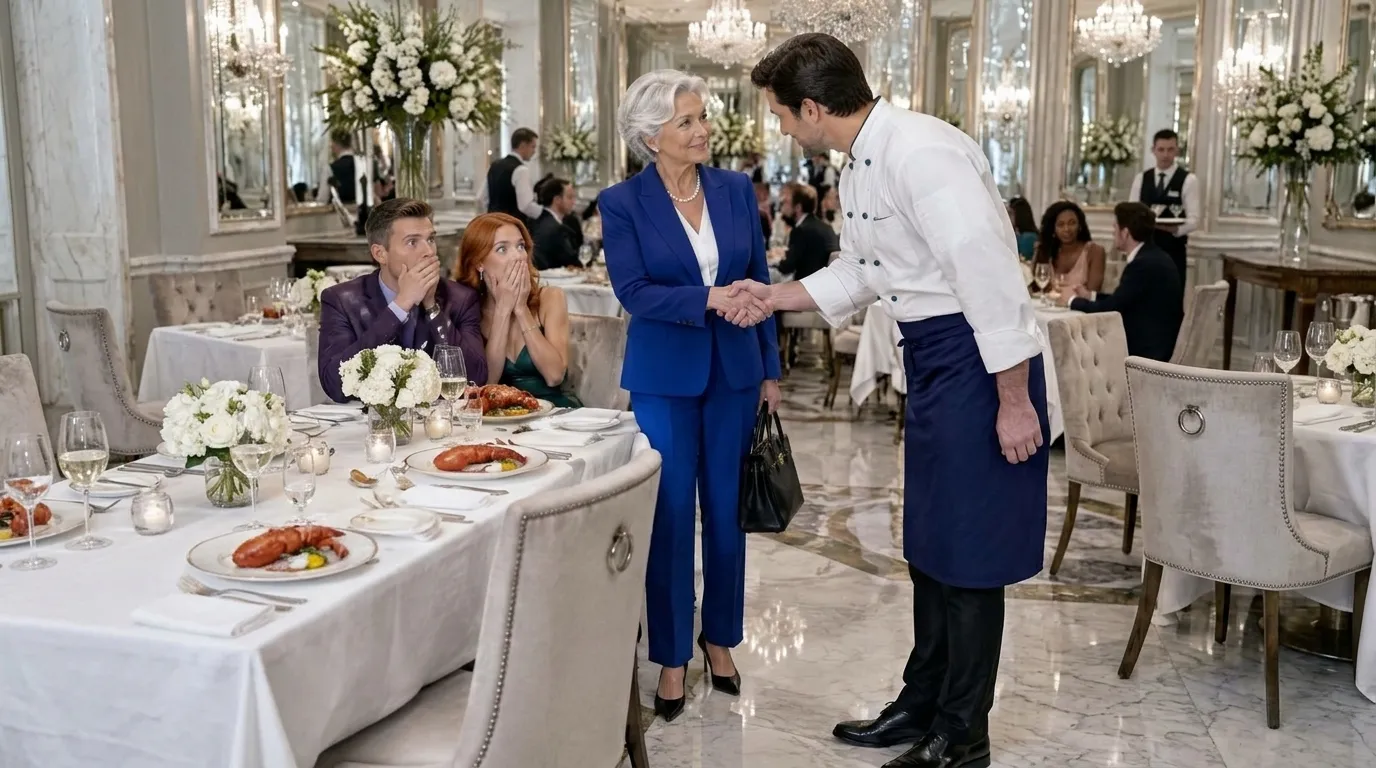
Then the executive chef entered the dining room.
I knew him immediately.
He knew me too.
The dinner continued for another few minutes.
Lobster beneath warm butter and herbs.
Imported wine.
Dessert.
My untouched glass of water remained at the end of the table.
When the bill arrived, it totaled $780.
Four lobster dinners.
Wine.
Appetizers.
Desserts.
And one glass of water for me.
No one apologized.
Claire folded her napkin and reached for her purse.
Ethan prepared to leave.
They assumed I would quietly follow them outside, grateful to have been permitted a seat at their table.
Instead, I stood.
“Excuse me.”
Claire looked mildly annoyed.
I turned toward the kitchen.
I knew the sound of those doors.
The rhythm of staff moving with trays.
The sharp mixture of heat, steam, and urgency hidden behind every elegant dining room.
I had spent much of my life in places like that.
The executive chef stepped through the doors.
He stopped when he saw me.
Removed his hat.
And gave me a respectful nod.
“Mrs. Hayes,” he said. “The management team is ready for you in the private office.”
Everything behind me went quiet.
Claire had followed far enough to hear him.
Ethan stood several steps behind her.
“Why does he know you?” Claire asked.
I carried my glass of water with me.
Took one slow sip.
Then placed it on a passing tray.
I followed the chef into the private office.
The general manager stood when I entered.
“I’m sorry you had to experience that in our dining room, Mrs. Hayes.”
“You don’t need to apologize. Your staff did nothing wrong.”
He glanced toward the door.
“Would you like us to ask them to leave?”
“No.”
Humiliating them wasn’t going to restore my dignity.
I already had it.
After Ethan left for college, I had continued working in restaurants.
But I also began saving.
Then investing.
I understood restaurants better than almost anything else.
Food costs.
Suppliers.
Staffing.
Customers.
Location.
The tiny details that made someone return for a second meal.
Eventually, I became a minority investor in a struggling neighborhood restaurant.
Then an owner.
Then I opened another.
And another.
I reinvested nearly everything.
Learned leases.
Contracts.
Commercial property.
Made mistakes.
Corrected them.
Over the years, the business grew quietly.
The restaurant where my own family had just allowed me to sit with a glass of water was one of several properties in my group.
I had never hidden that success as a test.
I lived simply because I liked living simply.
I drove an ordinary car because it worked.
I remained in my modest apartment because it felt like home.
And I never told Ethan exactly what I owned because I wanted him to value me as his mother.
Not as a source of money.
When I returned to the table, Claire’s smile was gone.
Ethan stood so quickly his chair scraped across the floor.
“Mom.”
I looked at him.
“I’m sorry.”
But I noticed something immediately.
He didn’t look devastated.
He looked frightened.
Claire recovered first.
“This was just a misunderstanding.”
“No.”
She stopped.
“The dinner became awkward.”
“No, Claire.”
Her face tightened.
“You ordered food for every adult at the table except me.”
“I thought you weren’t hungry.”
“You told the waiter water was enough.”
Her parents stared at their plates.
Claire started again.
“I was joking.”
I looked at Ethan.
“You knew.”
His eyes dropped.
“Yes.”
“And you said nothing.”
“I didn’t know what to do.”
That hurt more than anything Claire had said.
She had never claimed to love me.
Ethan had.
I nodded slowly.
“I knew what to do.”
Claire stepped forward.
“I never meant to hurt you.”
“You don’t get to decide what I’m worth according to what you think I own.”
Then I picked up my purse.
Ethan reached for my hand.
“Mom, please. Give me another chance.”
I looked at the man whose life I had once built my own around.
“I gave you one tonight.”
I pulled my hand away.
“You just didn’t recognize it.”
I left without shouting.
The chef thanked me for stopping by.
The manager offered to carry Lily’s strawberry cake to my car.
I stood outside beneath the city lights and breathed.
For years, I had wondered whether Ethan’s growing distance came from adulthood.
Marriage.
Work.
Life.
That night answered something harder.
He had learned to measure people by usefulness.
And somehow, I had become useless in his eyes.
Until he discovered I wasn’t.
The next morning, Ethan called repeatedly.
I didn’t answer.
Then Claire sent me a message.
We need to talk. There is something about Ethan you don’t know.
I stared at it.
For the first time, I wondered whether dinner had been more than simple cruelty.
I agreed to meet Claire the following morning at a café across town.
She arrived before me.
No designer confidence.
No polished smile.
She wrapped both hands around a coffee she never drank.
“I was cruel to you.”
“Yes.”
“I let my parents treat you badly because I wanted them to believe Ethan and I belonged in their world.”
“That doesn’t explain the dinner.”
“I know.”
Tears gathered in her eyes.
Then she told me the part I hadn’t known.
Several months earlier, Ethan had discovered an old business article mentioning my restaurant investments.
He confronted Claire.
“He said you must have millions.”
I stayed silent.
“He couldn’t understand why you never told him.”
“That was my decision.”
“I know.”
She looked down.
Then she admitted Ethan had lost money.
A bad investment with a colleague.
He had hidden it from her at first.
Then bills started piling up.
Their lease was ending.
Claire wanted to buy a condominium near her parents.
Ethan had promised her they could afford it.
Then he discovered my businesses.
“He said you could solve everything.”
I stared at her.
“Then why humiliate me?”
Claire’s face collapsed.
“Because Ethan thought you would defend yourself.”
I didn’t understand.
“He thought if my parents made you uncomfortable enough, you would finally tell everyone you were wealthy.”
I leaned back.
The water.
The comments.
The exclusion.
All of it had been designed to make me prove something.
“He invited your parents?”
Claire nodded.
“He said they knew exactly how to make someone care about status.”
Something cold moved through me.
“Ethan expected his mother to buy back her dignity.”
Claire started crying.
“Yes.”
For several seconds, I said nothing.
Her confession did not make her innocent.
She had participated willingly.
But for the first time, I understood the fear I had seen in Ethan’s face after the chef recognized me.
It wasn’t surprise.
He already knew.
He had simply discovered that his plan had gone much further than he expected.
Then Claire said something worse.
“There’s more.”
Of course there was.
“Ethan asked questions about whether you still owned the restaurants.”
I stared at her.
“What kind of questions?”
“Whether someone could manage them for you.”
My chest tightened.
“He asked whether you had ever signed a power of attorney.”
That changed everything.