The Girl Who Told the Truth About Her Marine Dad and Scout
Clara Reed was eight years old the morning her teacher threw her hero into the trash.
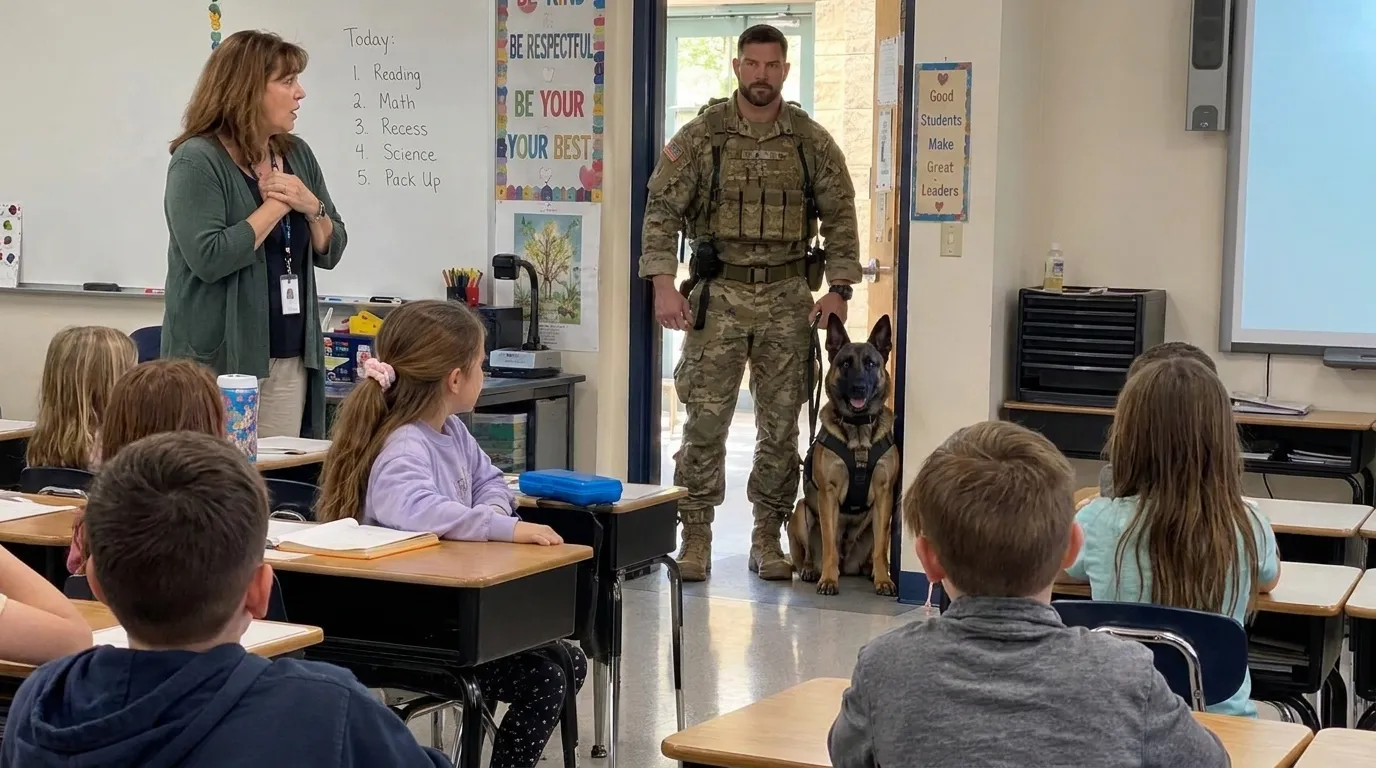
It happened at 8:47 a.m., in Room 3B, in front of twenty-two classmates.
Ms. Harrow took the blue folder from Clara, carried it across the room, and dropped it into the wastebasket by the door.
It landed on a pile of pencil shavings and eraser dust with a soft, flat sound.
Nobody breathed.
Then Ms. Harrow peeled a yellow sticky note off her pad, wrote something on it, and held it out.
“Come up here, Clara. Read this to the class.”
Clara stood up. Her legs felt like they belonged to someone else.
She walked to the front of the room and took the note. Her hands were shaking so badly that the little square of yellow paper trembled like a leaf.
She looked down at it.
I am sorry I gave the class information I could not prove.
Clara’s throat closed up.
She looked at the wastebasket. She could see one blue corner of her folder sticking out of the shavings.
Inside that folder was a drawing of a dog she loved and a story about a man she loved even more.
“Go on,” said Ms. Harrow. “We’re waiting.”
Clara opened her mouth. Nothing came out. She tried again.
“I am sorry,” she whispered, “I gave the class information I could not prove.”
Her voice cracked on the word prove.
“Louder, please. So everyone can hear.”
Clara said it again. Louder.
Every word was a lie, and she said every one of them.
“Thank you,” said Ms. Harrow. “You may sit down.”
Clara walked back to her desk, sat down, and folded her hands on top of it, the way she’d been taught.
She didn’t cry. She wanted to more than she had ever wanted anything. But she didn’t.
Her father had told her once that the bravest thing a person can do is keep their feet under them when everything in them wants to fall down.
So she kept her feet under her.
She just didn’t know yet that by the next morning, her father would be walking through the front doors of that school.
And he wouldn’t be walking alone.
It had started two weeks earlier, with a worksheet.
Ms. Harrow handed them out on a Monday. Clara remembered because Mondays were library days, and she was already thinking about which book she’d check out when the paper landed on her desk.
REAL-LIFE HERO REPORT, it said at the top.
Choose a real person you know who helps others. Interview them. Write a report about what they do and why it matters. Include a drawing. Reports will be presented to the class, and the best ones will be displayed on our Hero Wall.
Ms. Harrow tapped the bulletin board at the back of the classroom. It was covered in bright blue paper with a border of little gold stars.
It was empty.
“Now, I want to be very clear,” she said.
She was a tall woman with gray hair cut sharply at her jaw and reading glasses that hung on a chain around her neck. When she talked, she put her glasses on and took them off again, like punctuation.
“This is a report about a real person. Not a superhero. Not someone from a movie. Not somebody you’ve made more exciting than they really are.”
Glasses on.
“Last year, a student in this class wrote a report about her uncle who was supposedly a secret agent. It was a very creative story. It was also completely untrue. Her uncle sells mattresses in Carlsbad.”
A few kids laughed.
Glasses off.
“We are writing the truth in this classroom. The truth is always enough. Understood?”
“Yes, Ms. Harrow,” said twenty-three voices.
Clara didn’t laugh with the others.
She was already thinking about her dad.
At dinner that night, she told her mother she knew exactly who she was going to write about.
Lauren Reed was standing at the stove, stirring spaghetti sauce. She looked over her shoulder and smiled.
“Let me guess. Grandma Jo? She did volunteer at the food bank for twenty years.”
“No.”
“Mrs. Alvarez next door? She did save that cat off the roof.”
“Mom.”
Lauren set the spoon down. She already knew. Clara could tell by the way her mouth went soft at the corners.
“Daddy,” Clara said. “And Scout.”
Lauren came over and sat down at the table across from her.
“You know Daddy’s out at the field site right now. Three more weeks. You’d have to interview him on the video calls.”
“I know.”
“And the signal out there is terrible. Half the time it freezes.”
“I know. I’ll ask my questions fast.”
Lauren looked at her daughter for a long moment.
Clara had her father’s eyes, dark and serious, and her father’s habit of setting her jaw when she’d made up her mind about something.
“Okay,” Lauren said. “Then let’s write your questions down so you’re ready.”
Staff Sergeant Ben Reed was a Marine Corps military working dog handler.
That’s what Clara wrote at the top of her first page, in her very best handwriting, the letters all sitting neatly on the line.
Most of the kids in her class had parents who worked at the base. That’s what happened when you lived in Oceanside, right outside Camp Pendleton.
Half the dads and moms at pickup wore uniforms or had very short haircuts.
Mateo’s mom was a helicopter mechanic. Ava’s dad drove trucks. Jaylen’s parents both worked in an office on base doing something with computers, which Jaylen said was “boring but important.”
But nobody else’s dad worked with a dog.
Scout was a Belgian Malinois. He looked a little bit like a German shepherd, only thinner and quicker, with a black face and ears that stood straight up like they were listening to everything in the world at once.
He was five years old.
He was trained to find explosives. He could smell things buried under dirt, hidden in cars, and tucked inside bags. When he found them, he’d sit down very still and stare at the spot until Ben came to see.
Clara had met Scout lots of times at the kennels on base, on family days. She wasn’t allowed to pet him unless her dad said it was okay, and her dad always said the same thing first.
“He’s not a pet, Clara-bug. He’s a Marine. You ask him politely.”
So Clara would hold her hand out, low and flat, and Scout would sniff it very seriously, like he was reading a letter.
Then he’d push his head under her palm, and she’d get to scratch the pale spot above his right ear where the fur grew back lighter.
It was a scar.
“He got that jumping a fence during training,” her dad had told her. “Caught his ear on some wire on the other side. Didn’t even slow down. Finished the whole course with that cut. The vet put in four stitches, and he tried to eat every one of them.”
Clara thought that was the bravest thing she’d ever heard.
The first video call was a disaster.
Ben’s face kept freezing in weird positions. First with his mouth wide open. Then with one eye closed. Then just a blurry brown square that Lauren said was probably his hat.
“—can you hear—Clara, are you—”
“Daddy, you’re frozen!”
“—the tower out here—hold on—”
The call dropped.
Clara sat at the kitchen table with her list of questions and her pencil, staring at the black screen of her mom’s phone.
“He’ll call back,” Lauren said.
He called back twelve minutes later.
The picture was worse, but his voice came through okay if he held the phone up high and stood on something. Clara could see a piece of desert sky behind him and the corner of a tent.
“Okay, reporter,” he said. “Hit me. What’s your first question?”
Clara looked down at her list. She’d written it with her mom the night before.
“What is your job?”
“I’m a military working dog handler,” Ben said. “That means Scout and I are a team. I take care of him and train him, and he does the part I can’t do, which is smell things that are dangerous before they can hurt anybody.”
Clara wrote as fast as she could. Her pencil scratched across the paper.
“How does he tell you when he finds something?”
“He does what’s called a passive alert. That means he doesn’t bark or dig or get excited. He just sits down, super still, and points his nose right at it. Because if something’s dangerous, you don’t want a dog scratching at it.”
“Passive,” Clara said slowly, writing. “How do you spell passive?”
Ben spelled it. Lauren helped.
“What’s the hardest part?”
Ben thought about it. On the screen, he looked away for a second, out at something she couldn’t see.
“The hardest part,” he said, “is trusting him completely. When Scout sits, I have to believe him. Even if I can’t see anything. Even if everything looks normal. My whole job is believing what he’s telling me, even when I can’t see it myself.”
Clara wrote that down very carefully.
Every word.
Then the call froze again.
Over the next week, they did four more calls.
Clara learned all kinds of words.
She learned that the place where the dogs lived on base was called the kennels, and the Marine in charge of all the dogs and handlers was called the kennel master.
She learned that MWD stood for military working dog.
She learned that Scout had to pass tests every year, called certifications, to prove he could still do his job.
She learned that the dogs trained with people called decoys, who wore thick padded bite suits, and that Scout was trained for detection but also for patrol, which meant he could chase someone down if he had to.
“Does he bite people?” Clara asked, wide-eyed.
“Only if I tell him to. And only bad guys. And only on the sleeve.”
Ben laughed.
“Mostly he bites tennis balls. He’s very serious about tennis balls.”
On the fourth call, she asked her favorite question. Her mom had helped her think of it.
“What is something about Scout that most people don’t know?”
Ben grinned. It was the first time the video didn’t freeze, and she could see his whole face, sunburned and tired and happy.
“Here’s a good one. There’s an old tradition that military working dogs are one rank higher than their handlers. So technically, Scout outranks me.”
Clara’s mouth fell open.
“Scout is your boss?”
“Scout is definitely my boss. Just don’t tell him. It’ll go to his head.”
Clara laughed so hard she fell off her chair.
She wrote it down in capital letters.
SCOUT OUTRANKS MY DAD.
She drew a little star next to it.
When she finished her draft, she read it out loud to her mom three times.
Then, on Sunday night, she held the pages up to the phone camera one at a time so her dad could read them.
“Stop there,” he said on page two. “Can you fix one thing? It’s the kennel master, not the kennel manager. Different job.”
Clara erased manager and wrote master.
“And here—the vet put in four stitches, not five. I know. I’m picky. But you want it exactly right.”
“Because it’s a real report,” Clara said. “Ms. Harrow says the truth is always enough.”
Ben was quiet for a moment.
“Your teacher’s right,” he said. “The truth is always enough. You don’t need to make it bigger. You just need to tell it right.”
She made every correction in her neatest handwriting.
Her mom helped her type the final version on the computer so it would look professional, and Clara picked a font called Georgia because it looked serious.
They printed it at the library for ten cents a page.
Then she drew Scout.
It took her three nights. She used colored pencils, the good ones Grandma Jo sent her for her birthday.
She did his black face first, then his tan chest, then his ears standing up straight. She kept erasing the nose until it looked right.
And very carefully, above his right ear, she used a white pencil and a light gray one to make the pale little stripe of the scar.
She showed it to her mom.
Lauren looked at it for a long time.
“Clara,” she said, and her voice sounded funny. “That’s him. That’s exactly him.”
They put everything in a blue folder. Blue, because it was a Marine color, her dad said.
On the front, Clara glued a label she’d printed:
MY REAL-LIFE HERO:
STAFF SERGEANT BEN REED AND MWD SCOUT
By Clara Reed, Room 3B
She slept with the folder on her nightstand the night before she presented.
She woke up twice to make sure it was still there.
Presentation day was a Thursday.
The kids went up one at a time.
Mateo presented about his mom, the helicopter mechanic, and brought a real wrench that was almost as long as his arm.
Ava presented about her grandpa, who was a volunteer firefighter.
Jaylen presented about a crossing guard named Mr. Tony who knew every kid’s name at his old school.
Ms. Harrow smiled at all of them. She said “Lovely” and “Very nice” and gave them gold stickers.
She pinned Mateo’s report to the Hero Wall right away.
Then she said, “Clara Reed.”
Clara walked to the front of the room holding her blue folder with both hands.
She took a breath. She opened it. She held up her drawing of Scout first, the way she’d practiced in front of the bathroom mirror.
A few kids said, “Whoa.”
“My real-life hero is my dad,” Clara said, “Staff Sergeant Ben Reed. He is a Marine Corps military working dog handler. His partner is a Belgian Malinois named Scout. Scout is trained in explosive detection and patrol.”
She turned to the first page and started reading.
“My dad and Scout work together as a team. When Scout finds explosives, he does a passive alert. That means he sits very still and points with his nose instead of barking or digging, because—”
“Stop.”
Clara stopped.
Ms. Harrow had stood up from her desk. She was walking toward the front of the room.
She put her glasses on.
“May I see that, please?”
Clara handed her the folder.
Ms. Harrow flipped through the pages. The whole class was quiet.
Clara could hear the clock ticking over the door and someone’s shoe squeaking on the floor.
“Explosive detection,” Ms. Harrow read out loud. “Passive alert. Kennel master. Certification. Decoy. Patrol.”
She turned a page. Her mouth got thinner.
“Scout outranks my dad.”
A couple of kids giggled.
Ms. Harrow looked down at Clara over the top of her glasses.
“Clara. Who wrote this?”
“I did.”
“These are not words an eight-year-old knows.”
“I learned them. My dad taught me. I interviewed him.”
“When?”
“On video calls. He’s at the field site. The signal is bad, so it took five calls.”
Ms. Harrow turned another page.
“And he told you that a dog outranks a United States Marine.”
“It’s a tradition,” Clara said. “He said it’s an old tradition.”
“I see.”
Ms. Harrow took her glasses off.
“Clara, I want you to think very carefully before you answer this next question. Did you copy this from the internet?”
“No.”
“Did someone else write it for you?”
“No. My mom helped me type it. And my dad helped me fix the mistakes. But I wrote it.”
Clara’s voice was getting smaller.
“I have my notes. I can show you my notes.”
She had them folded in her back pocket. She’d brought them just in case.
She pulled them out—three pages of messy pencil handwriting, eraser smudges everywhere, with PASIVE crossed out and PASSIVE written above it, with a star next to SCOUT OUTRANKS MY DAD.
“I talked to him,” Clara said. “I really did. I talked to him.”
Ms. Harrow barely looked at the notes.
“Anyone can write notes, Clara.”
She walked back to her desk. She set Clara’s folder down. She opened the drawer and took out a red pen.
The whole class watched her uncap it.
On the title page, right across MY REAL-LIFE HERO, she wrote two words in thick, heavy strokes. She went over the letters twice, so they bled through the paper.
NOT VERIFIED.
She gave the report a failing grade, then closed the folder and handed it back.
“This will not be going on the Hero Wall,” she said. “In this classroom, we tell the truth. When you can prove what you’ve written, we can talk about it. Until then, you may sit down.”
Clara stood there holding the folder.
Somebody in the back said, “She made it up,” in a loud whisper.
Somebody else laughed.
“Sit down, please, Clara.”
Clara sat down.
She put the folder in her desk so nobody could see the red letters.
For the rest of the afternoon, she didn’t hear a single word anybody said. Every time she blinked, she saw NOT VERIFIED on the inside of her eyelids.
At lunch, she didn’t eat. She sat at the end of the table and pushed her apple back and forth.
Mateo slid down the bench toward her.
“I believe you,” he said quietly.
She looked at him.
“My mom says dog handlers are crazy,” he said. “Like, in a good way. She said one time she saw a dog jump into a helicopter.”
“Scout’s been in a helicopter,” Clara said.
“See?”
Mateo shrugged and took a bite of his sandwich.
“Ms. Harrow doesn’t know everything.”
It was the only nice thing anybody said to her at school that day.
She held onto it like a railing.
When Lauren picked her up, Clara climbed into the back seat and didn’t say anything.
“How’d it go, superstar?”
“Fine.”
Lauren looked at her in the rearview mirror.
Clara never said fine.
At home, Clara said “AMAZING” or “the worst day of my life” or gave a forty-minute summary of what everyone ate at lunch.
Clara did not say fine.
“Clara.”
“It was fine, Mommy.”
At home, Clara went straight to her room. Lauren gave her ten minutes.
Then she knocked and went in.
Clara was sitting on her bed with the blue folder in her lap, open to the title page.
Lauren saw the red letters from the doorway.
She walked over slowly and sat down on the bed. She didn’t grab the folder. She just looked at it for a long time.
NOT VERIFIED.
“Tell me what happened,” she said.
Clara told her. All of it.
The words out loud. The red pen. The laughing.
“Anyone can write notes, Clara.”
When she got to the part about the Hero Wall, her chin started to shake.
“I told the truth,” she said. “I told the truth and she said I didn’t. And Daddy said the truth is always enough. But it wasn’t enough, Mommy. It wasn’t.”
Lauren pulled her daughter into her lap, folder and all, and held on.
Over Clara’s head, she stared at the wall.
“We’ll fix it,” she said. “Okay? It’s a mistake. Grown-ups make mistakes. We’ll fix it.”
That night, after Clara went to bed, Lauren sat at the kitchen table with her laptop and wrote a message through the school’s parent portal.
She wrote it three times.
The first version was too angry. She deleted it.
The second version was too long. It had four paragraphs about how hard Clara had worked. She deleted most of it.
The third version was the one she sent. She read it over twice to make sure it sounded calm.
“Dear Ms. Harrow,
My name is Lauren Reed, and I’m Clara’s mother. Clara told me her Real-Life Hero report was marked ‘Not Verified’ today. I want to assure you that everything in her report is accurate.
Her father, Staff Sergeant Ben Reed, is a military working dog handler with the Marine Corps at Camp Pendleton, and his partner is MWD Scout. Clara interviewed him herself over several video calls, and he helped her correct her facts.
I’m happy to provide official documentation from his unit, photographs of Ben and Scout, or anything else you need. Ben can also speak with you directly by phone.
Clara worked incredibly hard on this and was very upset today. I’d be grateful if we could resolve this quickly.
Thank you,
Lauren Reed”
She hit send at 9:14 p.m.
The portal showed a little gray message under it.
Delivered.
Ms. Harrow saw it at 7:02 the next morning.
She was sitting in her car in the school parking lot with a travel mug of coffee, going through her phone the way she did every morning before she went inside.
The notification popped up at the top of her screen.
New message from Lauren Reed (Parent – Clara Reed).
She read the first two lines in the preview.
“Dear Ms. Harrow, My name is Lauren Reed, and I’m Clara’s mother. Clara told me her Real-Life Hero report was marked ‘Not Verified’ today. I want to assure you that everything—”
Ms. Harrow sighed.
Of course the mother was writing. The mothers always wrote.
She’d been teaching for twenty-six years. She knew exactly how this went.
The child went home and cried. The parent got defensive. The parent insisted their precious baby would never, ever make something up.
She’d seen it a hundred times.
Last year, with the secret-agent uncle, the father had written her a furious message.
“My daughter doesn’t lie.”
Two weeks later, the uncle showed up at the school fair in a polo shirt with a mattress store logo on it.
The principal had not been happy with Ms. Harrow for putting that report on the wall.
There had been a meeting. A “conversation about standards.”
She’d been embarrassed in front of the whole staff.
She was not going to be embarrassed again.
The mother would probably offer documentation. Right. Parents could print anything these days.
And even if the father really was in the military—half the parents at this school were—a dog outranking a Marine?
Children made things bigger than they were. That’s what they did.
It was her job to teach them not to.
She did not open the message.
She swiped it away.
Then she sat in her car and finished her coffee and decided something.
The class had watched a child present a made-up story and get away with it once.
It had been all over the classroom that afternoon.
“Clara made it up.”
“No she didn’t.”
“Yes she did.”
Children needed to see that there were consequences for that. Otherwise, next year, every one of them would be writing about their secret-agent uncles.
She would make it simple. Clear.
A lesson they’d remember.
She got out of the car.
That was the morning of the wastebasket.
Ms. Harrow waited until after the morning announcements and the Pledge of Allegiance. Then she stood at the front of the room.
“Before we begin today, I want to talk about honesty.”
She walked to Clara’s desk.
“Clara, would you give me your Hero folder, please?”
Clara looked up.
For one bright second, her whole face lit up.
She thought her mom’s message had worked. She thought Ms. Harrow had read it. She thought her report was going to be put on the Hero Wall.
She pulled the blue folder out of her desk and handed it over with both hands.
Ms. Harrow held it up so the class could see the red words on the front.
“Yesterday, Clara presented a report that contained information she could not prove. When I asked her about it, she did not admit it. In this classroom, we do not keep work that is not honest.”
Then came the walk to the wastebasket.
Mateo made a small noise, like a hiccup.
Clara didn’t make any noise at all.
And then came the sticky note, and the words Clara had to read out loud, and the long walk back to her desk with her feet under her even though everything in her wanted to fall down.
She kept her feet under her all day.
Through spelling. Through math.
Through lunch, where she didn’t eat again, and Mateo gave her his cookie and she didn’t eat that either.
Through recess, where she sat on the bench by the fence and watched the other kids play tag. She kept looking at the classroom windows, thinking about her folder at the bottom of the trash.
The custodian emptied the trash cans after school. She knew that. She’d seen him do it with his big gray cart.
If she didn’t get it before then, it would be gone.
When the final bell rang, Clara packed her backpack slowly.
She took so long that she was the last one out the door. She walked down the hall to the front of the school, where the parents waited.
Then she turned around and walked back.
The door to Room 3B was open. The lights were still on. Ms. Harrow wasn’t there.
Her purse was gone from the chair.
Clara crept inside.
The wastebasket was right where it had been. She knelt down beside it.
She could see the blue corner.
She reached in and pulled it out.
The folder was bent down the middle. Somebody had dumped a whole pencil sharpener on it at some point during the day—the blue cardboard was covered in curly wood shavings and gray smudges.
There was a wad of gum stuck to the back.
The corner of her drawing of Scout was crumpled, and a long black smear of pencil lead ran right across his tan chest.
But the scar above his ear was still there.
Pale and careful.
Exactly right.
Clara brushed the shavings off with her sleeve. She tried to smooth out the bend.
It didn’t really work.
“You okay there?”
She jumped.
A man was standing in the doorway with a big gray cart.
The custodian.
His name was Mr. Okafor. He had white in his beard and wore a blue work shirt with his name stitched on the pocket.
All the kids liked him because he knew how to fix the drinking fountain and he could whistle through his fingers louder than anyone.
Clara held the folder against her chest.
“I’m not stealing,” she said quickly. “It’s mine.”
Mr. Okafor looked at the folder. He looked at the wastebasket.
Then he looked at her face.
He didn’t ask anything. He just walked over, pulled a clean paper towel out of his cart, and knelt down beside her.
“Gum’s the worst,” he said. “Hold still.”
He worked the gum off the back of the folder with the edge of a plastic scraper.
It took a while. He was very gentle.
When he was done, he looked at the drawing of Scout sticking out of the top.
“That’s a Malinois,” he said.
Clara stared at him.
“How do you know?”
“The face. The ears. Knew a few of them, a long time ago.”
He tapped the pale stripe above the dog’s ear.
“He got a scar there?”
“From a fence. During training. He didn’t even slow down.”
Mr. Okafor nodded slowly.
“Sounds right. They never do.”
He stood up with a grunt and pushed his cart toward the door.
Then he stopped and turned around.
“You take that home,” he said. “You hold onto it. Something that’s true doesn’t stop being true just because somebody put it in the trash.”
Lauren had been waiting in the pickup line for twelve minutes.
She’d texted the front office. She’d started to get worried.
She was about to get out of the car when she saw Clara come out of the front doors, walking slowly, with her backpack on and the blue folder pressed flat against her chest with both arms.
Clara climbed into the car without a word.
“Hey. Where were you? I was getting—”
Then Lauren saw the folder.
The crease down the middle. The gray smudges. The one curl of pencil shaving still stuck in the corner.
The red words.
“Clara,” she said. “What happened to your folder?”
Clara looked at her lap.
“She threw it away.”
Lauren went very still.
“Who threw it away?”
“Ms. Harrow. In the trash. In front of everybody.”
Clara’s voice was flat, like she was reading it off a card.
“And then she made me read a note that said I was sorry I told the class stuff I couldn’t prove.”
“She made you—”
“I had to read it out loud. Two times. Because the first time wasn’t loud enough.”
Behind them, a car honked. The pickup line was moving.
Lauren didn’t move.
She sat there with her hands on the steering wheel, staring at her daughter in the rearview mirror.
At the folder.
At the eraser dust on Clara’s sleeve.
Another honk.
Lauren put the car in drive and pulled out of the line. She drove to the far end of the parking lot, parked under a eucalyptus tree, turned off the engine, and turned all the way around in her seat.
“Give me the folder, baby.”
Clara handed it to her.
Lauren opened it. She turned every page.
She looked at the black smear across Scout’s chest. She touched the place on the back where the gum had been.
And something inside her went from shock to something else.
Something cold and quiet and very, very steady.
She’d sent that message. She’d offered documents. She’d offered photographs. She’d offered a phone call with a Marine staff sergeant.
And the next morning, her daughter’s work had gone into the trash anyway.
“Mommy?” Clara said. “Are you mad at me?”
Lauren looked up.
“No,” she said. “No, Clara. I am not mad at you. I have never been less mad at anybody in my whole life.”
“You look mad.”
“I am mad,” Lauren said. “But not at you.”
She closed the folder, very gently, and handed it back.
“We’re going to call your dad.”
The signal at the field site was always best between eight and nine at night. Everyone in the family knew that.
It was when the other Marines were done with evening chow and the tower wasn’t as busy.
At 8:02, Lauren propped her phone against the sugar jar on the kitchen table, the same way they always did for family calls.
Clara sat in front of it with the folder in her lap.
Ben’s face came up on the screen. Sunburned. Tired. His cover pushed back on his head.
Behind him, the tent wall moved in the wind.
“There’s my girls!” he said. “How’d the big report go? Did Scout get on the Hero Wall?”
Clara looked at her mother.
Lauren nodded.
“Show him, baby.”
Clara held up the folder.
The picture was grainy, but not grainy enough. Ben leaned closer to his phone.
The smile slowly faded off his face.
“What’s that say?” he asked. “Clara-bug, hold it closer. What does that say on the front?”
Clara held it closer.
“Not verified,” she read.
Lauren told him. All of it.
She didn’t add anything. She didn’t make anything bigger. She told it exactly right, the way Ben had taught Clara to tell her report.
The red pen.
“Anyone can write notes.”
Her message through the portal.
The trash can.
The sticky note.
The two times Clara had to read it out loud.
Clara held up the sticky note. Ms. Harrow had left it on her desk, and she’d kept it because she didn’t know what else to do with it.
I am sorry I gave the class information I could not prove.
Ben read it.
Then his face went completely still.
Clara had seen her father angry before.
When the car got a flat on the freeway. When their neighbor’s dog got out and chased a kid down the street.
His face got red and his voice got loud and he said words she wasn’t supposed to repeat.
This wasn’t like that.
This was quiet.
His face didn’t move at all. He didn’t say anything for a long time.
The only thing that moved was a muscle in his jaw.
“Daddy?” Clara said.
“I’m here, bug.”
“Are you mad at me?”
His eyes came back to her, and they were wet.
“No, baby. No. Never. You did everything right.”
His voice was very low.
“You told the truth. You told it exactly right. And you stood up there and said what you had to say, even though it wasn’t true, because an adult told you to, and you were scared.”
He stopped. Swallowed.
“That’s not your fault. That’s hers.”
“The truth wasn’t enough,” Clara whispered. “You said it was always enough.”
Ben looked at her for a long time.
“It is enough,” he said. “Sometimes it just needs help getting through the door.”
He looked past the camera, at Lauren.
“How long is the school open tomorrow?”
“Seven-thirty to three.”
“Principal’s name?”
“Dr. Patel.”
Ben nodded. He took his cover off his head and held it in his hands.
“Let me make a call,” he said. “I’ll call you back.”
“Ben,” Lauren said. “Don’t do anything—”
“I’m not going to yell at anybody, Laur. I’m not going to threaten anybody. I’m going to do this the right way.”
He looked at Clara.
“Bug, go brush your teeth. Leave the folder out on the table. Okay?”
“Why?”
“Because I might need to see it in person.”
The screen went black.