A Boy Invited His Former Teacher to a Halloween Concert—But What He Did Onstage Changed Everything
“Can Mrs. Parker come to my concert?” my son, Owen, asked at breakfast.
“Of course,” I said. “Why?”
“She used to teach there. I think she’d like it.”
Mrs. Parker lived two houses down from us. She had taught at Owen’s school for more than thirty years before retiring. Owen had gotten to know her the previous summer, when he started helping in her garden.
He came home one afternoon with dirt on his knees and another argument to report.
“She says marigolds don’t necessarily keep bugs away.”
“Do they?”
He shrugged. “We’re testing it.”
Mrs. Parker never talked down to him. When my 12-year-old proposed a pumpkin that played music, she asked about the wiring.
By fall, he was still stopping at her house after school.
I had begun to notice how carefully she gripped her front rail. Her daughter, Beth, drove three hours almost every weekend, arriving with groceries and leaving with laundry.
When I gave Mrs. Parker the invitation to Owen’s Halloween concert, she smiled.
“He really asked for me?”
“Twice,” I said.
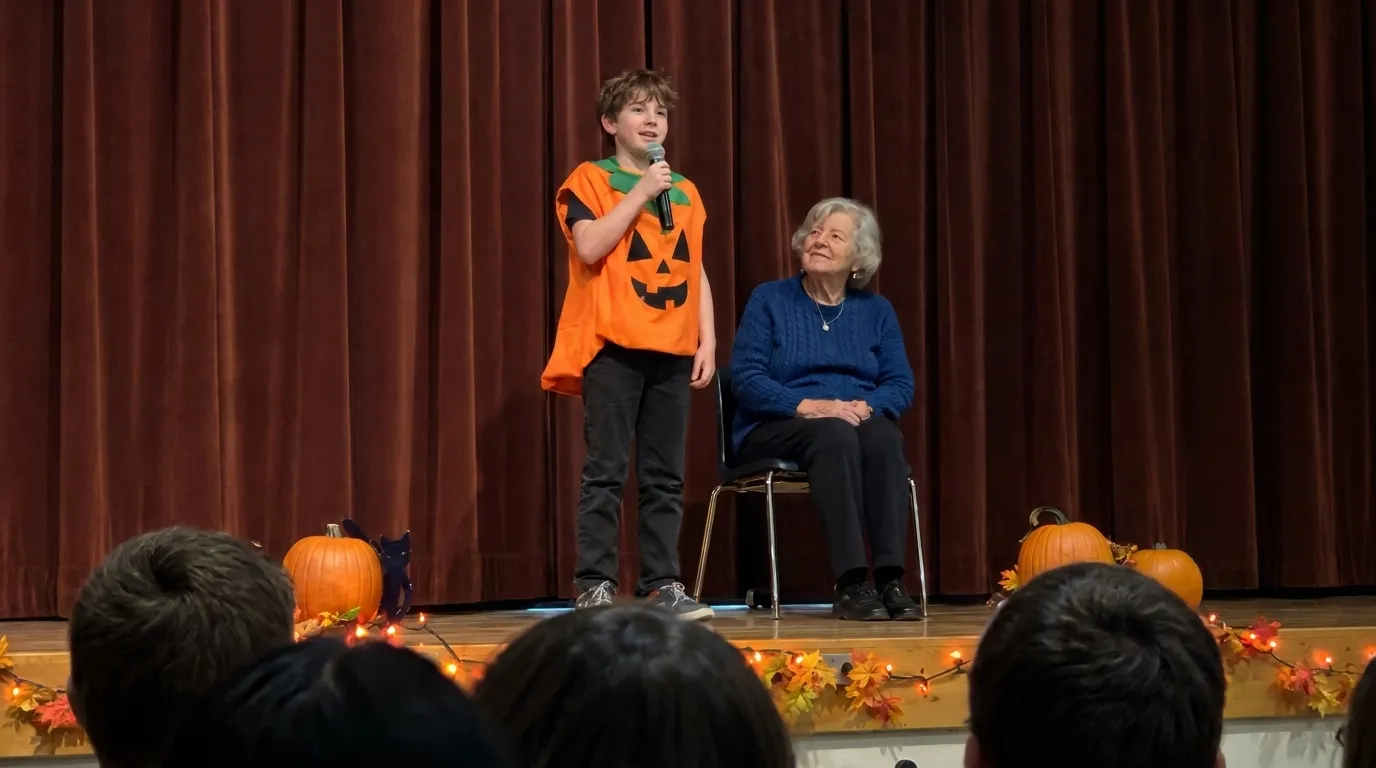
On the night of the concert, Owen wore a pumpkin costume we had made together. He had practiced his songs for weeks, but during the drive, he kept asking whether Mrs. Parker would sit near the front.
“She’ll be sitting with us, bud,” I told him.
“Near the front front.”
The school auditorium was full of families. Mrs. Parker wore a purple sweater and smiled at the paper bats and Halloween decorations. She told me she had not been back to the school since retiring after more than thirty years of teaching there.
Owen came out with his class, spotted us, and waved.
After their last song, the music teacher handed him the microphone.
“Before we finish, I want to ask someone to come up here,” he said.
He looked toward our row.
“Mrs. Parker, would you please come onstage?”
She looked at me. “Me?”
I helped her up the steps. Owen took her hand and led her to the middle of the stage.
I expected him to thank her for coming.
Instead, he asked the music teacher to bring out a chair.
“Mrs. Parker, could you sit down for a minute?”
She laughed nervously, but she sat.
Owen nodded toward the side of the stage.
The curtain opened.
A green-and-gold dragon towered above the children. Its enormous wings unfolded across the stage.
People gasped all around me.
Mrs. Parker gripped the arms of her chair.
“Owen,” she whispered, “how did you know?”
“I found your drawings,” he said. “Mr. Alvarez helped me plan this.”
The music teacher waved.
Then the dragon lifted off its headpiece, revealing a man in his thirties.
“I was Third Villager in 2003,” he said. “You told me I had a gift for dying dramatically. I build theater costumes now. A few of us want to help the children put your show back on.”
Owen leaned toward Mrs. Parker.
“Will you help direct it?”
“Well, the wings should open slower,” she began. “And that entrance needs to come from—”
She stopped.
Her expression changed. She seemed to shrink in her chair.
“I can’t, honey,” she said softly. “I’m moving.”
Owen’s shoulders dropped inside his pumpkin costume.
In the fourth row, Beth wiped her eyes.
Later, when the concert was over, Beth and I spoke privately.
“Mom needs reliable help,” she said. “I have to drive six hours when something goes wrong. Last Tuesday, I missed a whole day of work.”
Mrs. Parker nodded glumly.
“She’s right. I’d rather stay near my garden and my neighbors. But I know I need help.”
Owen stood beside her, staring at the floor.
“What if the community helped?” I asked. “You saw all those former pupils on the stage tonight.”
“We can explore it,” Beth said. “Something safe.”
Owen looked at me, and I turned to Mrs. Parker.
“With this many people, we’ll find a way for you to stay.”
Beth pressed her lips together.
Mrs. Parker reached for Owen’s concert program and began drawing a better entrance for the dragon.
The first assessment allowed us to try support at home.
We arranged rails, moved everyday items within reach, and hired an aide for mornings and personal care. Neighbors offered meals and transportation. Beth kept the assisted-living arrangement available.
“Every essential task needs coverage,” she said.
“We have coverage,” I told her.
“We have a spreadsheet. Who’s coming when someone cancels?”
I pointed to the names.
She asked which people had actually agreed to those hours. I had to make more calls.
While I did, Beth unpacked her mother’s groceries. She opened jars before putting them away and moved the milk into a smaller jug.
Mrs. Parker thanked her.
Beth kissed her mother’s head, checked the clock, and hurried out for the long drive home.
At our house, my husband, Marcus, took over pickups I would normally have handled.
One evening, he ate reheated dinner while I answered messages about groceries. I thanked him and opened the next message.
For a while, things seemed to work.
Mrs. Parker began attending rehearsals, seated while other adults carried props. When she changed the shepherd’s entrance, a scene that had dragged suddenly worked.
Owen ran over afterward.
“Did you see?” he said. “She fixed it.”
I watched Mrs. Parker laughing with the children and stopped worrying about Beth’s questions for a while.
Then the aide called.
Mrs. Parker had fallen in the kitchen while reaching for a pot.
She received help immediately and had no fracture, but afterward, she needed more assistance moving around.
The reassessment identified the obstacle we could not quickly solve: her only bathroom was upstairs, and she could no longer manage those stairs safely without help.
Beth stayed with her while arranging the move.
That could not become the permanent solution, either.
“We tried your way,” Beth told me. “She’s moving near me.”
“We could add evening help,” I said. “More people could—”
“More dinners don’t get her to the bathroom. You can’t keep adding names and hoping the house changes.”
“Beth,” Mrs. Parker began.
Her daughter turned to me.
“I’ve already called the facility.”
Owen tugged my sleeve.
“Make her stop.”
Mrs. Parker sat very straight. She was looking at me, too.
I wanted to offer another answer.
Instead, I sat beside her.
“I shouldn’t have promised you could stay,” I said. “I didn’t know enough. I won’t ask you to return to something that isn’t safe.”
Owen pulled away from me. He walked to the window and would not turn around.
The next morning, with Beth still staying at the house, I visited Mrs. Parker again.
“What are you most afraid of losing?” I asked.
“Owen coming by. Faces I know. The show.” She glanced toward the stairs. “I wanted the house, too. But I’m beginning to understand that part may have to change.”
I thought about the ground-floor room where I worked from home. Our downstairs bathroom had a step-free shower.
I said nothing about it until I had spoken to Marcus.
“Absolutely not,” he said before I had finished. “She can’t live here.”
I braced myself.
Then he rubbed his eyes.
“I’m sorry. But you use that room every day. And this week, I’ve been doing pickups you forgot to tell me you couldn’t make.”
“I know.”
“I want to help her. I don’t want to discover what I’ve agreed to after she’s moved in.”
I closed the notebook I had brought.
“Then we start with what you haven’t agreed to.”
We talked after Owen went to bed.
I could move my work upstairs, but the small room there would mean losing storage and most of my quiet. Marcus would keep his existing commitments, not take over mine whenever something slipped.
I wrote down the hours I could cover and checked them against actual work, rather than the week I wished I had.
Mrs. Parker’s care coordinator assessed the downstairs room and bathroom.
With the agreed assistance, they could meet her current needs without requiring stairs.
Her own care budget could cover the paid support. We worked out the household costs separately. The coordinator also checked what Marcus and I could safely help with between visits.
Marcus agreed to consider a temporary stay through the production, provided those arrangements were in place.
Beth listened to the proposal without touching her tea.
“You’ve already persuaded Mom once,” she said. “I’m not canceling her place for another experiment.”
“We’re not asking you to cancel anything before there’s a workable alternative.”
“Does Marcus actually want this?”
“I agreed to these responsibilities,” he said, showing her the schedule. “I haven’t agreed to everything.”
She read it carefully.
“And when an aide calls in sick? Which of you misses work?”
“I cover the gap,” I said. “If the required help isn’t available, we change our plans. We don’t leave her alone and hope.”
“Until you have a deadline. Then my phone rings.”
She pushed her tea away.
“Mom told me she was managing meals. Then I came down and found almost nothing in the fridge. She hadn’t wanted to worry me. How do I know you’ll hear what she’s afraid to tell you?”
Mrs. Parker looked at her hands.
“I was embarrassed,” she said. “I won’t do that here.”
I could not blame her.
“You won’t be our default backup,” I told Beth. “We’ll tell you what happens, but we won’t assume you’re available.”
Beth looked toward the room we had cleared.
“I need to know someone will notice before she has to ask.”
“So do I,” Mrs. Parker said from beside us.
Beth opened her mouth, but her mother held up a hand.
“You’ve kept me going, sweetheart. I know what that’s cost you. But you keep discussing where I’ll live without asking me.”
“I’m trying to keep you safe.”
“I need help, Beth. I still need you to ask me.”
Beth looked down at the schedule.
After a moment, she pushed it toward her mother.
“What do you want?”
Her voice was softer, but she kept the schedule in front of her.
When Mrs. Parker hesitated, Beth waited rather than answering for her.
Mrs. Parker ran a finger along the edge of the paper.
“I’m afraid of becoming a burden here,” she said. “And leaving later could hurt more if I stay now.”
“You don’t have to direct the show to stay,” I said. “If you stop enjoying it tomorrow, the room is still yours for the agreed time.”
She studied Marcus.
“And you’ll tell me if it’s too much?”
“Yes,” he said. “We all need to tell the truth.”
“Then could I stay until the production ends? And we decide again afterward?”
We set the review for the Sunday after the show, six weeks after her arrival.
Beth agreed to help with the transition.
I told Owen exactly what we had agreed.
He hugged me, then asked whether he could make a sign for Mrs. Parker’s door.
Moving day was warm and awkward.
Mrs. Parker apologized when I carried her bag, then again when she asked where to put her things.
“Please use the drawers,” I said. “You don’t have to live out of the bag.”
She unpacked her books and asked whether she could shut the door when she wanted quiet. I showed her that it closed properly.
A few minutes later, Owen knocked and waited to be invited in.
Upstairs, I knocked my knee against the smaller desk. Marcus put my last box beside it and left for the pickup we had agreed he would do.
The next weeks included ordinary adjustments: paid help, shared meals, private time, and visits from former pupils.
Mrs. Parker helped with rehearsals twice a week.
On other afternoons, she and Owen argued about the dragon’s wings.
Then, on the morning of the final rehearsal, the aide called in sick. The replacement could not arrive until five.
I was due at a client’s office at eleven for a presentation, and the school expected us at three-thirty. Marcus was already at work.
I called the client before asking him to change anything.
“We moved this once,” the client said. “The team is here today. If you can’t come, we’ll use someone else.”
I looked at the fee on the agreement beside my laptop.
I had counted on that money.
Mrs. Parker had heard enough.
“Go,” she said. “I’ll sit here with my tea. I won’t move.”
“You shouldn’t have to promise not to need anything.”
“It’s only a few hours.”
I remembered telling Beth I would cover a gap.
“I can’t attend,” I told the client. “I understand you’ll need someone else.”
Afterward, I closed the agreement.
I could tell Marcus that night and work out which expense would have to wait.
I could not make that morning safe by wanting it to be convenient.
At three, Owen came home to collect his props.
When I explained that Mrs. Parker could not attend rehearsal that day, he stared at me.
“She has to come. It’s the final rehearsal.”
“We can’t do it safely today.”
“Then what’s the point of having her here?”
Mrs. Parker lowered her eyes.
Owen saw it, and his face changed.
“I didn’t mean…”
He took a breath.
“We could have a video call so you can still be there,” he said. “We can put the phone by the stage, so you can see.”
She smiled.
“That would help.”
Mrs. Parker directed the rehearsal from her armchair, occasionally asking me to move the screen.
Later, I told Marcus about the fee for the canceled client.
“I know,” he said, sitting beside my laptop.
“That’s going to hurt.”
“I know.”
We looked at the coming month’s expenses.
He did not tell me it did not matter, and I did not ask him to. We found something we could postpone.
Beth called that evening. I told her about the staffing gap, the canceled presentation, and the rehearsal.
“Why didn’t you call me?”
“There was nothing you needed to fix.”
She was quiet for a moment.
“Did Mom have everything she needed?”
I passed the phone to Mrs. Parker so she could answer herself.
On opening night, Owen carried Mrs. Parker’s script while an adult helped her to her aisle seat.
He started toward the wings, then came back.
“Can you see properly?”
She adjusted her glasses.
“Go,” she said. “I’m ready.”
The dragon’s wings opened slowly.
A little girl in a sheep costume froze at the entrance, took a breath, and stepped onto the stage.
Mrs. Parker caught my hand.
Beth sat on her other side, watching her mother as much as the children.
When the applause began, Beth leaned over.
“They listened to you, Mom.”
Mrs. Parker smiled.
“Eventually.”
At Sunday’s review, we put the schedule on the kitchen table again.
Mrs. Parker spoke first.
She liked the mornings together. She disliked feeling as though she had to ask before inviting someone over.
Marcus and I explained what was working and where we were stretched.
We included the cost of covering canceled shifts in the next month’s budget instead of assuming every client would wait.
With the care coordinator’s guidance, we agreed to extend the stay by a month, with the same support and another review date.
Mrs. Parker chose the extension.
Beth agreed it was reasonable.
Nobody promised what would happen after that month.
Owen rested his chin on the table.
“If you move later, will you still visit me?”
“Of course,” Mrs. Parker said. “You can visit me, too.”
That evening, they spread the production drawings across the table.
Mrs. Parker held out her hand without looking up.
“Pass me the green pencil, please.”
Owen did.
Then he pulled his chair beside hers.
Latest Posts
- My Husband’s Best Friend Drove Our Daughter to Ballet—
My Husband’s Best Friend Drove Our Daughter to Ballet—Then Her Teacher Asked Me a Chilling Question My sixteen-year-old daughter used to beg me to watch her dance. Then she stopped practicing, barely spoke to me, and began acting as though I’d betrayed her. I couldn’t understand what had changed. Before that, Audrey practiced ballet in …
- Mother Was Wary of Her Son’s Tattooed Doctor –
Mother Was Wary of Her Son’s Tattooed Doctor—but Never Imagined the Difference He Would Make in Their Lives I never expected the most intimidating doctor in the hospital to become my dying son’s favorite person. At first, I was grateful to see my boy smiling again. Then I noticed how often they whispered together, and …
- My Mother-in-Law Made My Baby Shower About Herself—Then My Husband Stood Up
I wanted a small baby shower, but my mother-in-law ignored nearly every request and turned the day into a celebration of becoming a grandmother. I kept swallowing my frustration for one deeply personal reason, until she crossed a line neither my husband nor I could ignore. I was seven months pregnant with our first child, …
- A Man Kept Manspreading Into a Woman’s Plane Seat for Hours –
A Man Kept Manspreading Into a Woman's Plane Seat for Hours – When He Returned From the Restroom, He Shouted, 'What the Hell Did You Do?!' I boarded that plane thinking the hardest part of my trip would be traveling without my husband. Instead, I found myself beside a stranger who treated my kindness like …
- My husband worked as a doctor in the same hospital where I spent an entire month fighting to survive—and he never came to see me #2 #2
My Husband Worked in the Hospital Where I Spent a Month Fighting to Survive—and Never Visited I spent thirty days in the hospital hovering between life and death, and my husband—a surgeon in the very same building—didn’t come to see me even once. On the day I was discharged, I carefully folded my hospital gown …