The first security officer arrived before Gertrude could speak again.
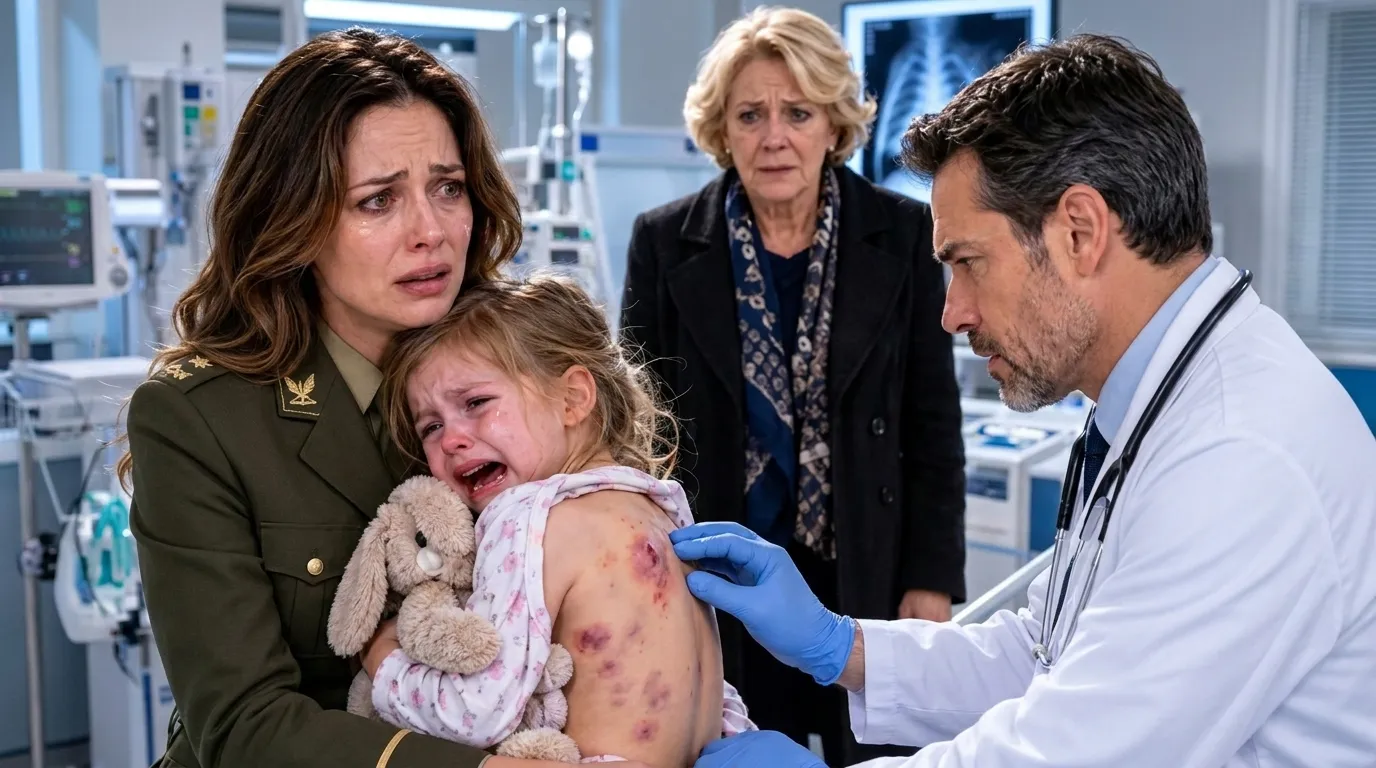
Dr. Hayes explained quietly that she had interfered with Chloe’s examination and tried to take my phone.
Gertrude straightened her coat.
“This is a misunderstanding.”
The officer asked her to step outside.
She looked at me as if I were supposed to object.
I held Chloe closer.
“No,” I said when Gertrude started toward us. “You don’t get to come near her.”
Her face tightened.
“Cassandra, think about what you’re doing to this family.”
I looked down at my daughter’s small hand, still tangled in my sweater.
“I am.”
The officer escorted her out.
When the door closed, Chloe lifted her head.
“Grandma gone?”
“Yes, sweetheart.”
“Coming back?”
“Not into this room.”
I could not promise that everything would be simple. I could not tell her yet what tomorrow would look like.
But I could promise that.
Dr. Hayes waited until she settled before speaking to me.
“We need to take care of the injury now. The police can speak with you while we arrange the next steps.”
I nodded.
My phone felt heavy in my hand.
I wanted to listen to every second of that recording. I wanted to know exactly what they had done.
But Chloe needed me to look at her, not at a screen.
I paused it.
The nurse helped us prepare for the X-ray. She explained each movement before making it and stopped whenever Chloe became frightened.
Nobody told my daughter she was being dramatic.
Nobody complained that she was taking too long.
When she cried, they listened.
That ordinary kindness nearly broke me.
The X-ray showed a thin metal object beneath Chloe’s right shoulder blade.
Dr. Hayes brought the image up and pointed without making me look longer than I could bear.
“It appears to be a fragment of a pin.”
I stared at the pale shape.
“A pin?”
“Yes.”
“How did it get there?”
He glanced at the phone in my hand.
“That will need to be investigated. Right now, she needs pain relief and a procedure to remove it safely.”
He explained that the surrounding area was inflamed and that the team would assess and treat the wound as well.
I listened carefully.
I asked him to repeat the parts I could not absorb.
Then I gave my consent.
Chloe was resting against me when she whispered, “Grandma said Daddy got the pins too.”
I looked down.
“What, sweetheart?”
Her eyelids were heavy.
“When he little.”
I did not ask her to explain more.
I had already heard enough to know that I must not turn her hospital bed into another place where adults demanded things from her.
“You haven’t done anything wrong,” I told her.
Her fingers moved against my sleeve.
“Not bad?”
“No. You are not bad.”
A few minutes later, my phone rang.
Christopher.
For one foolish second, I hoped he had finally understood that our daughter was seriously hurt.
I answered.
“What did you tell them?”
Not, How is Chloe?
Not, Where are you?
“What did you tell them?” he repeated.
I looked through the doorway toward the nurse.
“They found a metal object in her back.”
Silence.
“Christopher?”
“You need to calm down.”
“I am calm.”
“Mother called. She says you’re making accusations.”
“Chloe is being treated.”
“What exactly did you say to the doctor?”
I gripped the phone.
“What should I have said?”
“Don’t do this.”
“Do what?”
“Turn a family matter into something it isn’t.”
I closed my eyes.
There it was again.
The family.
Never the little girl.
Never her pain.
“The police are coming,” I said.
His breathing changed.
“Cassandra, listen to me.”
“No. You listen. Do not come near Chloe.”
I ended the call.
My hand shook afterward, but I did not call him back.
When the officers arrived, I gave them the account as clearly as I could.
The time Chloe woke.
What she said.
Christopher refusing to help.
Gertrude’s coat and keys.
The drive.
The bruises.
Her demand that I delete the recording.
One officer asked whether I would allow them to preserve the original file.
“Yes.”
I did not trim it. I did not forward a few dramatic seconds and leave the rest behind.
I gave them the entire recording.
While Chloe was being prepared for her procedure, I sat with an officer in a quiet space just outside her room.
For the first time, I watched the video as well as listening.
The night-light made everything look pale and unfamiliar.
But I knew the room.
I knew Chloe’s bed.
And I knew the small wooden box in Gertrude’s hands.
I had seen it before, years earlier, among things she kept out of sight. When I asked Christopher about it, he said he did not know what I meant.
Later, when I mentioned it again, he insisted there was no wooden box.
Eventually, I stopped asking.
Now it was on the screen.
Gertrude set it beside Chloe’s bed.
Christopher stood behind her.
Our daughter sat up, confused and sleepy.
“Grandma?”
Christopher moved closer.
“It’ll be over quickly.”
I pressed my free hand against my mouth.
The officer lowered the volume.
“You can step away.”
“No.”
I needed to know.
Gertrude opened the box.
I could see slender metal pins inside.
Chloe began backing away.
“No, Grandma.”
“You were told not to make a fuss,” Gertrude said.
Christopher glanced toward the bedroom door.
“Keep your voice down.”
“Then hold her still.”
I could not watch the next moments.
I turned my face away while the recording continued.
There was crying.
A sharp sound.
Then Christopher’s voice, suddenly different.
“Wait.”
Gertrude said something I could not understand.
“Mother, it broke.”
The officer stopped the playback.
I stared at the blank wall.
For several seconds, I could hear only the blood rushing in my ears.
The first lie was gone.
Chloe had not fallen in the yard.
She had not imagined anything in a dream.
And Christopher had not been an uninvolved father who misunderstood a cry in the night.
He had been there.
He had helped.
“Do you need a moment?” the officer asked.
I nodded.
I took one breath, then another.
When I was ready, the officer resumed the recording, keeping the screen turned slightly away from me.
Christopher sounded frightened now.
“We need to tell Cassandra.”
“No.”
“It’s still in there.”
“Keep your voice down.”
Chloe was crying softly.
I recognized that sound. I had heard it through the floor and mistaken it for a brief bedtime fuss, the kind Christopher sometimes settled while I finished chores.
That memory would stay with me for a long time.
On the recording, he spoke again.
“You can’t keep saying things will be all right.”
Gertrude answered sharply.
“You turned out perfectly well.”
“This isn’t the same.”
“It is exactly the same. You cried too.”
Chloe’s words returned to me.
Daddy got the pins too.
Then Christopher said something that changed the room around me.
“You said that about Dad.”
The officer looked up.
There was a pause on the recording.
A long one.
“Leave your father out of this,” Gertrude said.
“He asked to go to the hospital.”
My hand tightened around the edge of the chair.
Christopher’s father had died before I married into the family.
I had been told the story more than once.
He had died suddenly at home. By the time Gertrude and Christopher found him, there was nothing anyone could do.
It had always been presented as a sad, settled fact.
On the recording, Christopher’s voice became clearer.
“He was still talking. He asked us to call.”
“You know why I didn’t want strangers in the house.”
“And I listened to you.”
“You were there too.”
“I know.”
The words were so quiet that the officer replayed them.
“I know,” Christopher said again through the phone’s speaker.
Gertrude answered him.
“Then remember that before you tell your wife anything.”
I looked at the officer.
Neither of us spoke.
Christopher had spent years telling me his father was already beyond help when they discovered him.
Now I was listening to him admit that his father had asked for help—and that he and Gertrude had withheld it.
The recording could not tell us everything about that death.
It could not establish, by itself, whether a doctor could have saved him.
But it exposed the lie.
They had not found him too late to hear him.
They had heard him.
They had chosen silence.
On the recording, Chloe whimpered.
Christopher said, “What if she wakes up?”
“Then Cassandra will deal with it.”
“And if she sees?”
“I’ll take them,” Gertrude replied. “You stay here. Don’t make her think there’s anything to worry about.”
The officer stopped the recording.
I thought of the winter coat.
The keys.
The running engine outside the emergency center.
Gertrude had been ready because she had known there might be a crisis.
Christopher had stayed in bed because they had agreed he would.
I had begged him to be her father while he pretended not to understand what was happening.
The officer asked whether I had somewhere safe to go after Chloe was discharged.
I looked toward the room where the medical team was caring for her.
“Not that house,” I said.
I did not yet know where we would sleep.
But I knew where we would never sleep again.
The procedure took longer than I wanted and less time than I feared.
When Dr. Hayes returned, I stood so quickly that the chair scraped across the floor.
“She’s doing well,” he said.
Those were the first words that night that let me breathe properly.
The metal fragment had been removed. Chloe would need care for the injury, medication as prescribed, and follow-up examinations.
He explained what to watch for and what the next few days might involve.
I asked every question I could think of.
Then I asked whether I could see her.
She looked very small against the hospital bedding.
Her hair was tangled at one side, and her face was still damp where tears had dried.
I sat beside her and took her hand.
When she stirred, the first word she said was “Mommy.”
“I’m here.”
Her eyes opened a little.
“Home?”
I brushed a strand of hair away from her cheek.
“Not yet, sweetheart.”
“Grandma?”
“No.”
Her fingers loosened in mine.
Then she went back to sleep.
I stayed beside her while the morning light crept across the room.
Somewhere beyond those walls, Christopher’s presentation was due to begin.
For hours, he had treated it as the most important thing in the world.
Now police were speaking with him.
Gertrude was being questioned separately.
Hospital staff documented Chloe’s injuries. The removed metal fragment was preserved, and the officers arranged to collect the wooden box through the proper process.
I did not return home to look for it myself.
I did not warn Christopher where to search.
For once, there would be no quiet family conversation in which Gertrude decided what had happened and everyone else learned to repeat it.
Later that morning, Christopher came to the hospital.
He was not allowed into Chloe’s room.
I agreed to speak to him briefly in the corridor, with an officer nearby and a nurse staying with my daughter.
His shirt was wrinkled. He looked as though he had dressed in a hurry.
For a moment, seeing his familiar face hurt almost as much as hearing his voice on the recording.
This was the man who had held my hand when Chloe was born.
The man whose face she searched for when she learned a new word.
He took a step toward me.
I stepped back.
“Cassandra.”
“What?”
“I never wanted this.”
I looked at him.
“You held her still.”
He glanced toward the officer.
“Can we speak privately?”
“No.”
His face crumpled.
“My mother did it to me when I was little.”
“I know.”
“You don’t understand what she’s like.”
“I understand what she did to Chloe.”
“I froze.”
“You helped her.”
He began to cry.
I had seen Christopher cry only a handful of times.
Once, that would have made me reach for him.
Now all I could see was Chloe holding both hands over her back.
“I thought if I stayed calm, it would stop,” he said.
“You had hours to call for help.”
He lowered his head.
“You could have told me when I came upstairs. You could have told me when she woke. You could have come to the hospital.”
“I was afraid.”
“So was she.”
He looked toward Chloe’s door.
“Please let me see her.”
“No.”
“She’s my daughter.”
“And you were supposed to protect her.”
For a moment, he seemed about to argue.
Then he whispered, “What are you going to tell them about Dad?”
The question settled the last uncertainty in me.
Even now, he was measuring what I knew.
I answered him plainly.
“The truth.”
I went back into Chloe’s room.
That was the last conversation I had with him without legal arrangements in place.
There was no single dramatic morning when everything was resolved.
There were interviews.
Forms.
Medical appointments.
Days when I could answer questions steadily and nights when I shook so hard I could not hold a cup.
A hospital social worker helped me arrange a safe place for us to stay. Legal protection followed, and Christopher and Gertrude were barred from approaching Chloe while the case moved forward.
I filed for divorce.
I sought sole custody.
And I began learning how to tell my daughter the same simple truth in as many ways as she needed to hear it.
“You did nothing wrong.”
She did not believe it immediately.
Sometimes, when a nurse checked her healing back, she apologized.
Sometimes, if she spilled her milk, she put both hands behind her and stared at me.
The first time that happened, I had to turn toward the sink for a moment so she would not see my face collapse.
Then I came back with a cloth.
“It’s just milk,” I said.
She watched me wipe the table.
“Not mad?”
“No.”
“Not bad?”
“No, sweetheart.”
We cleaned it up together.
That was how much of our recovery happened.
Not in speeches.
In spilled milk.
In a doctor asking permission before touching her.
In choosing pajamas that did not rub against the healing area.
In learning that bedtime could end with a story instead of fear.
Chloe received help from a professional experienced in working with young children. I received help too.
For a long time, I kept returning to the same question.
How had I not seen it?
I could list all the ordinary explanations I had accepted: Christopher taking over bedtime, Gertrude offering to help, a tired child resisting a bath.
None of them made the guilt disappear.
But slowly, I learned to separate the things I wished I had noticed from the decisions they had deliberately hidden.
Their secrecy was not evidence that Chloe had failed to tell me.
It was not proof that I should spend the rest of my life punishing myself.
What mattered now was that she had spoken, and I had listened.
The criminal case did not depend on making a three-year-old explain everything perfectly.
There were the medical findings.
The X-ray.
The removed fragment.
The wooden box.
The original recording, with its time stamp and the voices I knew too well.
There were also their own accounts, which changed as they learned what had been preserved.
Gertrude first called it a misunderstanding.
Then she called it discipline.
Then she insisted that Christopher was as responsible as she was.
For once, she was not entirely wrong.
He had been harmed as a child.
That mattered.
It did not erase the harm he helped inflict as an adult.
Both were eventually convicted for their roles in what happened to Chloe.
Gertrude received a prison sentence. Christopher was also sentenced to prison for his participation.
The court did not accept that a family custom could excuse hurting a child.
I attended the sentencing without Chloe.
She was somewhere safe, spending an ordinary day that did not have to include either of them.
When I was given the chance to speak, I brought a short statement.
I had rewritten it many times.
In the end, I said the thing that mattered most.
“My daughter thought she would be punished for letting a doctor help her. That is what they taught her. Every day now, I am teaching her something different.”
Gertrude stared straight ahead.
Christopher cried.
I finished my statement and sat down.
I did not wait for either of them to give me the right expression.
Nothing they did in that room could become the center of Chloe’s recovery.
The recording also led investigators to examine the circumstances of Christopher’s father’s death.
They reviewed what remained available and questioned both of them about the account they had repeated for years.
There were limits to what could be established after so much time.
I had to accept that exposing a lie did not always mean every unanswered question could be settled.
But the false story was no longer being repeated without challenge.
Christopher acknowledged that his father had been alive and asking for medical help while he and Gertrude delayed calling.
I could not say what timely treatment might have changed.
I could say that he had deserved the chance.
Just as Chloe had.
The divorce was finalized.
I was granted sole custody, with protective restrictions governing any future contact.
I did not take Chloe back to the house for one last look.
She did not need a farewell tour of the place where she had learned to be afraid.
We moved into a smaller home.
There was no grand transformation waiting inside.
The kitchen drawer stuck. One bedroom wall needed repainting. The first few weeks, our belongings stayed in boxes longer than I intended.
But no one complained when Chloe woke at night.
No one told her to apologize for crying.
Her small wooden bed came with us only after she said she wanted it. We put fresh bedding on it, and she chose where her night-light would stand.
For a while, I slept nearby.
When she woke, I answered.
Every time.
Months later, on an evening that seemed ordinary until I remembered how far we had come, Chloe spilled a cup of water beside her bed.
She looked at the wet floor.
Then she looked at me.
I waited.
“Mommy,” she said, “we need a towel.”
No apology.
No hands pressed behind her back.
Just a little girl asking for help with a spill.
I went to get the towel.
We dried the floor together, and she climbed beneath her blanket while I picked up her bedtime book.
Halfway through the story, she leaned against my arm.
“Mommy?”
“Yes?”
“If something hurts, I tell you.”
I set the book down.
“Yes, sweetheart. You tell me.”
“And you come?”
I kissed the top of her head.
“I come.”
She considered that for a moment.
Then she settled against me again.
“Read the next page.”
So I did.
The End.
Latest Posts
- My Mother-in-Law Made My Baby Shower About Herself—Then My Husband Stood Up #2
I wanted a small baby shower, but my mother-in-law ignored nearly every request and turned the day into a celebration of becoming a grandmother. I kept swallowing my frustration for one deeply personal reason, until she crossed a line neither my husband nor I could ignore. I was seven months pregnant with our first child, …
- My Son Grew His Hair for His Best Friend’s Wig—Then Her Father Called Me to School
A 14-Year-Old Boy Grew Out His Hair to Make a Wig for a Classmate Who Lost Hers to Cancer – The Next Day, His Mother Was Called to the School, Where the Girl's Father Said, 'You Have No Idea What Your Son Did, Do You?' The gum stuck in my son’s hair nearly ended the …
- 80-Year-Old Woman Spent Seven Days Visiting an Old Friend…
80-Year-Old Woman Spent Seven Days Visiting an Old Friend – She Returned Looking Half Her Size with a Suitcase That Wasn't Hers I almost walked past my mother at the train station. She was standing beside a bench, gripping the handle of an enormous black suitcase. Her gray hair was flattened against her forehead, and …
- The Winning Ticket and the Life My Husband Hid
My Husband Was Lying in a Hospital Bed When I Won 100 Million Dollars, and Then I Heard Him Laughing to His Mistress That I Would Hand Him Every Penny If I Thought He Was Dying. I Hid the Ticket, Called a Lawyer, and Walked Away, Never Imagining That His Fake Illness Was Only the …
- My husband divorced me to marry my own mother. #2
My Husband Divorced Me to Marry My Own Mother My husband divorced me to marry my own mother. Everyone told me to move on, but instead… I showed up at their wedding. And when she said, “I do,” they had no idea what I had already done. When Mark left me, he didn’t even try …