Investigators found the camera mounted high on a storage shelf.
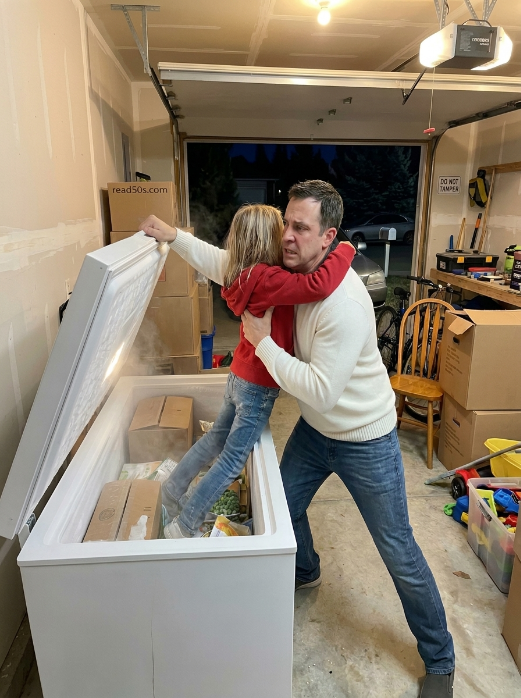
It pointed directly toward the chest freezer.
The footage was stored on a memory card.
I went with Lily to the hospital while officers secured the house and questioned Evelyn.
Doctors told me Lily’s body temperature was dangerously low.
But I had found her in time.
For several hours, I sat beside her bed while nurses slowly warmed her and monitored her heart.
She slept with my jacket folded beside her pillow.
I could not stop thinking about the camera.
Why would anyone need to record a child being punished?
Around midnight, Taylor arrived.
She rushed into the hospital.
“What happened?”
I stood between her and Lily’s bed.
“Your mother locked her inside a freezer.”
Taylor stopped.
And for half a second, something crossed her face.
Not surprise.
Fear.
I saw it.
“You knew.”
“No.”
“You knew something.”
Taylor looked toward Lily.
“My mother told me she used strict time-outs.”
“Inside a freezer?”
“I didn’t know that.”
I wanted to believe her.
Despite everything that had happened between us, I wanted to believe Lily’s mother could not have known.
Then investigators reviewed the recordings.
The footage covered nearly six weeks.
Evelyn had repeatedly placed Lily inside the freezer as punishment.
Sometimes only briefly.
Other times longer.
Lily cried.
Begged.
Promised to be good.
Evelyn stood nearby and watched.
And then investigators found the recording that destroyed every excuse Taylor had left.
Taylor entered the garage.
She looked toward the freezer.
Then asked:
“Did you put her in there again?”
Evelyn answered:
“She wouldn’t stop crying about wanting her father.”
Taylor rubbed her forehead.
Then said:
“Just don’t leave her too long.”
I watched the recording once.
I could not watch it again.
Taylor had known.
Maybe she had never physically put Lily inside herself.
Maybe the punishment had not been her idea.
But she knew.
And she allowed it to continue.
The next morning, Child Protective Services issued emergency restrictions preventing Taylor and Evelyn from having unsupervised contact with Lily.
My attorney immediately filed for a custody modification.
For the first time since the divorce, Lily came home with me.
I thought bringing her home would feel like victory.
It didn’t.
My daughter woke up crying whenever the furnace clicked on.
She refused to walk near the freezer in my apartment.
At bedtime, she asked:
“Was I good enough today?”
The first time she asked, I almost told her not to say things like that.
Then I realized she was not asking for reassurance about her behavior.
She was asking whether she had earned safety.
So every night, I gave her the same answer.
“You never have to earn the right to be safe.”
The criminal investigation continued for months.
Evelyn insisted she had never meant to seriously hurt Lily.
Her attorney described what happened as discipline that had gone too far.
The recordings told a different story.
They showed a frightened five-year-old begging to be released.
They showed Evelyn ignoring her.
They showed the punishment happening more than once.
And they showed Taylor knowing about it.
In family court, Taylor’s attorney argued that permanently removing Lily from her mother could create even more trauma.
My attorney responded by showing the garage footage.
The judge watched less than three minutes.
Then ordered a recess.
When court resumed, Taylor was crying.
I wasn’t.
By then, I had already cried enough in private.
The court granted me primary custody.
Taylor received professionally supervised visitation while she completed counseling, parenting programs, and the other requirements imposed by the court.
Evelyn was barred from contact with Lily.
She later accepted a plea agreement connected to child endangerment and unlawful restraint.
A court order required her to stay away from Lily.
Taylor was not accused of physically putting Lily inside the freezer.
But her failure to protect our daughter became central to the custody proceedings.
Eventually, during one supervised mediation session, Taylor finally admitted what the recordings had already shown me.
She had been afraid of her mother for most of her life.
Evelyn had controlled her emotionally and financially.
After the divorce, Taylor had become increasingly dependent on her for childcare and expenses.
Whenever Taylor objected to Evelyn’s treatment of Lily, Evelyn threatened to stop helping.
I listened.
I understood manipulation.
I understood fear.
But understanding was not the same as forgiveness.
“You were her mother,” I said.
Taylor covered her face.
“You were supposed to choose Lily.”
“I know.”
That was the only answer she had.