My Husband Divorced Me to Marry My Own Mother
My husband divorced me to marry my own mother. Everyone told me to move on, but instead… I showed up at their wedding.
And when she said, “I do,” they had no idea what I had already done.
When Mark left me, he didn’t even try to make it look complicated. There was no denial of an affair, no trembling speech about needing space, no tearful promise that he would always care about me.
He packed one suitcase, stood in the doorway of the house we had shared for eleven years, and said, “I’m done, Rachel.”
Then he walked out like he was late for dinner.
For two weeks, I lived inside a fog. I replayed every conversation, every silence, every cold glance over the last year, trying to find the exact place where my marriage had cracked open.
I blamed stress. I blamed grief. I blamed myself.
Then the truth arrived, and suddenly all those little broken pieces snapped into one hideous shape.
He wasn’t leaving me for some other woman.
He was leaving me for my mother.
Her name is Linda, and if you only met her once, you would probably call her elegant. She knew how to lower her voice just enough to sound gracious, how to tilt her head like she was listening, how to make a cruel sentence sound like concern.
People mistook that talent for warmth.
I used to mistake it for love.
After my father died, she leaned on Mark constantly for “help” and “support.” He fixed things around her house. He drove her to appointments she could have driven to herself. He stayed after family dinners to “make sure she was all right.”
I trusted both of them so completely that I never once considered what was happening right in front of me.
That trust cost me everything.
The divorce was fast in the way a knife is fast. Mark hired an aggressive lawyer who treated my life like a mess to be cataloged and used against me.
Linda sat in court and testified for him.
For him.
She said I was unstable, impulsive, emotionally exhausting. She said Mark had spent years trying to protect my peace.
I listened to my own mother describe me like a burden he had heroically survived.
By the time it was over, I had lost the house, most of my savings, and half the people I thought were my friends. Apparently, betrayal becomes easier for spectators when it dresses itself in polite language.
Then came the engagement announcement.
Public. Smiling photos. Champagne glasses.
My mother’s hand on my ex-husband’s chest as if it had always belonged there.
People flooded my phone with pity and advice.
“Move on.”
“Block them both.”
“Don’t let anger destroy you.”
But anger wasn’t what kept me awake.
It was betrayal.
Betrayal has a different temperature. It doesn’t burn hot and fast. It sits in your chest like ice and teaches you patience.
Their wedding was planned in a rush that felt almost desperate. Vineyard venue. White roses. Spring afternoon. Expensive photographer. Curated menu.
My mother even mailed me an invitation, because some people don’t just want to wound you—they want front-row seats to the pain.
Tucked inside was a handwritten note in her tidy script:
I hope one day you’ll understand love doesn’t follow rules.
I stared at that sentence for a very long time.
That was the moment something in me became perfectly still.
I wouldn’t scream. I wouldn’t beg. I wouldn’t send dramatic texts or warn their guests or throw wine in anyone’s face.
I would let them have their flowers, their vows, their little performance of destiny. I would sit there quietly and let them believe they had won.
And I would be there when everything they built began to crack.
Because while they were busy calling their betrayal a love story, I was doing something far more dangerous.
I was learning what my father had left behind.
My father had never trusted Linda the way the rest of the world did. As a teenager, I thought he was being harsh. As an adult, I realized he had simply been paying attention.
He used to joke that Linda loved security the way other people loved oxygen.
When he died, she took control of the house and the liquid accounts, and she behaved as if that meant she had inherited the whole world.
But my father had been careful.
The family business, the surrounding acreage, and several connected properties were held inside a revocable living trust so dense and technical that most people would never read past the first few pages.
I did.
Not alone.
During the months when everyone assumed I was falling apart, I was meeting with my father’s original estate attorney, a quiet, stone-faced man named Arthur Bell who remembered every line my father had ever signed.
Arthur didn’t offer sympathy.
He offered files. Old amendments. Witness statements. Trustee language. Handwritten notes in the margins.
Together we found the clause Linda had spent years not knowing existed.
It was buried deep, almost like a dare.
If Linda ever remarried, trusteeship transferred immediately and irrevocably to me.
Not eventually.
Not after review.
Immediately.
And once trusteeship transferred, control of the estate properties transferred with it.
I remember reading those lines once, then twice, then again, because I couldn’t quite feel the floor beneath me.
Linda thought she was untouchable. Mark thought he was stepping into money, land, and the kind of long-term security that erases every ugly thing a person has done.
Their lawyer thought the divorce had sealed every advantage in their favor.
None of them knew that the one event they were celebrating would trigger the very thing that destroyed them.
I kept quiet.
That was the hardest part.
I let them underestimate me. I let them call me broken.
While my mother picked floral arrangements and Mark practiced his vows, Arthur and I prepared every document that would become active the moment Linda said yes to her new life.
We verified the trust transfer.
We prepared notice on the house they thought they had taken from me forever.
We traced the debt on the vineyard hosting their reception, and three months before the ceremony, I acquired it through an anonymous LLC before anyone connected to them understood what was happening.
We reviewed Mark’s employment contract, too. The firm he bragged about working for was ultimately tied to my father’s holding company.
Once control shifted, so did my authority.
By the time the wedding day arrived, all that remained was timing.
So that morning, I dressed carefully.
Not in black. Not in anything theatrical.
Just calm, elegant, forgettable enough that people wouldn’t understand what they were looking at until it was too late.
I arrived early and took a seat in the back row. Guests whispered when they noticed me, but no one stopped me.
Curiosity can be just as rude as cruelty.
Then the music started.
Mark stood at the altar wearing the expression of a man who believed the universe had rewarded him for his choices.
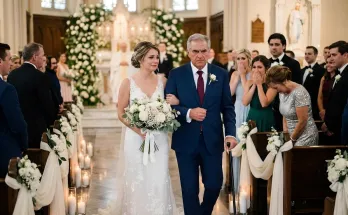
My mother walked toward him in white roses and satin, chin lifted, smile sharpened into victory.
When the officiant asked the final question, the vineyard went so quiet I could hear the breeze moving through the vines.
Linda smiled and said, “I do.”
And I smiled, too.
Because at that exact moment, the ground beneath both of them shifted, even if they were too in love with the spotlight to feel it yet.
The kiss was long, practiced, and perfectly angled for the photographers.
Guests applauded. Glasses clinked. Someone laughed too loudly.
Mark looked like a man who had won a prize. Linda looked like a woman who had stolen one.
They floated toward the reception pavilion with that smug, glowing energy people mistake for happiness.
I stayed behind for a beat, then followed just far enough to be seen.
Mark noticed me first. His face changed in a small, irritated way, like I had brought the wrong weather.
Linda turned, saw me, and arranged her features into that polished mask she wore whenever she wanted to appear generous in public.
“Rachel,” she said, loud enough for nearby guests to hear, “I’m glad you came. Maybe now you can finally see what real happiness looks like.”
I held her gaze.
“Oh, I can.”
Her smile tightened.
I added, “Actually, I brought you a wedding present. It’s waiting for you at the head table.”
For the first time all day, neither of them had an immediate reply.
I turned and walked away before they could find one.
Not toward the champagne. Not toward the dance floor.
Toward the parking lot.
I didn’t need to stand close enough to watch the impact. I only needed to know exactly when it landed.
Behind me, inside a room dressed in white roses and crystal, a thick manila envelope sat between a silver toaster and a vase tall enough to block half the room.
It didn’t look dramatic.
That was my favorite part.
Real consequences rarely announce themselves with fireworks. Sometimes they arrive looking like paperwork.
As I reached my car, I glanced back once.
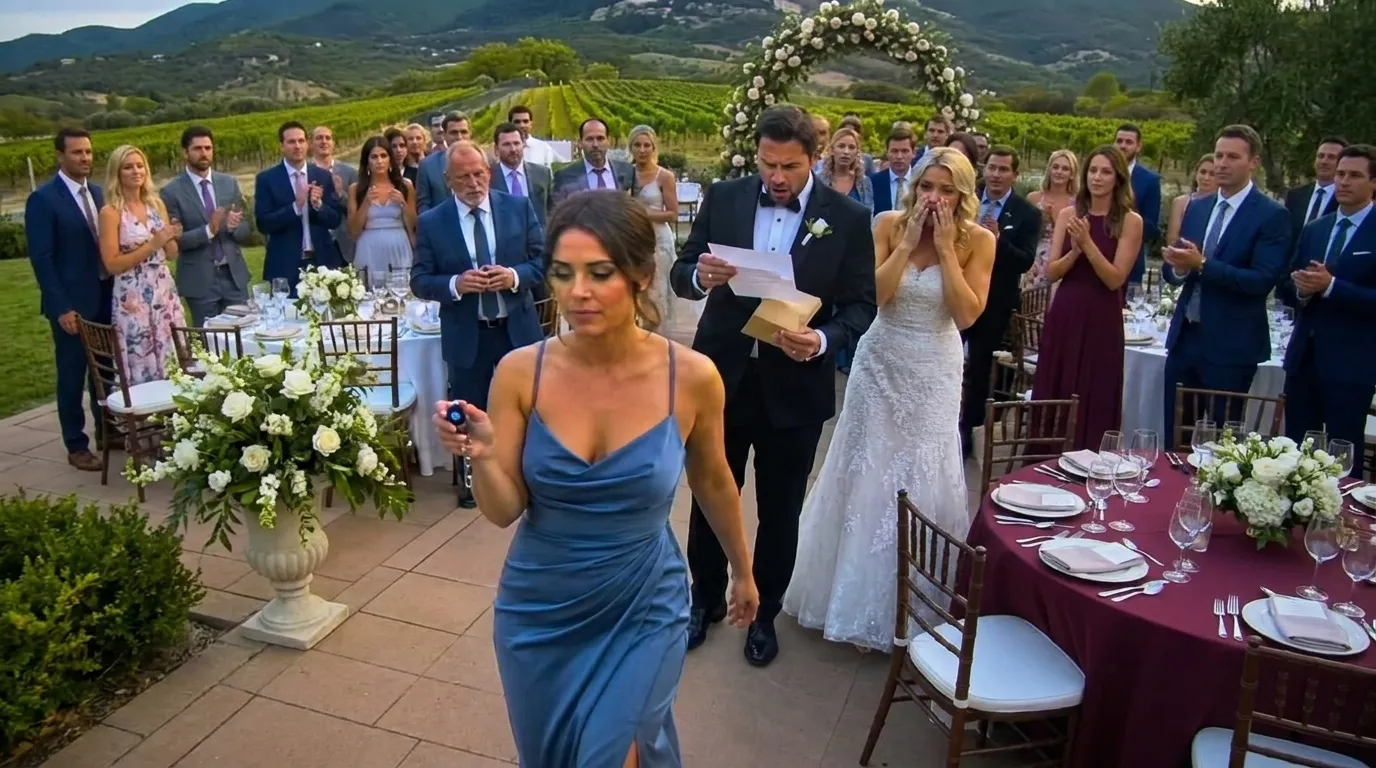
Mark had found the envelope.
Linda was leaning in beside him, still smiling for the benefit of the guests nearest the table, not yet understanding why his fingers had gone suddenly unsteady around the flap.
One page slid free.
Then another.
And as his eyes hit the first line of the document on top, the color drained from his face so fast that even from the parking lot, I could see it.
That was the moment the wedding actually began to end.
Because the first page was only the start.
When Linda took the second sheet from his hand, her hand froze in midair, suspended over the crystal and the white linen.
I unlocked my car, pulled the door shut, and settled into the quiet leather seat.
I didn’t turn the key.
I just watched through the clear expanse of the windshield, the glass framing the scene like a gallery painting titled The Price of Admission.
Mark had stopped pretending.
His shoulders, usually pulled square and rigid with that brand of suburban arrogance he wore like cologne, caved inward.
The document in his grip trembled hard enough to rustle.
The top sheet was the simplest of the bunch: a formal, notarized Notice of Immediate Trusteeship Transfer, bearing my late father’s original, elegant signature, Arthur Bell’s official wax seal, and the stamped certification of the probate court clerk.
Attached directly beneath it was a copy of the certified marriage register signed not twenty minutes earlier by their own officiant.
The condition precedent had been met.
The trigger had fired.
Linda tried to laugh. I could see the sharp, theatrical tilt of her head, the way her mouth opened to toss off some charming, dismissive remark to the bridesmaids hovering nearby.
But her gaze snagged on the second page.
It was the inventory.
Every parcel.
The historic homestead she had paraded around as her private kingdom.
The bank accounts she had quietly drained during the divorce to fund Mark’s new luxury SUV.
The commercial holdings along the valley floor.
Every single asset was legally tethered to the trust’s main account—an account that had, as of twelve minutes past four, been entirely frozen pending audit by the newly instated sole trustee: Rachel Vance.
Her mouth stayed open, but nothing came out.
The laughter died right behind her teeth.
Then came the third sheet.
I knew the exact moment Mark reached it, because he dropped the first two pages straight into Linda’s plate of cured duck and pomegranate reduction.
His head snapped toward the far side of the pavilion, toward the uniformed private security guards who had just quietly taken their posts at the pavilion exits and near the cellar entrance.
The vineyard hadn’t merely leased them space for the afternoon.
Three months earlier, through an LLC named Aegis Holdings, I had bought the mortgage note outright from an owner drowning in bad-harvest debt.
When Linda and Mark signed the contract for the reception, they signed a standard vendor agreement that included an explicit, non-negotiable indemnity clause regarding unencumbered funds.
The catering deposit had been drawn on a checking account linked directly to the trust.
An account that was now legally locked down.
The reception was operating on unauthorized, misappropriated funds, on private property whose landlord had not granted permission for the event to continue past sunset.
Inside the glass-walled pavilion, the music kept playing—some brassy, sweet jazz quartet Linda had hired to sound cultured.
But the dance floor was thinning.
Guests were beginning to whisper, their eyes darting toward the head table where the newly married couple had abruptly stopped looking at each other.
That was the most exquisite part: they weren’t looking at each other.
When a couple built on love faces a storm, they reach for each other’s hands.
When two predators realize they’ve walked into the same cage, they turn on each other.
Mark turned on Linda, his lips moving in rapid fury.
Even through the pavilion glass, the shape of his words was unmistakable.
What did you do? What is this?
Linda’s regal posture finally broke.
She grabbed at his sleeve, her manicured fingers digging into the expensive fabric of his rented tuxedo, her eyes wide and stripped of every polite grace she had ever cultivated.
For the first time in twenty years, she looked her age—shrunken, desperate, and bankrupt.
She had promised him an empire.
She had delivered him an eviction notice.
A server approached the head table, carrying a tray of champagne flutes topped with sparkling spun sugar.
Mark shoved the tray aside with a reckless jerk of his arm, sending three crystal glasses crashing onto the parquet floor.
The crash echoed through the microphone on the nearby podium, ringing out over the music.
The entire pavilion fell silent.
I reached forward, turned the ignition, and listened to the low, steady purr of the engine.
The air conditioning breathed cold across my wrists.
I didn’t feel triumph, not in the loud, messy way people write about it.
I felt empty, clean, and entirely whole—like a house that had survived a fire and finally cleared away the ashes.
Before shifting into reverse, I looked at my phone.
A single message had just come through from Arthur Bell:
Notices served on the residential property and the firm. Locksmiths arrive at seven. Have a peaceful evening, Rachel.
I let out a slow breath, slid the car into gear, and drove out past the rows of vines, leaving them standing in the wreckage of their perfect day.