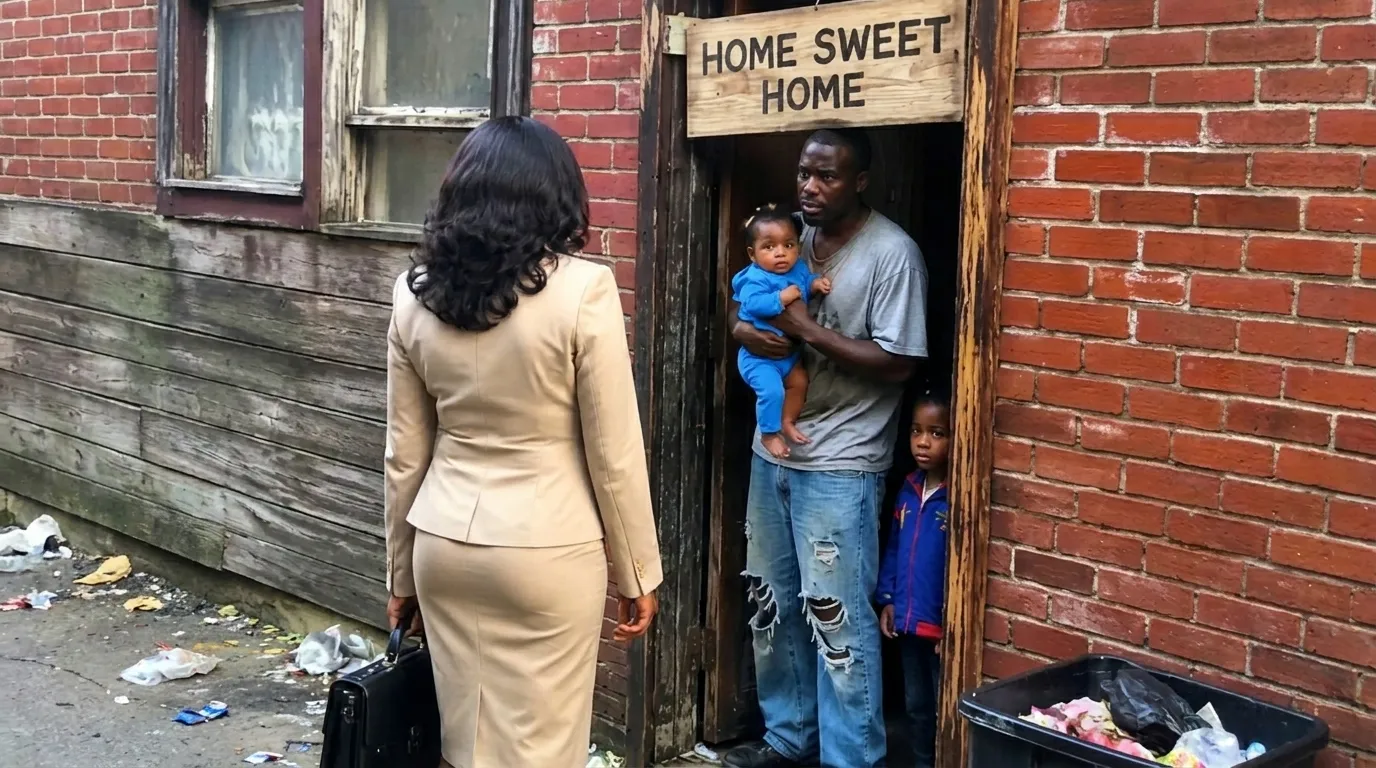
The first thing Laura Mendoza noticed inside Carlos Rodríguez’s house was not the sick woman, the crying baby, or the four children living in two cramped rooms.
It was the song.
The woman on the makeshift bed was barely conscious, her lips colorless and her breath coming in shallow pulls, yet she was humming to the boy beside her—a thin, wavering melody that slipped beneath the baby’s cries and reached straight into Laura’s chest.
Laura had not heard that lullaby in thirty-four years.
She had no memory of the face that once sang it. Only darkness, the warm pressure of arms around her, and four notes that had survived every polished corridor, every boarding school, every hostile negotiation, every night alone in a penthouse large enough to echo.
Her father used to say the melody was something Laura had invented after her mother died.
But the dying woman in Carlos’s house knew every note.
Laura tightened her grip on her purse.
“How long has this been going on?”
Carlos lowered his eyes.
At the office, he was always immaculate in his gray uniform, his name stitched neatly above his heart.
Here, an old T-shirt hung from his narrow shoulders, and dark circles beneath his eyes made him look decades older.
“The kidney failure began two years ago,” he said. “It became worse in March. She needs dialysis three times a week, but the public clinic lost one of its machines. Sometimes they turn us away.”
“And the children?”
The little girl holding Carlos’s leg stared at Laura’s pearls as if they were moons.
“Ours,” he answered.
Laura counted again.
The eight-year-old beside the bed.
A girl perhaps six.
A toddler behind the sofa.
The baby in Carlos’s arms.
“You never mentioned them.”
“You never asked.”
The words were not rude.
That somehow made them worse.
Laura looked around.
Rain stains spread across the ceiling. A cooking pot sat beneath a slow leak. Prescription bottles crowded a table beside a jar containing only a few coins.
Children’s drawings covered one wall.
A wooden cross hung beside them.
And there was a faded photograph turned partly toward the plaster.
Laura had come carrying a termination letter.
She had rehearsed the speech on the drive.
Standards.
Reliability.
Professional obligations.
Now every sentence sounded obscene.
“Why didn’t you request assistance from Human Resources?”
Carlos gave her a tired smile.
“I did.”
Laura looked sharply at him.
“Twice. The first request was marked incomplete. The second was denied because Elena is listed under a different surname on an old certificate.”
Elena.
The name landed strangely.
“Your wife’s name is Elena?”
The humming stopped.
The woman’s eyes opened.
Dark brown.
Clouded by pain.
They settled on Laura with an intensity that seemed impossible in such a fragile body.
Elena lifted one trembling hand.
“Lauri?” she whispered.
No one had called Laura that.
Not anyone living.
The baby began crying harder.
A truck rattled somewhere outside.
Laura stood rooted to the cracked floor while Elena stared at her as though a locked door had opened.
Carlos stepped between them.
“She has a fever. Sometimes she confuses people.”
“Who does she think I am?”
“Mrs. Mendoza—”
“Who does she think I am?”
Elena’s hand dropped.
Then she began coughing violently.
The eight-year-old cried out.
Carlos thrust the baby into Laura’s arms and bent over his wife.
“Elena. Look at me. Breathe slowly.”
The infant felt shockingly light.
Laura held her stiffly, terrified she might hurt the tiny body.
Elena’s breathing became desperate.
Laura’s business instincts returned before her emotions did.
“We’re taking her to a hospital.”
“The clinic won’t—”
“Not the clinic. San Gabriel Medical Center.”
Carlos’s face changed.
“We cannot afford that.”
“I can.”
“No.”
Laura stared at him.
Few employees had ever told her no.
“Your wife can barely breathe.”
“And I said no.”
His voice cracked.
“We do not want to owe the Mendoza family anything.”
That was not pride.
It was fear.
Elena suddenly seized Carlos’s wrist.
“The blue room,” she whispered. “He found the blue room.”
Carlos went pale.
“Enough, mi amor.”
Elena found Laura again with her eyes.
“Don’t let Rafael open the wall.”
Then she lost consciousness.
Laura called the ambulance.
At San Gabriel, money worked the way it always had for Laura.
Doors opened.
Forms disappeared.
Specialists arrived.
Within twenty minutes Elena was behind glass.
Within forty, a nephrologist had spoken of an acute crisis, infection, and immediate dialysis.
Laura signed the financial guarantee without looking at the total.
Carlos sat in the waiting room with the baby asleep against his chest.
The other children had been taken home by a neighbor, Doña Inés.
Laura stood at the window watching rain cover the city.
“Who is Rafael?”
Carlos said nothing.
“Carlos.”
He finally answered.
“Your uncle.”
Rafael Mendoza had been chairman of Mendoza Urban Holdings since Laura’s father died.
He had taught Laura to read a balance sheet at eleven, dismiss an incompetent manager at nineteen, and never apologize for winning.
He was seventy-one now, white-haired and elegant, with a voice journalists called reassuring.
“Why would your wife mention him?”
“She was delirious.”
“She called me Lauri.”
“Coincidence.”
“She knew my mother’s lullaby.”
Carlos’s thumb stopped moving across the baby’s knitted cap.
Laura sat opposite him.
“I came to your house to fire you.”
Carlos looked at her.
“I believed you were irresponsible, and I wanted the satisfaction of catching you in a lie.”
Her voice hardened.
“I was wrong. But if you lie now, I will find the truth without you.”
Carlos looked toward the intensive care doors.
“Some truths do not free people, Mrs. Mendoza. Some truths only tell you who built the cage.”
“Let me decide.”
For a long time, he said nothing.
Then he pulled a thin chain from beneath his shirt.
A small brass key hung from it.
“Your father’s house on Calle del Sol had a nursery on the second floor,” he said. “Pale blue walls. Painted birds near the ceiling. After your mother died, the room was sealed.”
Laura stopped breathing.
The old Mendoza house had stood empty for twelve years.
She had visited it only once since inheriting it.
The second-floor corridor ended at a plastered wall.
Rafael had told her an earthquake made the rooms beyond unsafe.
“How do you know that?”
Carlos looked at the key.
“Because I painted the birds.”
The intensive care doors opened.
A nurse announced that Elena was stable for now.
Then she asked about her legal name.
“The admission form says Elena Reyes, but an older document says Elena Valdés.”
Laura’s heart struck once.
Her mother’s name had been Elena Valdés de Mendoza.
The nurse walked away.
Carlos closed his eyes.
“Tell me.”
His shoulders sagged.
“The woman in that room is Elena Valdés.”
Laura heard the sentence without understanding it.
“There are thousands of women with that name.”
“Yes.”
“My mother died in a car fire when I was two.”
Carlos’s eyes filled.
“That is what Rafael wanted everyone to believe.”
The waiting room tilted.
“What are you saying?”
His answer came with thirty-four years of weight.
“I’m saying your mother is alive.”
Laura slapped him.
The sound cracked through the room.
The baby woke crying.
Carlos did not defend himself.
“You worked ten meters from my office for three years,” Laura said.
Her voice shook.
“You emptied my wastebasket. You saw photographs of my father. You heard people call my name. And all that time you knew?”
“Yes.”
“You let me believe she was dead.”
“She asked me to.”
Laura laughed bitterly.
“The sick wife of a poor employee suddenly becomes the long-lost mother of a millionaire. Convenient.”
Carlos flinched.
“That is why we never came.”
“Then why take a job in my building?”
He touched the key again.
“Three years ago, Rafael ordered the archives moved from the old house. Elena heard about it on television. That night, after twenty-nine years of refusing to speak your name, she told me something was hidden behind the nursery wall.”
“What?”
“Proof.”
“Of what?”
Carlos looked directly at her.
“That the Mendoza fortune began with graves.”
Laura stared at him.
Carlos explained that in 1991, Mendoza Construction had won a public contract to build Las Flores, six apartment buildings for low-income families.
Elena, then a twenty-four-year-old accountant, discovered Rafael had replaced specified steel and concrete with cheaper materials.
Inspection signatures had been purchased.
Millions disappeared through shell companies.
“My father ran the company,” Laura said.
“You are accusing him too.”
“Mateo discovered it after Elena did. He wanted to report Rafael.”
“You knew my father?”
Carlos’s expression became unreadable.
“I worked electrical crews at Las Flores.”
Two weeks before Elena planned to meet a prosecutor, one wing of Block C collapsed during a rainstorm.
Twenty-three people died.
The investigation blamed a landslide and a junior engineer who later disappeared.
Elena copied the original ledgers and inspection photographs.
She hid them in the nursery.
Then she tried to leave the city carrying two-year-old Laura.
“Her car went through the barrier at Kilometer Forty-Two,” Carlos said. “The police found one body burned beyond recognition.”
“My mother.”
“The nanny.”
Laura remembered a name from the prayers her father said every year.
Amalia.
“Amalia was driving. Elena sat in the back with you. A truck struck the car on the mountain road. Amalia died. Elena was thrown down an embankment. A farmer found her hours later, delirious and bleeding.”
“What happened to me?”
“Mateo had you.”
“Why didn’t she come back?”
“She did.”
Carlos’s voice hardened.
“Three months later she returned on crutches. Rafael met her outside the old house. He showed her photographs of you sleeping and a police statement naming her responsible for the Las Flores deaths.”
Laura’s stomach tightened.
“He told her that if she appeared again, you would disappear the same way the engineer had.”
“My father would have protected her.”
“She tried to reach him. Every letter came back. Every call was intercepted.”
“You expect me to believe Rafael controlled everything?”
“No.”
Carlos reached into his pocket and placed a plastic-wrapped photograph on the table.
“I expect you to test her DNA.”
The picture showed a young woman beneath a jacaranda tree.
She wore a white dress and had a crescent-shaped birthmark beneath her left collarbone.
Laura had the same mark.
The woman held a dark-haired toddler wearing a silver bracelet.
On the back someone had written:
My brave little Lauri, seventeen days before the road took everything.
Laura’s hands trembled.
“Where did this come from?”
“Elena had sewn it inside her coat.”
“And the children?”
“Foster children. All four lost parents or relatives in buildings owned by companies connected to Mendoza Urban. Elena could not save the families at Las Flores. When she became stronger, she spent her life helping whoever reached her door.”
Laura looked at the sleeping baby.
“She called the boy her son.”
“To her, blood has never been what makes a family.”
The doors opened.
The doctor said Elena was awake.
Only one visitor could enter.
Carlos looked at Laura.
“Go.”
“Why me?”
“Because she has waited thirty-four years.”
Elena looked tiny beneath the hospital blankets.
Laura approached slowly.
“Are you my mother?”
Elena studied her.
“You lift your left eyebrow when you are frightened,” she whispered. “Mateo did that.”
“Answer me.”
“Yes.”
Laura wanted recognition.
What she felt was rage.
“You abandoned me.”
Elena’s eyes filled.
“Every morning.”
“That makes no sense.”
“Every morning I woke and abandoned you again because staying away was the only way I knew to keep you alive.”
“You could have found another way.”
“I was twenty-four. Injured. Rafael had police, judges, doctors. Your father stopped answering me. I believed he chose the company over me.”
“He mourned you until he died.”
Pain crossed Elena’s face.
“Then Rafael lied to both of us.”
Laura turned toward the window.
Outside, Carlos paced with the baby.
A hospital cleaner moved silently down the corridor with a mop.
“Why now?”
“Because Rafael is building Aurora Heights.”
The project was Laura’s greatest achievement.
Twelve luxury towers.
A hotel.
A private medical complex.
Nearly nine hundred million dollars already committed.
Groundbreaking was Monday.
“What does Aurora Heights have to do with you?”
“He needs San Miguel cleared for the access road.”
Laura remembered the acquisition maps.
Numbers.
Percentages.
Compensation reserves.
No names.
No faces.
“The city approved the purchases.”
“The city approved notices sent to people who do not own computers, written in legal language, giving them ten days to challenge deeds older than they are.”
Elena coughed.
“House 847 sits above the old Las Flores evidence tunnel.”
Laura stared.
“Carlos said the evidence was in the nursery.”
“It was. Mateo moved it after the crash.”
Elena told her about a coded newspaper notice Mateo had left years later.
The birds have flown home to the orange trees.
Los Naranjos.
“Why didn’t you retrieve it?”
“I did not know which house until last month.”
Laura understood Carlos’s absences.
Court records.
Dialysis.
Searching beneath a house scheduled for demolition.
Elena squeezed her hand.
“Rafael knows Carlos found the blue room. That is why your Human Resources department suddenly began documenting his absences.”
“Rafael doesn’t manage custodial attendance.”
“Men like Rafael do not clean floors either.”
Elena’s eyes sharpened.
“But they always know what has been swept away.”
By midnight, Laura was back in the glass tower.
Aurora Heights glowed across a presentation screen.
Golden towers.
Blue pools.
Perfect landscaping.
No muddy roads.
No leaking houses.
No children.
Patricia stood beside her desk.
“I pulled Carlos’s HR file. His assistance requests never reached the benefits committee.”
“Who rejected them?”
“Both were rerouted through Executive Compliance.”
“Rafael’s office.”
Patricia nodded.
“There’s more. Eleven San Miguel residents have worked in this building during the last five years. Nine were dismissed for attendance violations after contesting their property valuations.”
Laura recognized none of their names.
“How did I not know?”
Patricia hesitated.
“The reports said ‘staffing adjustments.’ You approved them in batches.”
Laura remembered clicking approval buttons between international meetings.
People delivered.
Or they left.
She had believed efficiency made her strong.
Now she saw how efficiently suffering could be hidden.
“Find everything about Las Flores. Original reports. Insurance records. Board minutes. Nothing summarized.”
Patricia stayed still.
“What?”
“Three weeks ago, Rafael asked me to notify him if Carlos missed another shift.”
Laura looked up.
“I did.”
“What happened this morning?”
“After I gave you Carlos’s address, Rafael’s office called. They wanted to know whether you were going there.”
“What did you tell them?”
“The truth.”
Laura turned toward the city.
“Did he say why?”
“He said Carlos had stolen company documents.”
At that moment, every light in the office went out.
The screen died.
The emergency lights did not activate.
Footsteps sounded beyond the door.
Laura pressed the silent security alarm.
Nothing.
The door opened.
Rafael Mendoza entered carrying his silver-topped cane.
The corridor behind him remained brightly lit.
“Working late?”
Patricia moved closer to Laura.
Rafael smiled.
“Leave us, Patricia.”
“She stays.”
His gaze fell on the photograph beside Laura’s keyboard.
The photograph of Elena and toddler Laura.
For the first time, fear appeared in his eyes.
“You recognize her?” Laura asked.
Rafael recovered quickly.
“Of course. Your mother.”
“You told me there were no photographs from before the accident.”
“Most were destroyed.”
“Was she?”
Silence.
Rafael moved toward the window.
“Carlos Rodríguez is not what he appears to be.”
“Neither are you.”
“I built this company after your father lost himself in grief. I protected you from creditors, scandal, and people who saw an orphan as an open vault.”
He turned toward her.
“If Carlos found Elena, he has filled her head with fantasies.”
Laura felt Patricia stiffen.
“You know she is alive.”
Rafael realized his mistake too late.
Laura’s phone beneath a folder was recording.
“I knew she survived the crash,” he said carefully. “I also knew she was unstable. Mateo agreed you were safer without her.”
“Show me his agreement.”
“It was thirty-four years ago.”
“Tell me about Las Flores.”
Rafael’s expression hardened.
“Old concrete. Old ghosts. Neither can hurt you unless you insist on standing beneath them.”
“Is that a threat?”
“It is advice. Aurora Heights closes Monday. After that you control the largest real-estate group in the country.”
He stepped closer.
“Do not throw away your future because a cleaner showed you a sad room.”
The contempt in his voice clarified something painful.
Laura had spent her entire adult life learning to sound like him.
“Get out.”
“You do not dismiss me.”
“From my office, I do.”
“Your office exists because I allowed it.”
He left.
The lights returned before his elevator closed.
Patricia exhaled.
“Did you get it?”
Laura lifted the phone.
The recording was still running.
“Every word.”
Then her screen lit.
Doña Inés.
House 847 was on fire.
Laura drove through red lights.
Flames had already consumed the roof when she reached Los Naranjos Street.
Neighbors formed a bucket line.
Doña Inés stood barefoot with the children around her.
“Where is Carlos?”
She pointed at the burning house.
Laura ran toward it.
Patricia caught her arm.
“You can’t go in there.”
A window exploded outward.
Then a figure staggered through the doorway.
Carlos.
He carried a rusted metal box against his chest.
Laura and two neighbors caught him as he fell.
His eyebrows were singed.
One arm was blistered.
Blood ran from above his eye.
Yet he would not release the box.
“The children?” he coughed.
“Safe,” Doña Inés cried.
Only then did his arms loosen.
Laura touched the lid of the box.
A faded blue bird had been painted on it.
“You found the room.”
Carlos nodded.
“Under the kitchen floor.”
Patricia looked toward the burning house.
“How did the fire start?”
“I smelled gasoline.”
Sirens approached.
Paramedics lifted Carlos.
At the far end of the street, a dark sedan pulled away without headlights.
Laura caught three digits of its plate.
They matched a vehicle assigned to Mendoza Executive Security.
Something cold replaced fear.
Rafael had mistaken ignorance for loyalty.
Carlos’s poverty for weakness.
And silence for surrender.
By dawn, investigators found accelerant.
The metal box survived.
Inside were old ledgers.
Inspection photographs.
Cassette recordings.
Notarized statements.
And a sealed envelope addressed to Laura in Mateo Mendoza’s handwriting.
She knew the writing immediately.
Her father had signed every birthday card:
For the bravest person I know.
Laura reached for the envelope.
Carlos, breathing oxygen on the ambulance step, stopped her.
“Not yet.”
“You have kept enough from me.”
“The company’s crimes belong in daylight. That letter belongs to you alone.”
“And you think you can decide when I read my father’s final letter?”
Pain crossed his face.
“No.”
He lowered his eyes.
“I lost that right a long time ago.”
Before Laura could ask what that meant, the ambulance doors closed.
She stood holding the letter while House 847 collapsed inward.
Lucía slipped her hand into Laura’s.
“Are we homeless?”
Yesterday, Laura would have called an assistant and booked a hotel.
Problem solved.
Instead, she knelt.
“No.”
Lucía looked doubtful.
Laura pointed toward the neighbors gathered in rain and smoke, holding blankets, bread, bottles, and one another.
“A home is people who do not leave when the roof is gone.”
Lucía leaned against her.
For the first time, Laura understood that money could buy shelter instantly.
It could not buy the reason anyone chose to stay.