I wasn’t supposed to be home until Friday.
My business trip had been scheduled for four days, and I had planned to use the last afternoon to finish a presentation before catching my flight home.
Instead, I finished early, changed my ticket, and walked through my front door with a small suitcase in one hand.
I expected to find the house empty.
I expected to hear the television or the twins arguing over what to watch.
I didn’t expect to hear water running in the bathroom.
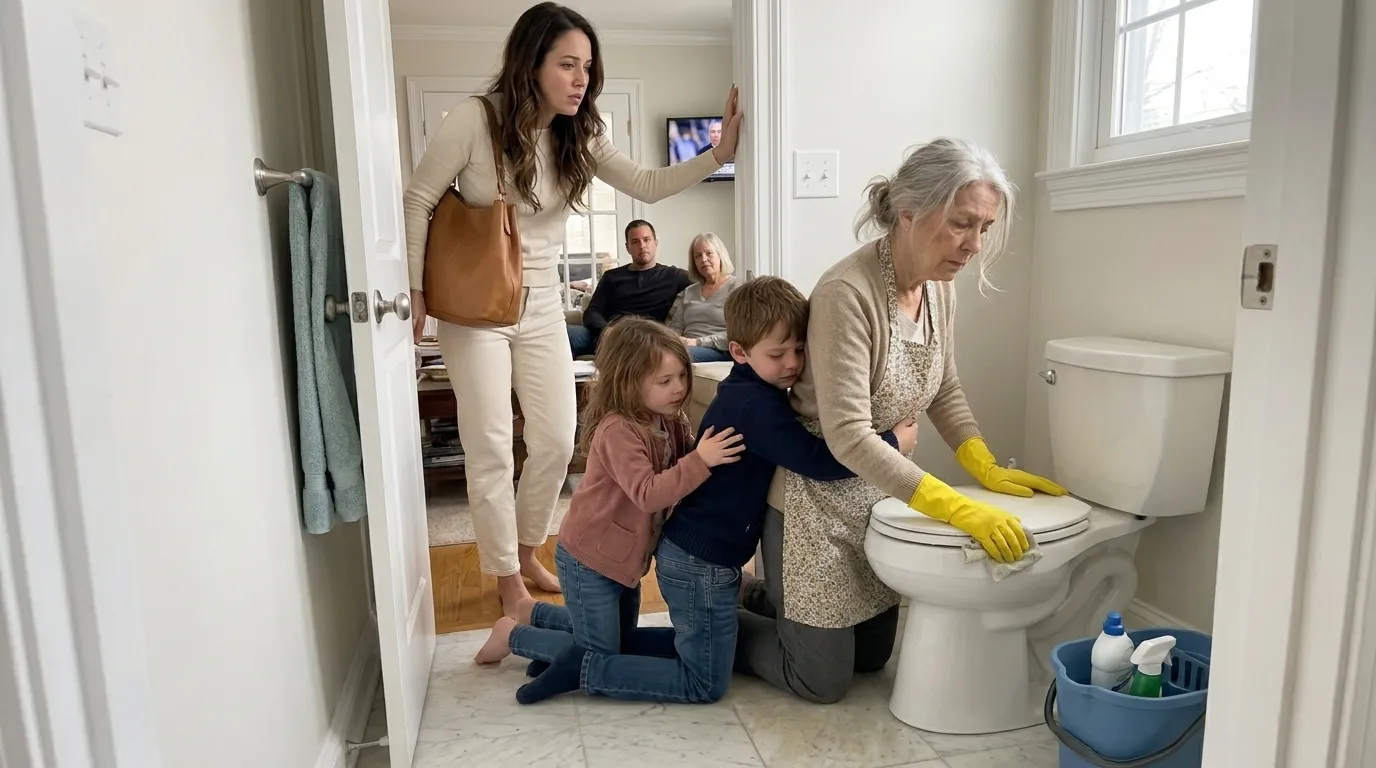
And I certainly didn’t expect to find my 68-year-old mother kneeling on the floor.
She was holding a cleaning cloth in one hand and steadying herself against the vanity with the other.
Her cardigan was damp at the sleeves.
A bottle of bathroom cleaner sat beside her knee, and there was a wet towel near the bathtub.
For a moment, I couldn’t understand what I was seeing.
Then I noticed the bruise around her wrist.
“Mom?”
She turned so quickly that the cloth slipped from her fingers.
“Daniela. You’re home early.”
I put my suitcase down.
“What are you doing?”
“Just cleaning up.”
“Why are you on the floor?”
She reached for the cloth again, almost automatically.
“It’s all right. I was nearly finished.”
I stepped forward and picked it up before she could.
Behind her, the bathroom door opened wider.
Marcus stood there.
My husband looked at me, then at the cleaning supplies, then back at me.
“Daniela, don’t turn this into a big drama.”
I remembered those words because he said them so casually.
Not as a question.
Not as an explanation.
As if the problem was already settled, and my only responsibility was to accept it.
I looked down at my mother’s wrist.
“What happened?”
Marcus folded his arms.
“Patricia had an accident. Your mother offered to help.”
“An accident?”
“She spilled something.”
“And that means my mother has to scrub the bathroom?”
“She said she didn’t mind.”
I turned toward my mother.
“Did you say you didn’t mind?”
She lowered her eyes.
That was when I felt something shift inside me.
My mother had never been someone who enjoyed confrontation. She was the kind of woman who apologized when someone else bumped into her at the grocery store.
She had spent most of her life making sure everyone else was comfortable.
But I had never seen her look this uncomfortable in her own home.
“Mom, stand up,” I said.
She tried to push herself up, but her knee seemed stiff.
I put one arm around her and helped her to her feet.
She leaned on me for a second longer than I expected.
I looked at Marcus again.
“Where’s Patricia?”
“In the living room.”
“Did she hurt Mom?”
His expression changed.
“Don’t start accusing people.”
“I asked you a question.”
“And I told you what happened.”
He walked past me, muttering that I had just returned from traveling and was probably tired.
My mother touched my sleeve.
“Please, sweetheart. Don’t argue.”
I looked at her.
“Why are you asking me not to argue?”
She shook her head.
“It’s nothing.”
But it wasn’t nothing.
The bruise was there.
The wet clothes were there.
The cleaning supplies were there.
And my mother had been kneeling on the floor when I walked in.
I helped her into the bedroom and found her a dry sweater.
She kept insisting that she was fine.
I kept asking what had happened.
Eventually, she told me that Patricia had complained about the bathroom floor.
Then she said Patricia had told her she was too slow.
Then she stopped talking.
I waited.
“Mom, what happened to your wrist?”
She pulled her sleeve down.
“I caught it on something.”
“What?”
“I don’t remember.”
She was looking at the carpet now.
I sat beside her.
“I’m not angry with you.”
“I know.”
“You can tell me.”
She pressed her lips together.
Then she whispered, “Please don’t make things worse.”
I couldn’t stop thinking about that sentence.
It was the kind of thing someone said when they believed telling the truth would bring consequences.
And I suddenly wondered how many times she had swallowed her words while I was away.
For weeks, Marcus had told me everything was fine.
He said my mother liked having company.
He said Patricia needed help with a few things.
He said the twins were doing well.
Whenever I called, he made the house sound ordinary.
Sometimes I spoke to my mother, but she always sounded tired.
I had assumed it was because she was getting older.
Now I wondered whether I had mistaken fear for exhaustion.
I went back downstairs.
Patricia was sitting in the living room with a cup of coffee.
She was dressed neatly, her hair in place, and she looked completely comfortable.
When she saw me, she gave me a small smile.
“Well, look who’s home.”
I didn’t return it.
“Why was my mother cleaning the bathroom?”
Patricia set down her cup.
“Oh, for heaven’s sake. It was a little spill.”
“Then why was she on her knees?”
“Because she was cleaning.”
“She has a bad knee.”
Patricia shrugged.
“She said she could manage.”
I looked toward Marcus.
He was standing near the hallway.
He didn’t say anything.
That silence told me more than his explanation had.
I asked Patricia whether she had grabbed my mother’s wrist.
Her expression hardened.
“Watch how you speak to me.”
“Did you grab her?”
“You’re making an accusation you can’t prove.”
I took a breath.
“I can see the bruise.”
Patricia gave a short, humorless laugh.
“People bruise as they get older.”
I looked at her for several seconds.
Then I turned away.
I knew that if I kept standing there, I would say something that wouldn’t help my mother or the children.
I went upstairs to check on the twins.
Leo and Maya were in their room, sitting on the floor with a board game between them.
They both looked up when I came in.
“Mom!”
They ran to me.
I hugged them tightly.
“Did you have a good day?”
They nodded, but neither one seemed eager to talk.
Maya glanced toward the hallway.
“Is Grandma okay?”
I pulled back.
“Why do you ask?”
She looked at Leo.
He shrugged.
“Grandma was crying yesterday,” he said.
My stomach tightened.
“Did you see what happened?”
“We heard Grandma and Grandma Patricia talking,” Maya answered.
“Did you hear what they said?”
Maya shook her head.
“Grandma told us to go upstairs.”
I hugged them again.
I didn’t want them to feel responsible for something they hadn’t caused.
I didn’t want them to think that adults being angry was their fault.
And I didn’t want them growing up believing that keeping the peace meant accepting cruelty.
That evening, I called my mother into the kitchen.
I asked her to tell me honestly whether she felt safe in the house.
She looked toward the living room before answering.
“I don’t want to cause trouble between you and Marcus.”
“That’s not what I asked.”
She rubbed her hands together.
For a long moment, she said nothing.
Then she admitted that Patricia had been ordering her around for weeks.
Small things at first.
Bring this.
Clean that.
Move something.
Do it again because it wasn’t done correctly.
My mother said she tried to avoid arguments because she didn’t want Marcus to become upset.
I asked whether Marcus knew.
She nodded.
“He said I should be patient.”
I felt sick.
“Did he see the bruise?”
“He was there.”
“And he did nothing?”
My mother looked down.
“He said I shouldn’t make a scene.”
I closed my eyes.
The words sounded familiar.
Almost identical to what he had said when I came home.
I had spent years thinking that Marcus was a reasonable man who disliked conflict.
Now I was beginning to understand that his version of peace depended on everyone else staying quiet.
Later that night, I went to our bedroom.
Marcus was sitting on the edge of the bed, scrolling through his phone.
He didn’t look up.
“You embarrassed me downstairs.”
I set my bag on the chair.
“Your mother embarrassed herself.”
“That’s my mother.”
“And mine is 68 years old. She shouldn’t be cleaning up after her.”
“She offered.”
“Stop saying that.”
He finally looked at me.
“What do you want me to do? Apologize for something that didn’t happen?”
“I want you to tell me why you let her treat my mother that way.”
He shook his head.
“You’re making this bigger than it is.”
I stared at him.
“Would you say that if someone treated your mother like that?”
He didn’t answer.
Instead, he started talking about how difficult things had been while I was away.
He said Patricia had been under stress.
He said my mother was sensitive.
He said I had walked into the middle of a situation without understanding it.
Every explanation placed the responsibility somewhere else.
None of them explained the bruise.
Then he said something I hadn’t expected.
“Maybe you should think about what happens if you keep acting like this.”
I looked at him.
“What does that mean?”
He shrugged.
“Marriage isn’t just about what you want. We have children. We have a life here.”
It sounded like a warning.
I didn’t respond.
I walked out of the bedroom and checked on the twins again.
I stayed beside them until they fell asleep.
After that, I sat at the kitchen table with my mother’s hand resting in mine.
I thought about my father.
He had been gone for years, but there were things about him I still remembered clearly.
He was careful with money.
He kept every important document.
He fixed things instead of replacing them.
And he had a habit of preparing for problems before anyone else realized there might be one.
When I was younger, he had shown me my mother’s old sewing machine.
He pointed to the wooden base and told me that there was a hidden compartment inside it.
I had laughed because I couldn’t imagine why anyone would hide something in a sewing machine.
He hadn’t laughed.
“If anyone ever makes your mother feel unsafe, Daniela,” he had told me, “look inside that machine. There’s something you need to know.”
I asked him what he meant.
He only said, “You’ll understand if the day comes.”
I had never forgotten the conversation.
I just never thought I would need it.
The next morning, I began packing.
I didn’t announce what I was doing.
I put clothes for the twins into two bags.
I gathered their school things, medications, favorite blankets, and the small items they would miss if they had to leave quickly.
My mother watched me from the bedroom doorway.
“Where are we going?”
“Somewhere safe.”
“Daniela, don’t do anything because of me.”
I stopped folding a sweater.
“I’m doing this because of what happened. And because I don’t want the children thinking this is normal.”
She looked as though she wanted to argue.
Then she sat on the bed and began helping me fold.
Marcus found us before lunch.
He stood in the doorway, staring at the bags.
“What are you doing?”
“Taking the children and Mom somewhere else.”
“You can’t just leave.”
“I can.”
He stepped farther into the room.
“Where are you going?”
I didn’t answer.
He looked at my mother.
“This is ridiculous. You’re letting her turn you against your family.”
My mother flinched.
I moved between them.
“Don’t speak to her like that.”
He raised his hands.
“See? This is exactly what I’m talking about.”
Then Patricia appeared behind him.
She looked at the bags and immediately began talking about divorce.
She said Marcus could take the children.
She said I was unstable.
She said leaving the house would make me look like I was abandoning my family.
I listened until she mentioned custody.
Then I picked up my keys.
“You don’t get to threaten me with my children.”
Marcus stepped into the hallway.
“Daniela, think carefully.”
“I have.”
I took the twins downstairs.
My mother followed with her purse and coat.
Nobody stopped us.
The drive wasn’t long.
I went to the adjoining duplex unit, a property I had heard about for years but had never entered.
People had told me it was tied up in foreclosure.
The property had been purchased through a private family trust my father created, and the ownership had been kept separate from our everyday household affairs.
I knew very little about the details.
I only knew my father had insisted that the property remain available.
When I reached the front door, I found the key on my ring.
It turned easily.
The house was quiet.
There was dust on the window ledges, but the furniture was covered and the rooms were intact.
The twins stayed close to me as I checked the downstairs.
My mother stood in the entryway, looking around as if she recognized something.
“Your father used to come here,” she said.
“How often?”
“Sometimes when he had things to take care of.”
I asked what things.
She shook her head.
“I don’t know all of it.”
I took the children into the front room and made sure they had somewhere to sit.
Then I checked the kitchen.
The electricity worked.
The refrigerator was empty, but the appliances were in place.
The house wasn’t luxurious.
It was simply a place where no one could order my mother to kneel on the floor.
That was enough for the moment.
I called a trusted friend to help me get groceries and a few necessities.
I also sent Marcus a short message telling him that the children were safe and that I would discuss arrangements when everyone had calmed down.
He called immediately.
I didn’t answer.
His next message said I was overreacting.
Then he said I was making a mistake.
Then Patricia called.
I let that one go to voicemail too.
For the first time in a long while, I didn’t feel obligated to respond to every demand the moment it arrived.
A little later, there was a knock at the front door.
I looked through the window.
Patricia was standing on the porch.
Marcus was behind her.
I opened the door but kept my body in the doorway.
“What are you doing here?”
Marcus looked past me.
“We need to talk.”
“Not in front of the children.”
“Then let us inside.”
“No.”
Patricia pushed a hand against the door.
“This is family business.”
I didn’t move.
“Then you should have treated my mother like family.”
Her face tightened.
Marcus lowered his voice.
“Daniela, this is getting out of hand.”
I looked at him.
“You keep saying that. You haven’t once asked whether my mother is hurt.”
He glanced away.
Patricia tried to step around him.
Then she saw the inside of the house.
Her eyes moved across the front room, the hallway, and the old wooden trim.
Finally, she looked toward the basement door.
She stopped.
It was such a sudden change that even Marcus noticed.
“What?” he asked her.
Patricia didn’t answer.
She stared at the basement door.
Her lips parted slightly.
Then she whispered, “I thought he had gotten rid of it.”
I turned toward my mother.
Her hand closed around mine.
“Daniela,” she said quietly, “don’t let her go down there.”
I looked from my mother to Patricia.
“What is in the basement?”
Patricia shook her head.
“Nothing that concerns you.”
My mother took a breath.
“That’s not true.”
The room went still.
Patricia looked at her.
For the first time, I saw something other than irritation in her expression.
I saw fear.
I asked my mother what she knew.
She told me my father had bought the duplex long before anyone mentioned foreclosure.
He had kept it in the family trust because he wanted a place that couldn’t be taken away if the family situation changed.
He had also kept records there.
Not ordinary household papers.
Records he believed might someday be important.
I remembered the sewing machine.
My father’s warning.
The compartment.
That night, after the twins had eaten and settled into the front room, I brought the old sewing machine into the kitchen.
It had belonged to my mother for decades.
The wooden case was scratched, and one corner had been repaired with a small metal bracket.
I turned it over and examined the base.
At first, I saw nothing unusual.
Then I noticed a narrow seam beneath the wood.
I found a small screwdriver in the kitchen drawer.
The panel didn’t move immediately.
I worked carefully, trying not to damage the old machine.
Finally, it shifted.
Inside was a folded envelope.
My name was written across the front in my father’s handwriting.
Beneath it lay a small key.
My mother covered her mouth.
I sat down.
I hadn’t seen my father’s handwriting in years.
For a moment, I couldn’t bring myself to open the envelope.
Then I unfolded the letter.
He wrote that the duplex had never been intended as an investment.
It was meant to be a place my mother could go if she ever needed to leave a situation where she wasn’t safe.
He wrote that he had made arrangements to keep the property paid for and protected through the trust.
He also wrote that there were records in the basement.
He didn’t explain everything.
He simply said that if I ever found myself holding that letter, I should use the key and look carefully.
My mother was crying quietly.
I put my arm around her.
“Why didn’t you tell me?”
She shook her head.
“Your father asked me not to say anything unless it became necessary.”
I looked at the key.
Then I looked toward the basement.
The next morning, Patricia returned.
This time, Marcus wasn’t with her.
She stood on the porch and asked to speak to my mother.
I told her that my mother could decide for herself.
My mother stepped into the doorway but didn’t leave the house.
Patricia looked at her for a long moment.
Then she said, “You need to tell Daniela what this is about.”
My mother answered, “I think she deserves to find out herself.”
Patricia’s face tightened.
“Your husband should never have kept those things.”
“My husband kept them because he knew what you were capable of.”
I had never heard my mother speak to Patricia that way.
Her voice wasn’t loud.
It didn’t need to be.
Patricia glanced toward the basement again.
I asked her what she thought was down there.
She said nothing.
Then she turned and walked back to her car.
I waited until she was gone before I went downstairs.
The key fit the basement lock.
I turned it slowly.
The door opened with a creak.
The basement was clean, though it smelled faintly of old wood and cardboard.
There was a metal filing cabinet against one wall.
Beside it sat a wooden chest.
A sealed box rested on top of a small table.
Each item had a label in my father’s handwriting.
I stood at the bottom of the stairs for several seconds.
My mother came down behind me.
She stopped when she saw the photograph on the wall.
It was an old picture.
My father stood beside a younger version of Patricia.
They weren’t smiling.
There was a third person in the photograph, someone I didn’t recognize.
My mother moved closer.
“That’s the day he found out what she had done,” she whispered.
I looked at her.
“What did Patricia do?”
My mother didn’t answer immediately.
She reached toward the photograph but stopped just short of touching it.
Then she looked at the metal filing cabinet.
“Your father tried to protect us,” she said. “But he couldn’t tell you everything while he was alive.”
I turned toward the sealed box.
There was a date written on the top.
It was from years before my father died.
And beneath the date were six words:
Open only when Daniela is ready.
I looked at my mother.
Then I heard a sound from the stairs.
Someone had opened the basement door upstairs.
Neither of us moved.
A moment later, Patricia’s voice came from above.
“Daniela, don’t open that box.”
I looked at the key in my hand.
My mother reached for my arm.
And I realized that whatever my father had left behind, Patricia had been afraid of it for years.
I took a breath and opened the box.
Inside were copies of old bank records, handwritten notes, photographs, and a second letter from my father.
There was also a document bearing my mother’s name.
I read the letter first.
My father wrote that, years before I met Marcus, Patricia had tried to pressure my mother into signing documents related to a family property. Patricia had claimed the documents were routine, but my father discovered that they would have given Patricia control over money and property that did not belong to her.
The third person in the photograph had been the attorney who helped my father stop it.
My father had kept the records because Patricia had never admitted what she had tried to do. More importantly, he had worried that one day she might try to control my mother in another way.
He wrote that he did not want me to live in fear of Patricia, but he also did not want me to mistake silence for safety.
At the bottom of the letter, he had written one final sentence:
If she ever makes your mother feel small again, believe your mother the first time.
I read that sentence twice.
Then I looked at Mom.
She was crying quietly, but she didn’t look away.
“I should have told you,” she said.
“You were trying to protect me.”
“I was trying not to make trouble.”
I took both of her hands in mine.
“You didn’t make trouble. They did.”
For a moment, neither of us spoke.
Then I heard Marcus’s voice upstairs.
“Patricia, what are you doing?”
He sounded irritated, not concerned.
That told me everything I needed to know.
I gathered the letters and records, placed them carefully back inside the box, and locked the basement door behind us.
When we reached the front room, Marcus was standing near the entrance. Patricia stood beside him, pale and angry.
“What did you find?” Marcus asked.
I looked at him.
“Enough.”
Patricia took a step forward.
“Those are old family matters.”
“No,” I said. “They are part of a pattern.”
Marcus frowned.
“You’re still making this bigger than it is.”
I held his gaze.
“No. I’m finally seeing it clearly.”
Patricia started to speak, but my mother interrupted her.
“You will not speak to my daughter that way again.”
The room became quiet.
Mom’s hands were trembling, but her voice held steady.
“You will not order me around. You will not touch me. And you will not make me feel as though I should be grateful for being treated badly.”
Patricia stared at her.
Marcus looked from his mother to me, as if he expected one of us to soften the moment for him.
Neither of us did.
I told him that the children and I would be staying in the duplex.
I told him we would discuss arrangements properly and calmly, but not while he continued to excuse his mother’s behavior or threaten me for protecting my family.
He opened his mouth, then closed it.
Patricia turned toward the door first.
Marcus followed her.
Before he left, he looked back at me.
“Daniela—”
But I shook my head.
“Not today.”
The door closed behind them.
For the first time since I had walked into that bathroom, the house was quiet.
Not the tense silence of people trying not to say the wrong thing.
A real silence.
A safe one.
That evening, Leo and Maya sat on the floor of the front room beneath a blanket fort they had built from cushions and sheets.
My mother watched them with a small smile.
I sat beside her on the sofa.
“You don’t have to apologize anymore,” I told her.
She looked at me.
“I know.”
And I believed she did.
My father had left us more than a house, a key, and a hidden compartment.
He had left us proof that my mother deserved protection.
But he had also left us a place to begin again.
The duplex was still dusty. The refrigerator was still nearly empty. The future ahead of me was uncertain.
But my mother was no longer kneeling on a bathroom floor.
My children were safe.
And for the first time, I understood that protecting the people you love sometimes means refusing to keep the peace at your own expense.
Latest Posts
- My Husband’s Best Friend Drove Our Daughter to Ballet—
My Husband’s Best Friend Drove Our Daughter to Ballet—Then Her Teacher Asked Me a Chilling Question My sixteen-year-old daughter used to beg me to watch her dance. Then she stopped practicing, barely spoke to me, and began acting as though I’d betrayed her. I couldn’t understand what had changed. Before that, Audrey practiced ballet in …
- Mother Was Wary of Her Son’s Tattooed Doctor –
Mother Was Wary of Her Son’s Tattooed Doctor—but Never Imagined the Difference He Would Make in Their Lives I never expected the most intimidating doctor in the hospital to become my dying son’s favorite person. At first, I was grateful to see my boy smiling again. Then I noticed how often they whispered together, and …
- My Mother-in-Law Made My Baby Shower About Herself—Then My Husband Stood Up
I wanted a small baby shower, but my mother-in-law ignored nearly every request and turned the day into a celebration of becoming a grandmother. I kept swallowing my frustration for one deeply personal reason, until she crossed a line neither my husband nor I could ignore. I was seven months pregnant with our first child, …
- A Man Kept Manspreading Into a Woman’s Plane Seat for Hours –
A Man Kept Manspreading Into a Woman's Plane Seat for Hours – When He Returned From the Restroom, He Shouted, 'What the Hell Did You Do?!' I boarded that plane thinking the hardest part of my trip would be traveling without my husband. Instead, I found myself beside a stranger who treated my kindness like …
- My husband worked as a doctor in the same hospital where I spent an entire month fighting to survive—and he never came to see me #2 #2
My Husband Worked in the Hospital Where I Spent a Month Fighting to Survive—and Never Visited I spent thirty days in the hospital hovering between life and death, and my husband—a surgeon in the very same building—didn’t come to see me even once. On the day I was discharged, I carefully folded my hospital gown …