Lucy kept both hands around the purple cloth bag for several seconds before finally letting go.
“Mom said I should give it to you if Dad tried to send us away.”
Her voice cracked.
I moved closer.
“You and your sisters are not going anywhere.”
I placed my hand over hers.
“You are safe here.”
Lucy finally released the bag.
Inside was a black notebook secured with an elastic band, a small digital recorder, two flash drives, and a sealed envelope.
My name was written across it in Rose’s handwriting.
Dad—open this only if Arthur abandons the girls or tries to control what happens after I die.
Seeing my daughter’s handwriting almost stopped my heart.
I reached toward it.
Lucy stopped me.
“There’s another one.”
From the bottom of the bag, she removed a thinner envelope.
It read:
To the woman Arthur plans to marry.
“Did Rose know about her?”
Lucy nodded.
“She knew everything.”
I opened the notebook first.
The beginning was painfully ordinary.
Medication schedules.
School activities.
Doctor appointments.
Grocery lists.
A reminder to buy April new shoes.
A note about Rachel’s history project.
Then the entries changed.
February 8: Arthur said another business trip was extended. His hotel receipt shows two guests.
February 21: Found messages from a woman named Celeste. He told her we were already separated.
March 3: Arthur transferred money from the girls’ education accounts. He claims it was temporary.
March 16: He told me that if I became too sick to care for the girls, he would not “throw away his life” raising them alone.
April 2: He said Dad was old and would eventually become tired of helping. Then the state could take the girls.
My hands shook.
Rose had been receiving treatment for a severe immune-system disorder.
Her doctors had warned that high fever, confusion, breathing difficulty, or sudden weakness required urgent medical attention.
Arthur knew.
He had attended the appointment.
Rose had written the instructions inside her notebook and underlined them twice.
The next entries were worse.
May 11: My emergency medication was missing again. Arthur said I must have misplaced it.
May 14: Pharmacy confirmed he collected the refill himself.
May 18: Arthur canceled my appointment and told the clinic we had traveled out of state. We had not.
May 24: He said I was ruining his life by refusing to “let nature finish what it started.”
I closed the notebook.
“Lucy… did your mother tell anyone?”
“She tried.”
“Who?”
“Dad took her phone.”
Lucy stared at the table.
“He told everybody she was confused because of the medicine.”
Then she looked at me.
“But Mom wasn’t confused.”
“No.”
“She knew he wanted her to die.”
I reached for her hand.
“We don’t know everything yet.”
“I heard him.”
She picked up the recorder.
“Mom started recording him after he told Grandma she was imagining things.”
Lucy pressed play.
Static filled the kitchen.
Then Rose’s voice.
Tired.
But completely clear.
“Arthur, where is my medication?”
“You already took it.”
“No, I didn’t.”
“You don’t remember half of what you do anymore.”
“My doctor said I can’t miss another dose.”
“Then call your doctor.”
“You canceled my appointment.”
“You weren’t strong enough to go.”
“I was dressed and waiting.”
Arthur exhaled irritably.
“Rose, I have a life too. Everything cannot revolve around you being sick.”
The recording stopped.
Lucy selected another.
This time Arthur was speaking to someone by phone.
“She won’t make it through the summer at this rate.”
A woman replied too softly to understand.
Arthur continued.
“Once it happens, I’ll handle the funeral and send the girls to her father. If he won’t take them, that becomes the state’s problem.”
Then he laughed.
“No, I’m not raising three grieving children during our first year of marriage.”
My vision blurred.
Lucy stopped the recording.
“Mom heard him.”
Then she hesitated.
“There’s one more.”
It was from the night Rose became critically ill.
Rose’s strained breathing came first.
“Arthur, please call the hospital.”
“You’re having another panic attack.”
“My temperature is over one hundred and three.”
“Take something and lie down.”
“The doctor said I need the emergency room.”
“I have plans.”
Then Lucy’s younger voice entered the recording.
“Dad, Mom can’t stand up.”
“Go back to your room.”
“She needs help.”
“I said go upstairs.”
Rose tried again.
“Call my father.”
“No. Your father already believes I’m useless. I’m not giving him another reason to interfere.”
“Arthur, please.”
“I am not spending another night inside a hospital because you refuse to accept what is happening.”
A door slammed.
Silence.
I stopped the recorder.
“What happened after he left?”
Lucy’s eyes filled.
“He took Mom’s phone and our tablets.”
“Why?”
“He said we weren’t allowed to call anybody because we would embarrass him.”
“How did you get help?”
“I waited until his car was gone.”
She swallowed.
“Then I ran to Mrs. Donnelly’s house.”
“You called the ambulance?”
She nodded.
“But Mom had already fallen asleep. I couldn’t wake her.”
“You gave her a chance.”
“She died.”
I pulled my chair closer.
“Lucy, listen to me.”
She looked at me.
“You were twelve.”
“Your mother was critically ill.”
“Your father frightened you and removed every way you had to call for help.”
“None of that was your fault.”
Her tears finally spilled.
“He told us if we talked, police would separate us.”
Now I understood the look the sisters exchanged at the cemetery.
Arthur had taught them that telling the truth might cost them one another.
I held Lucy while she cried.
When she finally calmed, I opened Rose’s envelope.
Inside was a letter.
A key.
And the business card of an attorney named Miriam Cole.
Rose wrote:
Dad, if you are reading this, Arthur has done exactly what I feared. Please believe the girls before you believe him. He has spent months preparing everyone to think I was confused, but I am not confused. I am afraid.
She explained that she had privately updated her will and created a trust for the girls.
Her life-insurance proceeds, the family home, and whatever remained of their education savings were to be independently protected.
She named me as her preferred guardian if Arthur abandoned the girls or was found unfit.
Rose understood a will alone could not erase a surviving parent’s rights.
So she documented why a court should investigate before allowing Arthur to control the girls or their property.
The key belonged to a safe-deposit box.
Inside were financial records, signed medical instructions, and copies of messages Arthur thought had been deleted.
Then I reached the final paragraph.
I know you will blame yourself for not seeing this sooner. Please don’t. Arthur became very skilled at performing concern whenever anyone was watching. Protect my girls. Remind Lucy that she is a child, not another mother. Remind Rachel that silence is not the same as safety. And tell April every day that she was wanted. All three of them were the greatest joy of my life.
I covered my face.
Then Lucy asked:
“Are you still going to keep us?”
I stared at her.
“Sweetheart, I’m not keeping you because nobody else wants you.”
I took both her hands.
“You’re staying because you belong here.”
“Because I love you.”
“And because your mother trusted me to protect you.”
“Together?”
“Always together.”
That was when Lucy finally cried like a twelve-year-old girl instead of another exhausted parent.
The following morning, I called Miriam Cole.
She answered immediately.
“Mr. Hale?”
“Yes.”
“I’ve been expecting this call.”
Those words told me everything.
Rose had not merely feared Arthur might abandon their daughters.
She had expected it.
Miriam arrived two hours later.
She listened to the recordings.
Photographed the notebook.
Secured the original evidence.
Then contacted the investigator handling Rose’s death.
Until then, everyone had believed Rose died from complications of a serious illness.
Arthur told doctors she had refused help.
The recordings told a different story.
The girls were interviewed separately by trained specialists.
Lucy described the final night.
Rachel confirmed Arthur had taken their devices and ordered them upstairs.
April remembered standing at the top of the staircase while her mother called for help.
None of them needed to exaggerate.
The truth was enough.
That afternoon, we opened the safe-deposit box.
Inside were medical documents proving Arthur had received written instructions explaining Rose’s emergency symptoms.
There were pharmacy records showing he collected medicine that apparently never reached her.
Then we found the financial statements.
Thousands of dollars had been moved from the girls’ education accounts.
The money went to an event-planning company.
A wedding.
The venue deposit had been paid four months before Rose died.
The dress.
Flowers.
Photographer.
Honeymoon.
All booked before her final hospital admission.
Arthur had not simply moved on quickly after Rose died.
He had been constructing his new life while my daughter was still alive.
And many of those expenses had been paid with money belonging to Lucy, Rachel, and April.
The safe-deposit box also contained messages between Arthur and Celeste.
The woman waiting in the white van outside the cemetery.
Arthur had told Celeste that Rose and he were already separated.
That Rose wanted the girls to live with me.
That her illness had made her confused.
Celeste’s messages revealed something important.
She had apparently never been told that Rose’s medication was disappearing.
She did not know appointments were being canceled.
And she had not been told Arthur truly intended to place the girls in foster care.
That did not excuse her relationship with a married man.
It did not excuse her waiting at the funeral.
But it meant Rose’s second envelope was not addressed to an accomplice.
It was addressed to another person Arthur had deceived.
Miriam filed for emergency guardianship before the courthouse closed.
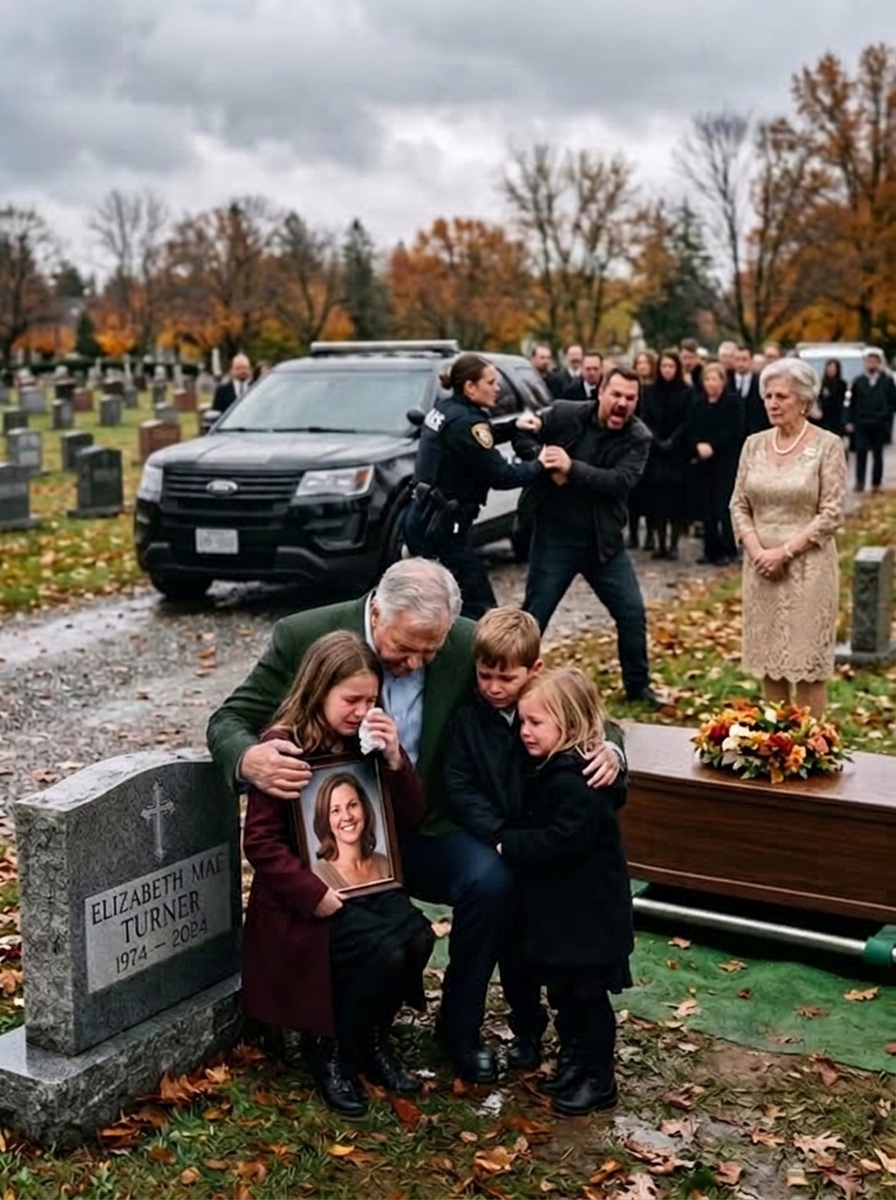
More than two hundred people had heard Arthur abandon his daughters beside Rose’s grave.
Several had recorded it.
By the following afternoon, a judge granted me temporary custody and prohibited Arthur from removing the girls while the investigation continued.
The trust accounts were frozen.
The education funds could no longer be accessed.
Arthur’s control over Rose’s estate was suspended pending review.
Three hours later, he arrived at my house.
He pounded on the door.
“Charles! Open this door!”
The girls were upstairs with my sister.
Two officers waited inside because Miriam had warned us Arthur might come.
I opened the door with the security chain still attached.
Arthur’s face was red.
“What did you do to my accounts?”
“I protected the money belonging to your daughters.”
“They are my children!”
“At Rose’s funeral, you called them a problem you wanted solved.”
“I was grieving.”
“You climbed into a van with your fiancée.”
His expression changed.
“Where’s the purple bag?”
That question confirmed everything.
“What bag?”
“Don’t play games. Rose stole private documents.”
“Rose documented what you did.”
“She was unstable.”
“She was dying, Arthur.”
I stared at him.
“There’s a difference.”
He stepped closer.
“You have no idea what I sacrificed for her.”
One officer moved into view.
Arthur stopped.
I opened the door wider.
The officer handed him the emergency order.
He was prohibited from removing or contacting the girls except through counsel.
He was also instructed not to destroy medical, financial, or electronic evidence related to the investigation.
Arthur read the paper.
Then looked at me.
“You planned this.”
“No.”
I shook my head.
“Rose did.”
For the first time, I saw fear.
Not grief.
Not regret.
Fear.
Fear that the woman he had tried to discredit had left behind a voice he could no longer silence.
“You’re going to ruin my wedding.”
I looked at him.
“Your wedding is the least important thing happening in this house.”
He left without asking to see the girls.
He did not ask whether April was sleeping.
Whether Rachel had eaten.
Whether Lucy still blamed herself.
He asked about his money.
The evidence.
And his wedding.
That evening, I opened the envelope Rose had addressed to Celeste.
The letter read:
Celeste,
I don’t know what Arthur has told you about me. I don’t know whether you believe our marriage ended before your relationship began. But I know he has promised you a life paid for with money taken from my daughters.
You are not responsible for my illness. You are responsible for what you do after learning the truth.
Arthur told you the girls wanted to live with their grandfather. They do not. He told you I refused medical help. I did not. He told me he would send our daughters to foster care because you didn’t want them. If that is also a lie, you deserve to know.
The ring he gave you was purchased from Lucy, Rachel, and April’s education account. So was the venue. So was the honeymoon.
If he can build your wedding beside my hospital bed, ask yourself what he will build beside yours when you become inconvenient.
At the bottom:
Please return whatever belongs to my girls. Then walk away while you still can.
I gave the letter to Miriam.
“This belongs to the investigation.”
“It also belongs to Celeste.”
Miriam nodded.
“I’ll make sure she receives it properly.”
Arthur’s wedding was scheduled for seventeen days after Rose’s funeral.
Seventeen days.
He expected to bury my daughter.
Surrender his children.
Then marry another woman before the cemetery mud had dried from his shoes.
He never reached the altar.
Celeste received Rose’s envelope on the morning of the wedding.
She read it inside the bridal suite.
Then asked to hear the recordings.
When she heard Arthur saying he intended to send his daughters away because she supposedly did not want them—
Celeste realized he had lied about her too.
She had never demanded that Arthur abandon his daughters.
He told her the girls hated her.
That they wanted to live with me.
That they would be happier away from him.
Arthur had used Celeste’s name at the cemetery because blaming her was easier than admitting the truth.
He did not want to be their father anymore.
Celeste turned her phone over to investigators.
It contained messages Arthur had deleted from his own devices.
One read:
Once the funeral is over, I’ll force Charles to keep them. If he refuses, the state can handle it. I’m done letting children control my future.
Another said:
The insurance money will cover everything after the accounts clear. Don’t worry about the venue balance.
Celeste removed her wedding dress.
Returned the ring after learning it had been purchased with the girls’ money.
Then left the estate through a side entrance.
Arthur waited in front of the ceremony room for twenty minutes.
Eventually, someone told him the bride was gone.
He never got the chance to chase her.
Investigators were already waiting in the lobby.
There was no music.
No vows.
No fresh start.
Only consequences arriving before he reached the altar.