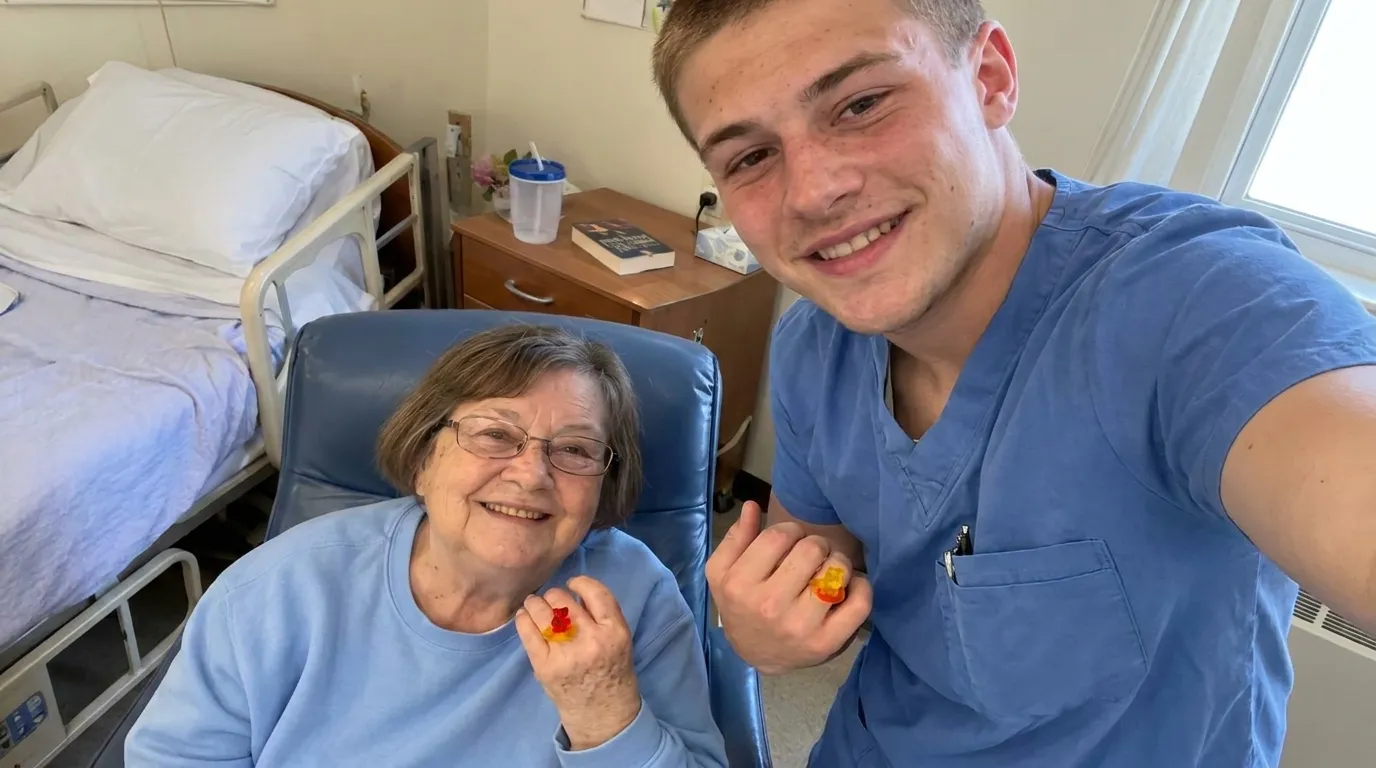
I’m 22. I proposed to a 69-year-old woman with a gummy ring because I couldn’t afford a real one.
Before she was even buried, her children were telling everyone I’d only wanted her money.
The worst part?
I understood why people believed them.
Eleanor was my patient.
I was a student care assistant at the facility where she’d spent the last fourteen months of her life. I had eleven dollars in my account when I proposed.
But Eleanor had made one thing clear.
“You’re not getting a cent from me, James. Not one.”
I’d told her I didn’t care.
And I meant it.
She left me nothing from her estate. Exactly as she’d said. I’d made my peace with that. I never wanted anything from her anyway.
So when her lawyer called after the funeral, I knew something was wrong.
“Eleanor arranged something for you before she died,” he said. “It’s not in her will. She asked me to explain it in person, and there’s a deadline approaching.”
He wouldn’t discuss the details over the phone.
I agreed to come the next morning.
That night, I kept remembering how everything started.
Eleanor was sitting beside her window, holding a book she couldn’t read because she’d misplaced her glasses.
“I could read to you,” I’d offered.
She looked suspicious.
“Don’t use that awful cheerful voice people use with old ladies.”
I laughed.
That became our routine.
I started reading to her because nobody else did. And then I kept doing it, because she was the first person in my life who talked to me like I was a whole person.
People had told me my whole life that I was old for my age. At school, it meant I had no friends.
With Eleanor, it meant we read the same books and argued about them.
I read during my breaks, and we debated the characters. She remembered everything I told her.
My exams.
My worries.
Even something I’d mentioned three weeks earlier. She’d remember it and come back to it.
Nobody had ever taken me seriously before. Not once.
Mom loved me, but she’d spent years worrying about bills and keeping our family together. I’d learned not to add my problems to hers.
With Eleanor, I didn’t have to pretend everything was fine.
Her children had put her in that facility. They visited twice in fourteen months.
Both times, they brought paperwork.
After one visit, she told me, “The worst thing about getting old is that people start talking about you as though you’re already gone.”
In March, I confessed my feelings.
She laughed for about a minute, until she realized I was serious.
“James, I’m dying, and I’m old. You know that, right?”
“I know.”
“And you’re 22.”
“I know that too.”
I was reassigned from her care when I disclosed my feelings, but I kept visiting her outside my placement hours.
In April, I proposed with a Haribo gummy shaped like a ring.
I had eleven dollars in my account, and I wasn’t going to pretend otherwise.
She laughed, slipped it onto her finger, and then grew serious.
She brought up the thing we argued about more than anything else.
“Look, if you’re doing this for the money…”
“How can you even think that?”
“Because everyone else will.”
“I’m here because I like being around you. I don’t want your money.”
She studied me for a long moment.
“You’re not getting a cent from me, James. Not one. I’ll be dead, and people will say exactly what they’re going to say regardless.”
“That’s fine.”
“I know,” she whispered. “That’s why.”
She died in September.
We never married.
In fact, she never reciprocated my romantic feelings.
Her children accused me of manipulating her anyway. They had a lawyer involved before the funeral. They were contesting everything, accusing me of coercion, and telling half the town what they thought I was.
And now, her lawyer was telling me she’d left me something.
The next morning, I sat across from a man named Daniel.
“Eleanor arranged a gift before she died,” he explained.
“What kind of gift?”
“Her book collection.”
I stared.
“Her books?”
“Nine boxes. She signed the transfer documents herself, without your involvement, and had them placed in storage under your name.”
He handed me an appraisal.
The collection was worth nearly $38,000.
I read the figure twice.
“She promised I wasn’t getting any money.”
“She didn’t leave you money from her estate. But these books have considerable value.”
Somehow, she’d kept the literal promise while giving me something worth more than I earned in a year.
“Her children will say I talked her into it.”
“They may challenge the gift. I can’t guarantee there won’t be difficulties.”
I pushed the paperwork away.
“Then I don’t want it.”
Daniel opened his drawer.
“Eleanor anticipated that.”
He handed me an envelope with my name across it.
I recognized her handwriting immediately.
“Dear James,
“Before you refuse the books, there’s something I should have told you while I was alive.
“I knew your grandmother.”
I stopped reading.
My grandmother, Margaret, was 73 and lived twenty minutes from my apartment.
She’d never mentioned Eleanor.
I continued.
“Margaret and I were practically sisters. We grew up together, shared everything, and promised nothing would separate us.
“Then we married, and I made a terrible mistake.”
Eleanor explained that she’d recognized my surname when we met.
It was the name my Grandma Margaret had taken when she married.
At first, she’d assumed it was coincidence. But after we’d become friends, she searched old newspaper announcements.
She found my father’s name in a family notice and recognized it from something I’d told her.
She discovered I was her former best friend’s grandson.
“By then,” she wrote, “you had already become very dear to me. I was afraid telling you would change everything.”
I stared at the letter.
Eleanor had known for months.
Every time I’d mentioned Grandma, she’d known exactly who I meant.
And she’d never said a word.
Daniel showed me the collection in a storage room.
Nine boxes, carefully labeled.
Inside one was a photograph.
Two teenage girls sat beneath a tree, sharing a book.
One was Eleanor.
The other had my grandmother’s eyes.
On the back was written, “Margaret and Ellie. Summer, 1972. Sisters forever.”
I turned it over several times.
What could have happened between them that neither had mentioned the other for decades?
Daniel explained that the prepaid storage period ended Friday.
I promised to return with a van.
Then I went home and continued Eleanor’s letter.
The next paragraph changed everything.
“James, there is something worse than my keeping our connection secret. Years ago, your family needed help. I knew. And I did nothing.”
I read it again.
I was nine when Dad lost his job.
I remembered Mom crying in the kitchen.
Grandma arriving with groceries and pretending she’d bought too much.
I remembered losing our house.
Eleanor explained that an old acquaintance had told her Margaret’s family was struggling.
Years earlier, she’d promised Grandma that if either family ever needed help, the other would be there.
“I could have called,” she wrote. “I could have written.
“But I was ashamed of what I’d done to Margaret, and terrified she’d reject me. So I convinced myself staying away was kinder.
“It wasn’t kindness, James. It was cowardice.”
I put the letter down.
The woman who’d made me feel valued had once turned her back on my family.
I wasn’t angry about the money.
I was angry because she’d known.
Had she been kind to me because she felt guilty?
Had I reminded her of my grandmother?
For the first time, I wondered whether I’d misunderstood our entire relationship.
I needed answers.
So I called Grandma.
“Did you know someone named Eleanor?” I asked.
Silence.
“Which Eleanor?”
I told her.
Something clattered.
“Grandma?”
“I’m here.”
“She died last month.”
Another silence.
Then, quietly, “Oh, Ellie.”
I’d never heard her sound like that.
I explained that Eleanor was once under my care.
I couldn’t tell her about my feelings.
I visited the following morning.
Grandma took one look at the photograph and started crying.
“We were inseparable,” she said. “She used to climb through my bedroom window carrying books.”
“What happened?”
She looked down.
“Your grandfather and I had a difficult marriage in the beginning. I was young and frightened. I told Eleanor I was thinking about leaving him.”
“And?”
“She told him.”
I stared.
“Why?”
“She thought she was helping. She told him I needed reassurance, that he should convince me to stay.”
Grandma shook her head.
“He came home furious. Accused me of telling everyone our private business. For weeks, every argument became another fight about what I’d told Eleanor.”
“Did you leave him?”
“No. We eventually worked through our problems. But I couldn’t trust Eleanor anymore.”
“Did she apologize?”
“She tried. I told her never to contact me again.”
“And she didn’t?”
“No.”
“She believed you hated her.”
Grandma sighed.
“For years, I did.”
“Do you still?”
She looked surprised.
“Of course not.”
“Then why didn’t you tell her?”
Grandma stared at the photograph.
“Life happened. Children, work, your grandfather getting sick. Eventually I wasn’t angry anymore. But after so many years, I didn’t know how to reach out.”
“She was afraid you’d reject her.”
Grandma wiped her eyes.
“Then she should have asked.”
I showed her the part about our family’s hardship.
She read it slowly.
“She knew?” she whispered.
I nodded.
“Would you have accepted her help?”
“When your father lost his job? James, I would have accepted help from anyone.”
She folded the letter.
Then she said something I hadn’t expected.
“I forgave Eleanor more than twenty years ago.”
I stared at her.
“Twenty years?”
“At least.”
“Why didn’t you tell her?”
“Because I was afraid she wouldn’t want to hear from me.”
We sat in silence.
Two women who’d loved each other like sisters had spent decades afraid to make the same phone call.
And now one of them was dead.
I brought the books to Grandma’s house the next afternoon.
She stood beside the boxes, recognizing titles she’d last seen as a teenager.
Then she found a small blue hardcover.
Its spine had been repaired with brown tape.
“Oh, my goodness.”
She opened it.
Inside the cover, in faded ink, it said: “To Ellie, because you always steal my books anyway. Love, Maggie.”
Grandma laughed through her tears.
“I gave her this for her sixteenth birthday.”
“She kept it all these years.”
“She kept everything.”
We spent hours reading their notes in the margins.
They’d argued about characters, corrected each other’s spelling, and written little jokes only they understood.
Eleanor hadn’t just left me expensive books.
She’d left me the friendship she’d lost.
My phone rang.
Eleanor’s daughter.
“I heard you collected my mother’s books,” she said.
“Yes.”
“Do you know what they’re worth?”
“Yes.”
“So she left you money after all.”
“She gave me books.”
“Don’t insult my intelligence, James.”
I walked into the hallway.
“You expect people to believe a 22-year-old boy wanted to marry my mother because he loved her?”
“I know how it looks.”
“Then give them back.”
“Your mother arranged this herself. I didn’t ask her for anything.”
“She wasn’t thinking clearly.”
“She argued with me about everything. Including whether I should finish school before making decisions about my future.”
“That doesn’t prove anything.”
“Maybe not to you.”
I looked toward the living room, where Grandma was holding a book she’d given Eleanor more than fifty years earlier.
“I’m not selling them,” I said.
“Why not?”
“Because they mean more to someone I love than the money ever could.”
“Who?”
“My grandmother. She grew up with your mother.”
Silence.
“She never told us that.”
“She didn’t tell me either.”
I told her I understood why our relationship raised questions, but I wouldn’t accept being called a manipulator.
She started arguing again.
I ended the call.
I was finished begging people to believe me.
That evening, Grandma went to bed early.
I stayed at her kitchen table with Eleanor’s letter.
There was one final page.
The handwriting was shakier than the rest.
“Dear James, there is something else I owe you. When you told me you loved me, I believed you. I still do.
“But I sometimes wondered whether the love you felt was different from the love you thought you were offering.
“You told me nobody had ever taken you seriously. You were surprised when I remembered things you said. You looked astonished when I asked about your day.
“Those things should never have been extraordinary. Perhaps you weren’t searching for a wife as much as someone who would listen, someone who would be proud of you, someone who would make you feel safe.
“Perhaps you were looking for a mother’s love.”
I stopped reading.
Eleanor continued.
“I could be wrong. I’ve been wrong about love before, as Margaret could certainly tell you.
“But whatever name you give your feelings, please know that you made my last months happier than I thought they could be.
“I should have told you about Margaret. I should have helped your family when I had the chance. I cannot undo either failure.
“When you gave me that ridiculous candy ring, I wanted to believe I had all the time in the world. I didn’t.
“You do.”
I wiped my face and kept reading.
“I hope one day you find a woman who sees everything wonderful in you and has the years ahead to share a life with you. Someone you can grow old beside.
“And please tell Margaret I loved her. I never stopped.”
I folded the letter.
For a while, I was angry.
She’d worn that gummy ring.
She’d told me she loved me.
And now she was suggesting I might have mistaken kindness for romance.
But she’d also admitted she could be wrong.
I thought about how lonely I’d been before meeting her.
How much it had meant when she remembered the smallest details of my life.
Maybe she was right about some of it.
Maybe she wasn’t.
I still loved her.
And I didn’t need to decide what kind of love it was for it to have been real.
The following Sunday, Grandma asked me to bring the blue book.
We sat beside her living room window.
“Read to me,” she said.
“You’re perfectly capable of reading.”
“I know. But I like listening to you.”
I opened it.
Halfway through the first chapter, Grandma interrupted.
“Ellie hated that character.”
“Why?”
“She thought he was selfish. I thought he was lonely.”
I looked at the margin.
Eleanor had underlined a sentence and written, “Margaret is wrong.”
Below it, in another handwriting, “Am not. Maggie.”
Grandma burst out laughing.
I laughed with her.
Then she reached for my hand.
“James, I wish she’d known I’d forgiven her.”
“I think she knew you loved her.”
“That’s not quite the same thing.”
“No,” I said. “I guess it isn’t.”
We sat quietly.
Then Grandma turned the page.
“Keep reading.”
So I did.
I still had bills to pay and classes to finish.
I still missed Eleanor.
Her children might never believe me.
But I no longer felt I had to prove that what we’d shared mattered.
Eleanor had seen something in me that I’d struggled to see in myself.
And sitting beside Grandma, reading a book two girls had loved more than fifty years earlier, I finally understood.
Eleanor hadn’t taught me how to be worthy of love.
She’d simply helped me recognize that I already was.
When I finished the chapter, Grandma squeezed my hand.
“That was lovely, James.”
For once, I believed her.
Latest Posts
- My In-Laws Gave Their Other Three Children $20,000 for Houses and Gave Us Only a Card Two Years Later, We Bought the Old Miller Place for $41,500
The envelopes were tucked under the Easter plates. Each had a name written on it in my mother-in-law’s round schoolteacher handwriting. Kim opened hers first. She’s the oldest. Divorced two years. Raising two boys in a rented trailer behind the grain elevator. She looked at what was inside the envelope and put her hand flat …
- My Mother-in-Law Told Me to Lose Weight After Giving Me a Dress That Didn’t Fit, but Minutes Later, She Regretted Everything
I couldn’t get it over my hips. I stood in my bedroom in my underwear with the dress bunched around my thighs like a deflated balloon. Midnight blue silk. A designer label I’d only ever seen in magazines. Tiny pearl buttons down the back. Beautiful. And four sizes too small. I pulled. I tugged. I …
- Teen Wore a Dress to His Best Friend’s Funeral—The Family Nearly Had Him Removed Before He Reached the Microphone
My son’s best friend read the eulogy at his funeral in a red dress. I almost had him removed before he reached the microphone. My son Jack died 17 days after his 18th birthday. Cancer. Fourteen months from diagnosis to funeral. We found out late. Too late, as it turned out, and the treatment never …
- My Mother Refused to Walk Me Down the Aisle—Then the Truth Surfaced
My mother had proudly escorted both of my sisters down the aisle as though they were miracles dressed in lace. On the morning of my own wedding, I stood in the bridal suite wearing my white gown, hoping for a single moment of family peace. Instead, she stared at me and said, “I refuse to …
- I Arrived at My Son’s House on Christmas Eve With Food and Gifts, but What Happened at the Door Broke My Heart
“Dad, who’s at the door?” My son didn’t even turn all the way around. He kept one hand on the doorknob and one foot on the porch, blocking the gap with his body like I was a salesman or a stray dog. “Wrong house,” he called back over his shoulder. Then he looked at me. …