Lorenzo Moretti reached for his car keys.
His right-hand man, Marco Bellini, looked up from the folder on his desk.
“Where are you going?”
Lorenzo didn’t answer. He was still staring at the phone.
The message remained on the screen:
Don’t apologize. Is your brother hungry right now?
A twelve-year-old girl.
Twenty dollars.
Milk.
Most messages Lorenzo received contained threats, demands, or pleas from people who knew exactly who he was. This one was different.
There was no manipulation in it.
Only a child who had made one wrong digit because she was desperate.
“Boss?”
“Find her.”
Marco blinked. “Who?”
“The girl who sent me this.”
“Emily Carter?”
“Yes.”
“Do you want me to scare her?”
Lorenzo finally looked up.
“No.”
“Then what?”
“Find out where she lives.”
Within minutes, Marco’s contacts identified the phone’s registered owner: Margaret Carter.
Lorenzo memorized the address.
“Let’s go.”
“You have a meeting with the Russo people in forty minutes.”
“Cancel it.”
“That’s the third meeting you’ve canceled this week.”
“Then cancel another one.”
Back at home, Emily sat on the kitchen floor with Noah in her lap. The stranger had not replied for almost two minutes, and she regretted sending the message.
Then the phone buzzed.
I’m coming.
Emily typed:
Who are you?
Someone who doesn’t want a hungry child to go to sleep tonight.
That didn’t make her feel safer.
I don’t know you.
I know.
Another message followed:
That’s why I’m asking you not to open the door for me. I’ll leave groceries outside.
A black SUV turned onto the street.
Emily pulled Noah closer and watched from behind the curtain.
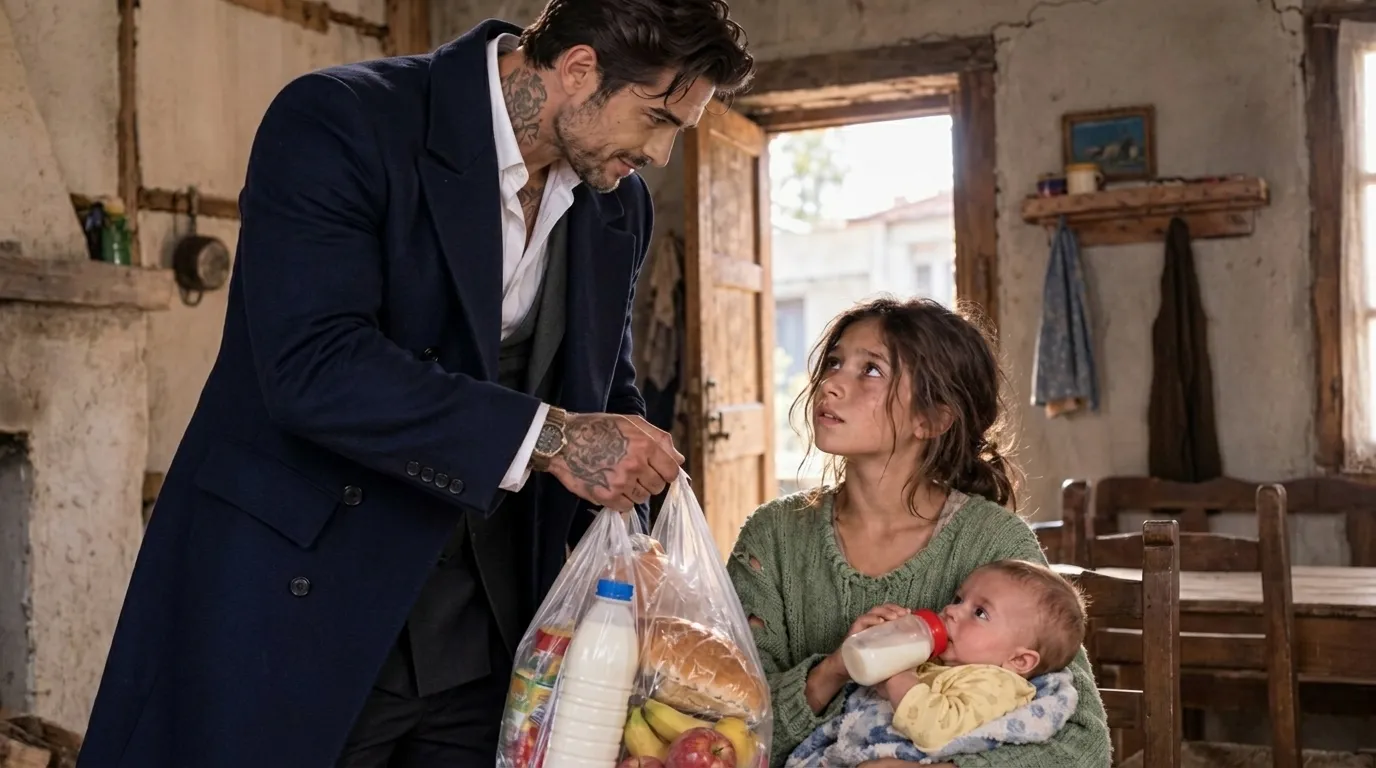
A man carried several grocery bags to the porch, placed them beside the door, and returned to the vehicle. Nobody knocked. Nobody tried the door.
When the cars disappeared, Emily opened the door.
There was milk, bread, eggs, cereal, formula, fruit, canned soup, chicken, and rice.
Inside the envelope was $100.
For emergencies. Not repayment.
Emily stared at the note, then cried silently.
For the first time that day, she could feed her brother.
Lorenzo watched from two blocks away.
“You’re really doing this?” Marco asked.
“She’s twelve.”
“I noticed.”
“She was asking for milk.”
“I noticed that too.”
Lorenzo looked toward the house.
“You have a problem with it?”
“No.”
“Good.”
That evening, Margaret returned from work and froze when she saw the food.
“Where did all this come from?”
Emily explained everything.
Margaret checked the number and searched it online.
Her face drained of color.
“Emily,” she said. “Do you know who you texted?”
“Who?”
“Lorenzo Moretti.”
“Who’s that?”
Margaret sat down.
“He’s dangerous.”
“But he helped Noah.”
“That doesn’t make him safe.”
Margaret had no answer for why a man like Lorenzo would care about them. The uncertainty frightened her more than a demand would have.
The next morning, Marco called.
“Mr. Moretti asked me to check whether the baby has enough formula.”
“He has enough.”
“Good.”
“I don’t want anything from him.”
“You don’t owe him anything.”
“I don’t trust him.”
“That’s understandable.”
“Then why should I believe you?”
“You don’t have to.”
Marco explained that Lorenzo had given them groceries because he could. Nothing more.
Three days passed without another message.
Then Emily found a package on the porch. Inside was a stuffed rabbit for Noah.
Margaret told her to throw it away.
That night, Marco returned.
He placed an envelope on the porch.
“Your landlord filed an eviction notice,” he said.
Margaret opened the door but kept the chain attached.
“I’ll handle it.”
“Your landlord agreed to delay the eviction for thirty days.”
“Why?”
“The building was purchased this morning.”
Margaret’s heart stopped.
“By whom?”
Marco didn’t answer.
She already knew.
“Moretti?”
He nodded.
“You bought our building?”
“Lorenzo did.”
“You can’t do this.”
“He already did.”
“Why?”
Marco looked at her.
“Because your daughter asked for twenty dollars.”
Margaret stared at him.
“That doesn’t make sense.”
“No,” Marco said. “Most things involving Lorenzo don’t.”
When Marco returned to the office, Lorenzo asked what Margaret had said.
“She doesn’t trust you.”
“Good.”
Marco raised an eyebrow.
“You’re okay with that?”
“I’d be more concerned if she trusted me after one week.”
Marco hesitated.
“Why are you doing this?”
Lorenzo looked away.
“Because nobody helped my mother when I was a child.”
He remembered a cold apartment, an empty refrigerator, and his younger sister crying while their mother pretended she wasn’t hungry.
At eleven, Lorenzo had promised his sister that dinner was coming.
It never did.
Nobody came.
He had never forgotten that night.
Maybe that was why Emily’s message reached somewhere inside him that money, power, and violence never could.
“Does Emily know?” Marco asked.
“No.”
“Will she?”
“Not unless she asks.”
Six weeks later, Emily met Lorenzo at a community-center food drive.
She recognized him immediately.
“You’re him,” she said.
“The wrong number?”
“The wrong number.”
“Why did you help us?”
“Because your brother was hungry.”
“That’s it?”
“That’s it.”
“You’re really a mafia boss?”
Lorenzo almost smiled.
“Who told you that?”
“Everybody.”
“Everybody is sometimes wrong.”
Emily studied him.
“My mom says dangerous people can look nice.”
“She is correct.”
“So are you dangerous?”
“Yes.”
Emily stepped back.
“But not to you.”
“Why?”
“Because you asked for milk.”
She frowned.
“That doesn’t make sense.”
“No.”
He glanced at the box in her arms.
“What are you doing?”
“Giving food to families who need it.”
“Why?”
“Because I know what it’s like.”
Lorenzo nodded.
“Then keep doing it.”
He walked away.
Over the next year, his help remained distant. He never entered their home or demanded gratitude.
Their refrigerator was never empty again.
Margaret found a better cleaning contract through a legitimate company. The community center received anonymous donations. The school received supplies.
Every birthday, Emily received a simple gift—a book, sweater, or art set.
Never cash.
Never anything extravagant.
Never a note asking for repayment.
Margaret still didn’t fully trust Lorenzo, but she began to understand him.
Then Emily turned fifteen.
On a rainy Tuesday, Margaret didn’t come home from work.
At 10:03 p.m., the hospital called.
Emily rushed there with Noah.
The nurse asked whether there was another adult they could contact.
Emily opened her mouth.
No answer came.
Then she remembered a number she had never forgotten.
She called Lorenzo.
He answered immediately.
“Emily?”
She couldn’t speak.
“What happened?”
“My mom.”
“Where are you?”
She told him.
“Stay there.”
Twenty minutes later, three black vehicles arrived.
Lorenzo stepped out.
For the first time, Emily saw fear in his face—not fear of her, but fear for her.
He crouched slightly.
“Where’s your brother?”
“With me.”
“Good. Listen to me. You don’t have to be strong tonight.”
That broke her.
She began crying.
Lorenzo stood beside her without touching her or telling her to stop.
He simply stayed.
Margaret survived, but her injuries were serious.
When she woke, she immediately confronted Lorenzo.
“You had no right.”
“Probably not.”
“You can’t buy your way into our lives.”
“I know.”
“Then why?”
“Because your daughter called me.”
Margaret stared at him.
“And if she calls again?”
“I’ll answer.”
For the first time, Margaret whispered, “Thank you.”
Lorenzo nodded.
“You’re welcome.”
Years passed.
Emily graduated high school and then college. She studied social work because she wanted to help children who knew what empty refrigerators felt like.
Lorenzo never tried to control her choices.
When she graduated, he sat in the back row.
After the ceremony, Emily found him outside.
“You came.”
“Of course.”
“You always come.”
Lorenzo looked at her.
“You asked me once if I was dangerous.”
“I remember.”
“Do you still think I am?”
“Yes.”
He nodded.
“But I also know dangerous people can choose what they do with their power.”
For the first time in years, Lorenzo smiled genuinely.
Ten years after the wrong-number text, Emily returned to the community center where she had first met him.
This time, she was running the program.
A sign above the entrance read:
THE TWENTY DOLLAR FOUNDATION
Its mission was simple:
No child should ever have to choose between asking for help and watching a sibling go hungry.
The foundation provided emergency groceries, childcare support, transportation, school supplies, and temporary housing assistance.
The initial funding had come from an anonymous donor.
Everyone knew who it was.
But only Emily said his name.
At the opening ceremony, Lorenzo sat quietly in the back.
He was older now, with gray in his hair, but his presence still made the room fall silent.
Emily held up a small cracked phone.
“Ten years ago, I sent a text to the wrong number,” she said.
People smiled.
“I asked for twenty dollars.”
She looked toward Lorenzo.
“I thought I was asking a stranger for help.”
She paused.
“But sometimes, the wrong number can become the right person at exactly the right moment.”
The room grew quiet.
“Needing help is not weakness,” Emily continued. “Sometimes, asking is the bravest thing you can do.”
After the ceremony, she found Lorenzo outside beneath a tree.
“You didn’t have to come.”
“Yes, I did.”
“Why?”
“Because I wanted to see what twenty dollars became.”
Emily laughed.
“You gave us a hundred.”
“I remember.”
“You bought our building.”
“I remember.”
“You paid for Mom’s hospital bills.”
“I remember.”
“You did more than twenty dollars.”
Lorenzo looked toward the center.
“No.”
Emily frowned.
“I gave you twenty dollars. You did the rest.”
Her eyes filled with tears.
“You know, I used to think you saved us.”
“And now?”
“Now I think you gave us enough time to save ourselves.”
Lorenzo nodded.
“That sounds right.”
Emily hugged him.
For a second, he froze.
Then he slowly put one arm around her.
The feared man who had once silenced entire rooms stood quietly while the little girl from the wrong-number text held him.
Years earlier, Emily had been twelve—hungry, frightened, and desperate enough to message a stranger.
She believed twenty dollars would solve everything.
It didn’t.
It bought one gallon of milk.
But that gallon gave Noah another night without hunger.
And the stranger who answered gave her something worth far more:
A chance.
A door.
A reason to believe that being poor did not mean being forgotten.
That asking for help did not make her weak.
That a small desperate decision could change an entire life.
That night, Emily returned to her office and opened an old file.
Inside was a screenshot of the original message:
“Aunt Lisa, can you send me $20? I need to buy milk for Noah. I promise I’ll pay you back. Please.”
Underneath it was Lorenzo’s first reply:
“Don’t apologize.”
Emily smiled.
Then she added one final sentence to the foundation’s website:
“If you’re reading this because you don’t know where your next meal is coming from, you don’t have to be ashamed. Ask.”
Outside, Detroit’s lights stretched across the dark horizon.
Somewhere across the city, Lorenzo Moretti was probably sitting in silence, pretending he hadn’t changed.
Maybe he hadn’t.
Maybe the dangerous man was still there.
But Emily knew something the rest of Detroit didn’t.
Behind the reputation, the black cars, the money, and the fear, there was a man who had received a text from a hungry twelve-year-old girl.
He could have deleted it.
Instead, he answered.
And that single answer changed two lives.
Emily had sent the wrong number.
But somehow, she had reached exactly the right person.
THE END
Latest Posts
- My Husband Mocked My Postpartum Appearance in His Brothers’ Group Chat—I Stayed Quiet for Five Days
Four months after giving birth, I thought my husband understood why I hardly recognized myself. Then I discovered the cruel joke he'd been sharing with his brothers, along with photos I never knew he'd taken. I kept my discovery secret for five days, determined to make him regret every word. “Dude, you weren't exaggerating 😂” …
- My Stepdaughter Called Me the Help Until My Envelope Changed Everything
The insult came before I’d even finished setting down the peach cobbler. I’d baked it at five that morning in the kitchen of the lake cabin we’d rented, and it was still warm under the foil. The smell of cinnamon followed me across the grass toward the pavilion tables, where thirty-two members of the Cole …
- My In-Laws Gave Their Other Three Children $20,000 for Houses and Gave Us Only a Card Two Years Later, We Bought the Old Miller Place for $41,500
The envelopes were tucked under the Easter plates. Each had a name written on it in my mother-in-law’s round schoolteacher handwriting. Kim opened hers first. She’s the oldest. Divorced two years. Raising two boys in a rented trailer behind the grain elevator. She looked at what was inside the envelope and put her hand flat …
- My Mother-in-Law Told Me to Lose Weight After Giving Me a Dress That Didn’t Fit, but Minutes Later, She Regretted Everything
I couldn’t get it over my hips. I stood in my bedroom in my underwear with the dress bunched around my thighs like a deflated balloon. Midnight blue silk. A designer label I’d only ever seen in magazines. Tiny pearl buttons down the back. Beautiful. And four sizes too small. I pulled. I tugged. I …
- Teen Wore a Dress to His Best Friend’s Funeral—The Family Nearly Had Him Removed Before He Reached the Microphone
My son’s best friend read the eulogy at his funeral in a red dress. I almost had him removed before he reached the microphone. My son Jack died 17 days after his 18th birthday. Cancer. Fourteen months from diagnosis to funeral. We found out late. Too late, as it turned out, and the treatment never …