During a family dinner, my older sister introduced her boyfriend—and for some reason, he kept staring at me.
He asked what I did for a living.
I answered.
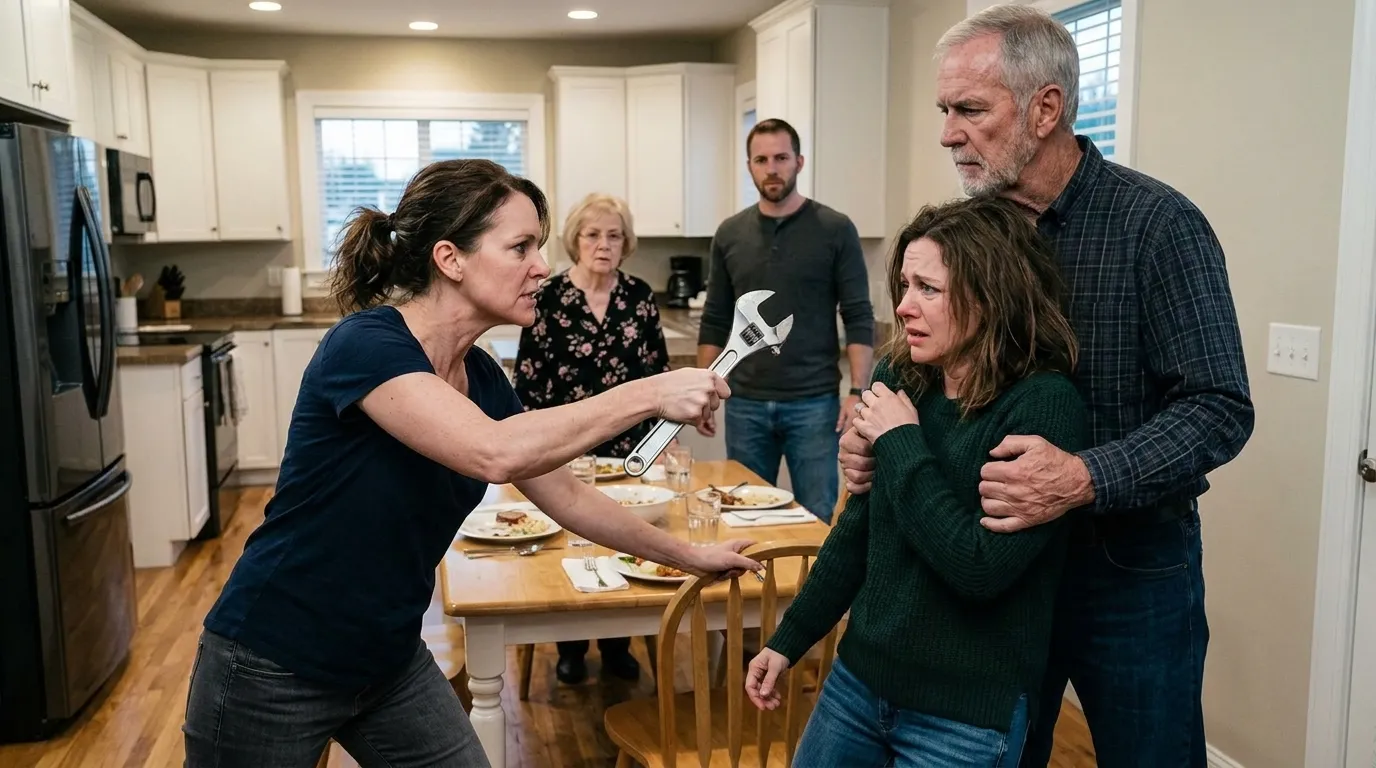
At that exact moment, my mother struck me across the face with a wrench for “talking back.”
My family burst out laughing.
“At least you’re pretty now,” my sister mocked.
“One hit isn’t enough,” she added.
My mother tossed the wrench to her.
“Your turn.”
I tried to shield myself.
My father grabbed my arms.
Everything went dark.
They were still smiling beside my sister’s boyfriend—as if I were…
The first thing I felt when the room came back was the hard floor against my shoulder and my father’s fingers still locked around one of my wrists.
My ears rang.
Somewhere above me, a dinner plate scraped across the table.
Then I heard my sister say, almost casually, “See? She always makes everything dramatic.”
Her boyfriend wasn’t laughing anymore.
He was staring at my mother, then at the wrench in my sister’s hand, then at my father holding me down.
His face had changed completely.
“Let her go,” he said.
My father gave him a look as though he had forgotten there was an outsider in the room.
“Stay out of family business.”
My sister reached for her boyfriend’s arm.
“Baby, don’t. She does this all the time.”
I managed to pull one knee underneath me.
My father tightened his grip for a second, but I stopped fighting him. I looked straight at my sister’s boyfriend instead.
“Why were you staring at me?” I asked.
My sister snapped, “Seriously? That’s what you care about right now?”
But he answered me.
“Because she told me to watch you.”
My sister’s hand dropped from his arm.
He said she had spent the entire week preparing him for this dinner.
According to her, I was rude, jealous, unpredictable, and constantly trying to ruin things for the family.
She warned him not to believe me if I complained about anyone.
She said I had a habit of turning ordinary arguments into stories where everyone else was cruel and I was always the victim.
Suddenly, the way he had watched me from the moment I sat down made sense.
My mother finally told my father to release me, but not because she was sorry.
She looked annoyed, as though the evening had gone off script.
“There,” she said. “Happy now? Get up and stop embarrassing your sister.”
I stood slowly, keeping one hand on the back of my chair until my balance settled.
My sister still had the wrench, but she was holding it down by her side now.
I looked around that table—the dinner they had invited me to, the chair they had given me, the people who had laughed while my father held my arms—and for the first time, I didn’t argue about what they had done.
I just said, “I’m leaving.”
My mother immediately answered, “Then don’t come crawling back tomorrow.”
Normally, that sentence would have worked.
It had worked in a hundred smaller ways before: making me feel guilty, making me defend myself, making me prove I still belonged.
This time, I pushed my chair back under the table.
“Okay.”
That one word upset them more than anything I could have yelled.
My sister demanded that her boyfriend come with her into the kitchen.
He refused.
My father told him he had misunderstood what happened.
My mother called it “discipline.”
He kept looking at me instead.
Then he said something that explained why this dinner had felt wrong before anyone ever touched the wrench.
“She told me tonight was supposed to prove you were the problem.”
He didn’t soften it after he said it.
My sister had told him to pay attention to everything I did at dinner—my tone, my face, whether I interrupted, whether I got angry—because, according to her, once he saw me “in action,” he would finally understand why the entire family treated me the way they did.
My mother cut in immediately.
“She’s twisting this.”
“I’m repeating what your daughter told me,” he said.
Then came the detail that changed the room again.
He had arrived earlier than I had.
While my sister was upstairs getting ready, he had heard her talking with my parents in the kitchen.
He hadn’t understood the conversation then, but now he did.
My sister had told my father that if I tried to leave after “causing a scene,” he shouldn’t let me walk away until I apologized.
My father’s grip on my arms hadn’t been some impulsive reaction after the wrench came out.
They had already discussed stopping me from leaving.
My sister turned on him.
“Why were you listening to us?”
That question told me more than a denial would have.
I picked up my things and headed for the door.
My mother warned me again that if I left, I shouldn’t expect anyone in that house to call me tomorrow and apologize.
“I’m not waiting for an apology,” I said. “I’m leaving because I finally understand what this dinner was for.”
My sister followed me halfway across the room, demanding that I stop making her boyfriend choose sides.
I didn’t ask him to choose anything.
But as I reached the door, he looked at my sister and made his own decision.
“I’m not going home with you.”
My sister stared at him as if he had betrayed her.
“You’re choosing her?” she demanded.
She moved between me and the exit.
“No,” he said. “I’m telling you to move.”
That distinction seemed to hit harder than an accusation.
He wasn’t pretending he knew me.
He wasn’t declaring me innocent of every argument our family had ever had.
He was talking about the one thing he actually knew because he had watched it happen.
My sister shifted aside.
I moved toward the doorway, but my mother called my name with the same sharp tone that had stopped me countless times before.
I turned.
She pointed toward my chair.
“You walk out now, don’t expect everything to be normal tomorrow.”
There it was again.
Tomorrow.
The promise that if I surrendered tonight, the family would reset everything by morning.
Nobody would apologize.
Nobody would name what happened.
I would simply be expected to return and participate in the version where I had caused it.
My sister’s boyfriend looked at me.
For the first time all evening, he wasn’t studying me because somebody had told him to.
He was waiting to see what I would choose.
I looked at my mother and said, “Then tomorrow can be different.”
And I walked out.
Behind me, my sister shouted his name.
His answer came before the door closed.
“I’m not lying about what I saw.”
The words followed me outside, but I kept moving.
My cheek hurt.
My wrist hurt where my father’s fingers had been locked around it.
My balance still felt uncertain, and every few steps, I had to concentrate on putting one foot in front of the other.
What I noticed most, though, was the absence of an argument.
For years, whenever somebody in my family accused me of something, I had treated the accusation like a problem I was required to solve.
If my mother called me disrespectful, I explained my tone.
If my sister said I was jealous, I listed all the ways I had supported her.
If my father told me I was causing trouble, I tried to prove I had entered the room wanting peace.
I had spent so much time defending my intentions that I had almost stopped noticing what everyone else was actually doing.
That dinner had changed something.
Not because my sister’s boyfriend had rescued me.
He hadn’t.
He was simply the first person in that room who had arrived believing their version of me and then been forced to compare it with what happened in front of him.
That difference mattered.
When I had arrived for dinner, he had watched me constantly.
At first, I had wondered whether I had something on my shirt.
Then I wondered whether my sister had told him something embarrassing about me.
Every time I spoke, his attention sharpened.
Every time my mother interrupted me, he watched my reaction.
Every time my sister made some small cutting remark and then smiled as if it were harmless, his eyes came back to me.
I had interpreted that attention as judgment.
I hadn’t known my sister had given him an assignment.
Watch her.
Don’t believe her.
Expect trouble.
By the time we sat down, he had already been handed the conclusion.
All he was supposed to do was witness enough behavior to confirm it.
Then he asked what I did for a living.
I answered.
That was all.
My mother decided the answer was “talking back.”
The wrench struck my face so suddenly that, for a second, the room seemed to tilt around the table.
Then came the laughter.
My sister’s comment.
“At least you’re pretty now.”
Then the second one.
“One hit isn’t enough.”
Then my mother tossing the wrench to her.
“Your turn.”
When I raised my arms, my father grabbed them.
That was the moment the story my sister had prepared for her boyfriend stopped working.
She had told him I transformed ordinary disagreements into stories about cruelty.
But there was nothing ordinary about what he was watching.
He didn’t have to trust my interpretation.
He only had to trust his own eyes.
When I came back to myself on the floor, my father still had one wrist.
My sister still had the wrench.
And she was still explaining me.
“See? She always makes everything dramatic.”
The sentence probably sounded normal to everyone else at that table.
To him, it landed differently.
He looked at the wrench.
He looked at my father’s hand around my wrist.
Then he looked at my mother.
“Let her go.”
My father immediately tried to restore the old boundary.
“Stay out of family business.”
That phrase had power in our house because it turned witnesses into intruders.
If something was “family business,” then outsiders were expected to stop asking questions.
My sister tried another route.
“Baby, don’t. She does this all the time.”
Even then, she wasn’t explaining what they had done.
She was explaining me.
I was dramatic.
I was difficult.
I was the recurring problem.
I managed to get one knee underneath myself.
Instead of fighting my father harder, I looked at the one person in the room who had no history with me.
“Why were you staring at me?”
My sister hated the question immediately.
“Seriously? That’s what you care about right now?”
But her boyfriend answered.
“Because she told me to watch you.”
That was when the dinner finally made sense.
My sister had spent a week telling him who I was before he met me.
She had described me as jealous and unpredictable.
She had warned him that I ruined family occasions.
Most importantly, she had told him not to believe me if I complained about the family.
It was a remarkably convenient warning.
Anything I said afterward could be treated as proof that the warning had been correct.
If I stayed quiet, they could call me cold.
If I objected, I was dramatic.
If I left, I was ruining dinner.
If I stayed, they controlled the room.
My mother finally told my father to release me.
Even then, she didn’t apologize.
“There. Happy now? Get up and stop embarrassing your sister.”
I used the chair to steady myself.
My sister still had the wrench down by her side.
Nobody had suddenly become gentle.
Nobody had suddenly understood.
The only thing that had changed was that there was now somebody at the table who had not learned the family rules.
And he was refusing to pretend that what he had seen fit the explanation he had been given.
I looked around the table.
There were the plates.
There was my chair.
There were the people who had invited me.
For once, I didn’t begin assembling a defense.
I didn’t remind my mother that I had answered a question someone else asked.
I didn’t ask my father why he thought holding my arms was acceptable.
I didn’t tell my sister how cruel her comments sounded.
I didn’t try to make any of them agree with me.
“I’m leaving.”
My mother responded immediately.
“Then don’t come crawling back tomorrow.”
That sentence carried more history than anyone else at the table could have known.
It wasn’t really about tomorrow.
It was about the expectation that I would panic at the possibility of being excluded.
The threat worked only if I rushed to prove that I still wanted my place.
Normally, I would have said that wasn’t fair.
Normally, I would have explained that I wasn’t abandoning anyone.
Normally, I would have tried to soften my departure before I had even made it.
Instead, I pushed the chair back under the table.
“Okay.”
The room reacted to that word because there was nothing to argue with.
My sister demanded that her boyfriend follow her into the kitchen.
He refused.
My father began telling him he had misunderstood.
My mother called what happened “discipline.”
Their explanations were different, but they all required the same thing from him.
He had to distrust what he had seen.
He kept looking at me.
Then he finally told me what the dinner had been designed to accomplish.
“She told me tonight was supposed to prove you were the problem.”
That sentence changed the question.
Until then, I had assumed my sister had simply complained about me to her boyfriend.
Families complain.
Siblings complain.
People tell biased stories about arguments.
But she hadn’t merely vented.
She had prepared him to interpret the dinner through a conclusion she had supplied in advance.
Then the exact behavior she had warned him about appeared—but not from me.
I reached for my things.
My mother called me dramatic.
I didn’t answer.
My father talked about what families did behind closed doors.
I didn’t answer him.
My sister moved between me and the exit.
She didn’t touch me.
After what had already happened, she didn’t need to.
The position itself was enough.
Her boyfriend saw it too.
He looked at her, then at me.
“Move.”
She stared at him.
“You’re choosing her?”
“No. I’m telling you to move.”
It mattered that he said it that way.
He wasn’t claiming to know my entire history.
He wasn’t turning himself into my defender after one dinner.
He was refusing to let my sister convert a simple fact into a loyalty test.
She was blocking my way.
He told her to stop.
My sister stepped aside.
I started toward the door.
Then my mother called me back with that familiar warning about tomorrow.
For years, “tomorrow” had meant restoration without accountability.
You returned.
You behaved normally.
You accepted that whatever happened yesterday had somehow become too old to discuss.
If you brought it up again, that became the new offense.
I looked at my mother.
“Then tomorrow can be different.”
I left.
My sister shouted after her boyfriend.
His response followed me out.
“I’m not lying about what I saw.”
Outside, I realized how strange it felt to hear somebody say that.
Not “I believe her.”
Not “I’m on her side.”
Not “she would never.”
Just the simplest possible statement.
He had seen something.
And he would not lie about it.
That was more unsettling to my family than a dramatic confrontation would have been, because their version of events depended on interpretation swallowing action.
My mother could call the wrench “discipline.”
My father could call restraint “family business.”
My sister could call my reaction “dramatic.”
But none of those descriptions changed the physical order of what had happened.
I answered a question.
My mother struck me.
My sister mocked me and accepted the wrench.
I tried to protect myself.
My father grabbed my arms.
Those actions didn’t become different because everyone at the table agreed on a softer vocabulary.
For a long time, I had thought the hardest part of my family was getting them to understand me.
That night showed me something else.
They often understood exactly what I was saying.
The argument wasn’t always confusion.
Sometimes the argument was the mechanism that kept me in the room.
If I was explaining, I wasn’t leaving.
If I was defending myself, I was still asking them to judge whether my feelings were legitimate.
If I was trying to prove that I belonged, they still controlled the terms of belonging.
“Okay” had interrupted that entire pattern.
So had walking out.
I didn’t know what my sister would tell her boyfriend after I left.
I could imagine the shape of it because I had heard versions of it all evening.
She would say I had manipulated him.
She would say he hadn’t seen the context.
She would say I wanted attention.
My father would probably return to the idea that outsiders couldn’t understand family dynamics.
My mother would probably insist I had provoked everything.
But there was one problem none of those explanations could erase.
He had entered that house prepared to believe them.
That was the part I kept returning to.
He hadn’t arrived sympathetic to me.
He hadn’t known me long enough to have loyalty toward me.
My sister had spent a week making sure of that.
If anything, the situation had been tilted against me before I walked through the door.
He watched me because she told him to watch me.
He distrusted me because she told him I was untrustworthy.
He expected me to create a scene because she told him I always did.
Then he watched the scene happen.
And the person his warning didn’t fit was me.
The people it fit were the ones who had given him the warning.
That didn’t repair anything.
It didn’t erase what had happened on the floor.
It didn’t make my mother apologize or my father release me because he suddenly understood the harm.
It didn’t make my sister take back the things she had said.
What it changed was smaller and more important.
The story no longer belonged entirely to them.
There was now someone who had seen the gap between their explanation and their actions.
And, for once, I didn’t feel responsible for closing that gap for them.
I had spent too many years trying to produce the perfect sentence.
The sentence that would make my mother admit she had gone too far.
The sentence that would make my father stop treating control like protection.
The sentence that would make my sister acknowledge that cruelty didn’t become harmless just because she laughed afterward.
There was no perfect sentence.
At dinner, I finally stopped searching for one.
The choice I made was painfully ordinary.
I pushed in my chair.
I picked up my things.
I walked toward the door.
When someone blocked me, I waited until the path opened.
When my mother threatened tomorrow, I accepted tomorrow.
That was it.
No speech.
No performance.
No attempt to win the room.
The chair mattered to me afterward because of how ordinary it was.
I had been given a place at that table, but the place had always seemed conditional.
Sit here.
Behave correctly.
Accept our explanation.
Don’t embarrass anyone.
Don’t make outsiders uncomfortable.
Don’t call cruelty cruelty.
And above all, don’t leave without first asking permission to belong again.
When I pushed that chair underneath the table, I wasn’t rejecting every memory I had with my family.
I wasn’t pretending the years before that night had contained nothing complicated or human.
I was doing something much narrower.
I was refusing to remain in that room under those conditions.
My sister’s boyfriend had been invited there to watch me.
By the end of dinner, he was still watching me.
But the meaning had changed.
At first, his attention had been surveillance borrowed from my sister’s suspicion.
At the door, he was watching because the decision belonged to me.
That distinction stayed with me.
So did his last sentence.
“I’m not lying about what I saw.”
He didn’t need to decide who I was.
Neither did I.
Not that night.
I only needed to decide what I would do with the door in front of me.
For once, I didn’t turn back toward the table to explain myself.
I opened it.
And I left.
Latest Posts
- My Mother-in-Law Made My Baby Shower About Herself—Then My Husband Stood Up #2
I wanted a small baby shower, but my mother-in-law ignored nearly every request and turned the day into a celebration of becoming a grandmother. I kept swallowing my frustration for one deeply personal reason, until she crossed a line neither my husband nor I could ignore. I was seven months pregnant with our first child, …
- My Son Grew His Hair for His Best Friend’s Wig—Then Her Father Called Me to School
A 14-Year-Old Boy Grew Out His Hair to Make a Wig for a Classmate Who Lost Hers to Cancer – The Next Day, His Mother Was Called to the School, Where the Girl's Father Said, 'You Have No Idea What Your Son Did, Do You?' The gum stuck in my son’s hair nearly ended the …
- 80-Year-Old Woman Spent Seven Days Visiting an Old Friend…
80-Year-Old Woman Spent Seven Days Visiting an Old Friend – She Returned Looking Half Her Size with a Suitcase That Wasn't Hers I almost walked past my mother at the train station. She was standing beside a bench, gripping the handle of an enormous black suitcase. Her gray hair was flattened against her forehead, and …
- The Winning Ticket and the Life My Husband Hid
My Husband Was Lying in a Hospital Bed When I Won 100 Million Dollars, and Then I Heard Him Laughing to His Mistress That I Would Hand Him Every Penny If I Thought He Was Dying. I Hid the Ticket, Called a Lawyer, and Walked Away, Never Imagining That His Fake Illness Was Only the …
- My husband divorced me to marry my own mother. #2
My Husband Divorced Me to Marry My Own Mother My husband divorced me to marry my own mother. Everyone told me to move on, but instead… I showed up at their wedding. And when she said, “I do,” they had no idea what I had already done. When Mark left me, he didn’t even try …