“Pick it up.
For someone living off garbage, five hundred dollars should feel like winning the lottery.”
Those were the words I shouted at the woman I had once promised to love until my final breath.
Three hours later, I would be standing in a freezing room beneath a leaking roof, staring at my paralyzed father while realizing that nearly every person I trusted had lied to me.
And the one woman I had spent three years hating had lost almost everything trying to protect me.
My name is Alexander Vance.
At thirty-nine, I thought I understood success.
I owned eleven luxury furniture showrooms across Illinois, Wisconsin, and Indiana.
My company supplied custom interiors to hotels, restaurants, and wealthy homeowners who thought nothing of paying fifteen thousand dollars for a dining table.
I lived in a glass-and-limestone house overlooking Lake Michigan.
I drove a black luxury SUV that cost more than the first home my parents had ever owned.
I had a private office on the forty-second floor of a downtown tower.
People returned my calls.
Bankers laughed at my jokes.
Employees stood when I walked into important meetings.
And somewhere along the way, I began confusing obedience with respect.
That Tuesday afternoon, Chicago was drowning beneath brutal spring rain.
Traffic had stopped beneath an overpass west of downtown, and I was already furious because a corporate meeting had run forty minutes late.
I remember drumming my fingers against the steering wheel while my phone lit up with messages from executives, clients, and my younger sister Maya.
Then I looked through the rain-streaked passenger window.
That was when I saw Lucy.
At first, I did not recognize her.
A thin woman in a faded blue raincoat was bent beside a row of commercial dumpsters.
She wore cracked boots and carried a torn plastic sack over one shoulder.
She was searching through trash.
Not casually.
Methodically.
She separated aluminum cans from bottles and flattened pieces of cardboard before placing them into another bag.
Then the wind pulled her hood backward.
I saw her face.
My breath caught.
Lucy.
My ex-wife.
For ten years, she had slept beside me.
She knew how I took my coffee.
She knew thunder made me restless because I had been trapped inside a storm cellar when I was seven.
She knew I pretended not to cry when our first dog died.
She had stood beside me when I opened my first furniture store with borrowed money and a handwritten sign.
And three years earlier, I had thrown her out of our home during a thunderstorm.
I had accused her of sleeping with our largest supplier, Daniel Mercer.
I had accused her of stealing $214,000 from my business.
I had called her a liar.
A parasite.
A fraud.
And when she tried to tell me there was something I did not understand, I told security to remove her from my office.
I never gave her a second chance to explain.
My evidence had seemed undeniable.
Bank transfers.
Private messages.
Hotel receipts.
Security footage.
An email from Lucy to Daniel saying that Alexander could never know what they were doing.
I had felt humiliated.
And humiliation, when mixed with money and pride, can turn an ordinary man into something vicious.
Lucy disappeared from my life after the divorce.
Maya told me she had probably gone to live with Daniel.
I believed her.
I wanted to believe her.
Because believing Lucy had betrayed me was easier than considering that I might have destroyed an innocent person.
Now, three years later, there she was sorting bottles from garbage in the rain.
Something dark and ugly rose inside me.
Vindication.
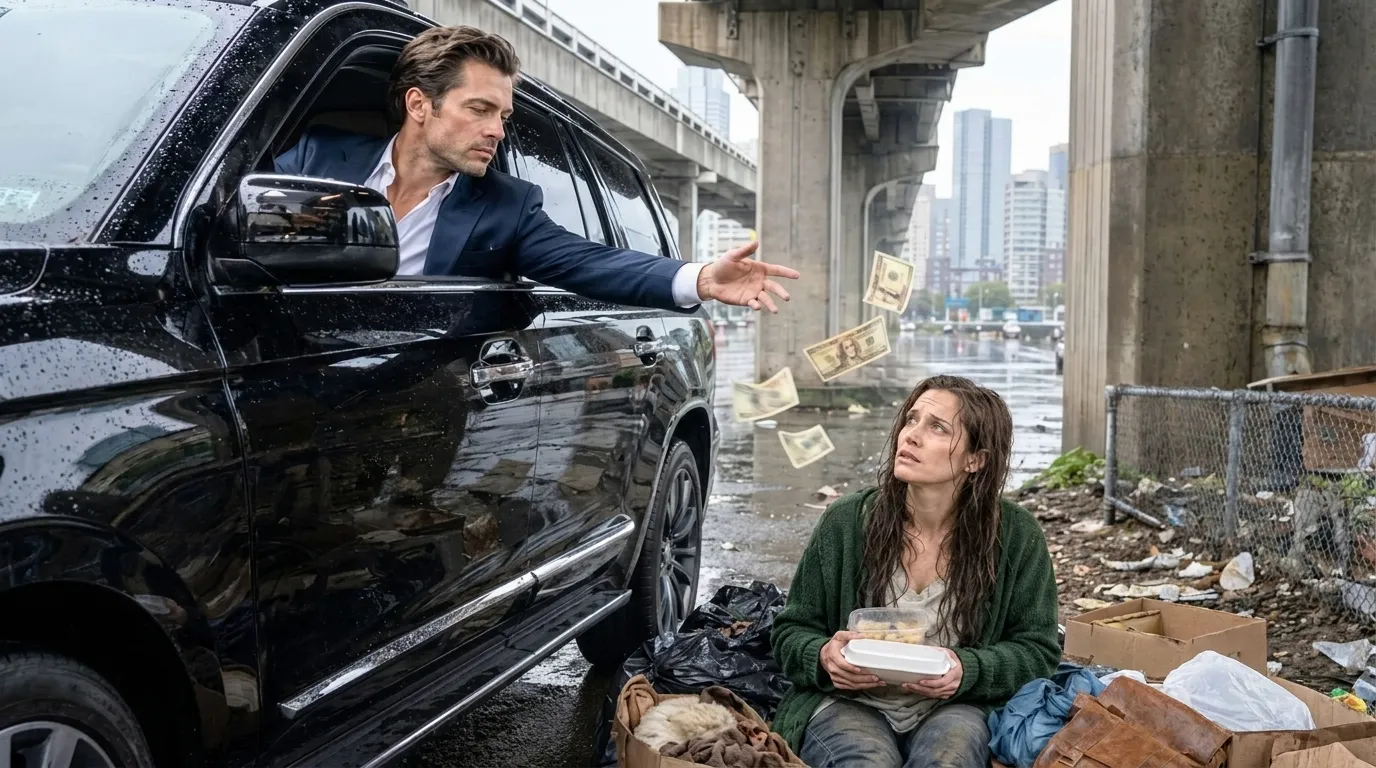
I lowered the passenger window.
“Lucy!”
She froze.
Slowly, she turned.
For several seconds, neither of us spoke.
Rain rolled down her cheeks like tears.
I reached into my wallet and pulled out five one-hundred-dollar bills.
I crumpled them in my fist.
Then tossed them through the open window.
They landed in a muddy puddle beside her boots.
“What happened to the millionaire?” I called.
“Did Daniel finally get tired of supporting you?”
Lucy stared at the money.
Then she looked at me.
Her face had changed since I had last seen her.
She seemed older.
Not in years.
In burden.
There were shadows beneath her eyes.
Her cheeks were thinner.
A pale scar ran near her temple.
But what unsettled me most was her expression.
There was no embarrassment.
No begging.
No anger.
Only disappointment.
“Keep your money, Alexander.”
Her voice was quiet enough that I almost missed it beneath the rain.
“You might need it someday.”
I laughed.
“For what?”
“To buy yourself a tiny piece of peace when you finally understand what you became.”
Then she pressed the toe of her worn boot onto one of the bills and pushed it deeper into the muddy water.
She turned and walked away.
I should have driven off.
That was what the version of me from that morning would have done.
But then I noticed three things.
Lucy was limping.
She carried a pharmacy bag beneath her coat.
And in her other hand was a plastic container of soup.
I put my SUV into park.
A driver behind me leaned on his horn.
I ignored him.
I grabbed my umbrella and followed Lucy.
She moved through an alley between abandoned warehouses, crossed beneath a rusted railway bridge, and continued into an industrial district I barely knew existed.
The streets became narrower.
The buildings became older.
My polished shoes sank into mud.
Lucy stopped beside a crumbling two-story structure squeezed between a shuttered repair shop and an abandoned loading yard.
She climbed three cracked concrete steps and entered through a metal door.
I waited thirty seconds.
Then followed.
Inside was a corridor that smelled of damp wood and old cooking oil.
I heard Lucy’s voice behind the last door.
“I’m home, Dad.”
I stopped walking.
Dad?
Lucy and I had never had children.
For years, infertility had been the silent grief in our marriage.
We had stopped discussing it because every conversation ended with Lucy crying in the bathroom while I pretended not to hear.
“I brought broth,” she said from inside the room.
“You need to eat before your medicine.”
I pushed open the door.
The room was barely larger than my walk-in closet.
A single exposed bulb hung from the ceiling.
Rainwater collected inside two plastic buckets.
There was a hot plate near the wall, a secondhand refrigerator, a folding table, and a narrow cot supported on concrete blocks.
On the cot lay an elderly man.
His left arm rested stiffly across his chest.
His face sagged slightly on one side.
His white hair had grown too long.
His body seemed impossibly small beneath a gray blanket.
I knew him immediately.
“Dad?”
Arthur Vance turned his head.
His eyes widened.
Then he began crying.
Not gently.
His chest shook.
His mouth opened, but only a broken rasp emerged.
I stood frozen.
My father had suffered a severe stroke six months earlier.
My sister Maya had told me she had moved him into Sunrise Grove, one of the most expensive rehabilitation residences outside Chicago.
Every month, I transferred $3,500 to Maya to cover additional treatment.
She sent videos.
Photos.
Updates.
Dad in a garden.
Dad beside a physical therapist.
Dad sitting near a fireplace.
Dad supposedly improving.
Yet he was lying in a freezing room while Lucy, the woman I had thrown away, knelt beside him with soup bought from recycling bottles.
“What is this?”
Lucy did not answer.
I stepped closer.
“What did you do to him?”
Her face hardened.
I grabbed her arm.
“Why is my father here?”
Lucy ripped herself free.
The look she gave me was almost worse than a slap.
“You still do it.”
“Do what?”
“Decide who is guilty before asking what happened.”
She walked to a rusted metal cabinet, yanked open the drawer, and dropped a thick stack of papers onto the folding table.
“Read.”
The top page was from Cook County General Hospital.
I recognized my father’s name.
Arthur James Vance.
The date was five months earlier.
I read the discharge notes.
Severe ischemic stroke.
Limited mobility.
Speech impairment.
Recommended inpatient neurological rehabilitation.
Then I saw another form.
Patient discharged against medical advice at request of authorized family representative.
The signature beneath it read:
Maya Vance.
I looked up.
“This is fake.”
Lucy laughed once.
There was no humor in it.
“Of course.”
“She sends me videos.”
“Then ask where they came from.”
“She told me he was at Sunrise Grove.”
Lucy walked toward my father.
“She left him in the waiting area of a free clinic at 2:13 in the morning.”
My stomach tightened.
“No.”
“He had no wallet. No identification except an old insurance card. No coat. No medication.”
“No.”
“The clinic found my number in the hospital records because I was still listed as an emergency contact from years ago.”
“No.”
“I came because nobody else did.”
My father reached toward me with his working hand.
I stepped beside the cot.
He gripped my wrist.
His fingers were weak.
But the desperation in his eyes was powerful.
“Dad.”
His lips trembled.
“Aaah.”
I leaned close.
“What?”
He tried again.
“M…”
“Maya?”
His whole body tensed.
He shook his head violently.
Lucy moved behind him.
“Don’t force it.”
I turned on her.
“What happened to him?”
Lucy stared at me for several seconds.
Then said the sentence that split my life open.
“Your father did not have his stroke because of age, Alexander.”
I felt the room tilt.
“What are you saying?”
“He had it forty minutes after discovering who framed me.”
Silence.
Rain hammered the roof.
I stared at her.
“What?”
Lucy pulled out another chair.
“Sit down.”
“I’m not sitting.”
“Then fall down when you hear the rest.”
“I know what happened between us.”
“No. You know what someone wanted you to believe.”
My chest tightened.
“I saw the transfers.”
“I know.”
“I saw your messages with Daniel.”
“I know.”
“I saw you entering the Lakeshore Hotel.”
“I know.”
“Then what exactly are you pretending I misunderstood?”
Lucy reached into a cardboard box and removed an old laptop.
The hinge was broken.
She placed it on the table.
“I kept this because your father asked me to.”
“What is it?”
“Your old company server backup.”
My anger returned.
“You stole company data?”
“Arthur copied it.”
My father squeezed my wrist.
I looked down.
He nodded once.
Lucy opened the laptop.
“I’m going to show you something. And when I’m finished, you can decide whether you still want to call me a thief.”
She clicked through several folders.
The first contained bank statements.
I recognized the transfers that had destroyed our marriage.
Two hundred and fourteen thousand dollars had been moved from Vance Interiors into an account connected to Daniel Mercer.
I pointed at the screen.
“There.”
Lucy nodded.
“Yes.”
“You approved them.”
“No.”
“Your authorization code was attached.”
“So was your mother’s maiden name.”
I froze.
“What?”
“The authorization account was created using my employee identity, but the recovery questions were yours.”
“That proves nothing.”
Lucy opened the metadata.
The account had been created at 1:17 in the morning from an IP address registered to my family home in Winnetka.
My parents’ old house.
The house Maya had been living in at the time.
I stared.
“Anyone could have used that address.”
“Correct.”
Lucy clicked another file.
Security access logs.
The user who created the transfer authorization had signed into my company network using my executive credentials.
My password at the time had been a combination of my childhood dog’s name and my father’s birth year.
Only a handful of people knew it.
Lucy knew.
Maya knew.
My father knew.
I shook my head.
“You could have done this.”
“I was in Milwaukee.”
She opened a hotel receipt.
Not the Lakeshore Hotel.
A conference reservation from Wisconsin.
Then a timestamped photograph from a furniture trade convention.
Lucy appeared in the background beside thirty other guests.
At the exact time the fraudulent authorization account had been created in Chicago.
My throat went dry.
“What about Daniel?”
Lucy inhaled slowly.
“Daniel was helping me investigate.”
I laughed because the alternative was screaming.
“You expect me to believe that?”
“I found irregular orders four months before you accused me. Supplies that never arrived. Payments to shell companies. I thought one of your managers was stealing.”
“Why not tell me?”
“I tried.”
“No, you didn’t.”
“I tried three times.”
She opened her phone.
Old email drafts.
One was addressed to me.
Alexander, I need you to look at something before we discuss expansion. I think someone is moving money through secondary vendors.
The message had never been sent.
Another read:
Please call me when you are alone. I have found something involving someone close to us.
Also unsent.
I glared at her.
“You could have written those yesterday.”
Lucy closed her eyes.
Then my father made a guttural sound.
He pointed toward the cardboard box.
Inside was a small digital recorder.
Lucy placed it in front of me.
“Your father recorded this three years ago.”
She pressed play.
For several seconds, there was static.
Then I heard my father’s voice.
Strong.
Healthy.
The voice I had not heard clearly in six months.
“Maya, tell me this isn’t yours.”
My sister answered.
I stopped breathing.
“Dad, lower your voice.”
“No. You tell me what this is.”
“You don’t understand.”
“I understand numbers.”
“Alexander was going to ruin everything.”
“What did you do?”
Then silence.
A chair scraped.
My father spoke again.
“Lucy did not steal that money.”
Maya began crying.
“She was digging into accounts she had no business looking at.”
“She is the chief financial officer.”
“She was going to tell Alex.”
“She should have.”
“You don’t understand what he’s like.”
“I raised him.”
“Then you know he would destroy me.”
Arthur’s voice became quieter.
“What did you do, Maya?”
There was a long pause.
Then my sister said it.
“I moved the money.”
My knees weakened.
The recording continued.
“I was going to put it back.”
“You forged Lucy’s authorization.”
“I had no choice.”
“You always have a choice.”
“I needed time.”
“For what?”
Another pause.
“Paul owed people money.”
Paul.
Maya’s husband.
A charming real-estate investor who always seemed to have another project failing.
“He said they would hurt him.”
Arthur sounded disgusted.
“So you stole from your brother?”
“I borrowed.”
“You framed his wife.”
“She would have exposed me.”
“You manufactured those messages?”
“Paul knew someone who could do it.”
“And the hotel footage?”
“She really met Daniel there. They were investigating vendors. I just made it look like something else.”
My vision blurred.
The recorder suddenly filled with shouting.
My father said:
“I’m calling Alexander.”
Maya screamed:
“Dad, wait.”
There was a crash.
Then Arthur gasped.
The recording ended.
I did not move.
Lucy watched me.
“What happened after that?”
“He called an ambulance himself.”
“And Maya?”
“She left.”
I looked at my father.
His eyes filled with tears.
“You knew?”
He nodded.
“You knew Lucy was innocent?”
Another nod.
My chest felt hollow.
“Why didn’t you tell me?”
His face twisted with frustration.
He tried to speak.
Nothing came.
Lucy answered for him.
“He tried.”
I turned.
“What?”
“The morning after his stroke, before his speech became worse, he asked the hospital to call you.”
“I never got a call.”
“Maya told the staff you were overseas.”
“I was in Chicago.”
“I know.”
“She told me Dad didn’t want visitors.”
“I know.”
Lucy sat beside him.
“Your father wrote your name on a piece of paper over and over. Maya took it away.”
I pressed both hands against my face.
Memories began rearranging themselves.
Maya calling me from the hospital.
Telling me Dad was confused.
Telling me visits might agitate him.
Telling me she would handle everything.
I had believed her because believing family had always seemed easier than asking difficult questions.
“How did he end up here?”
Lucy looked at Arthur.
“After he improved enough to communicate with writing, he threatened Maya again.”
My father nodded.
“She panicked.”
“She signed him out of the hospital and told him she was transferring him to rehabilitation.”
Lucy’s jaw tightened.
“Instead, she took his wallet, identification, and phone. Then she left him at a public clinic.”
I stared at her.
“And you found him.”
“They called me.”
“Why didn’t you call me?”
That question came out louder than I intended.
Lucy stood.
“I did.”
“No.”
“I called your office.”
“I never received anything.”
“I left messages.”
“Impossible.”
“I emailed you.”
“I never got them.”
“I came to your showroom.”
My stomach turned.
“What?”
“Your security team refused to let me upstairs.”
“Because I had issued an order after the divorce.”
“Yes.”
“You could have called my private number.”
“You blocked me.”
I had.
Every number.
Every account.
Every possible path back into my life.
I looked around the room.
“How long has Dad been here?”
“Five months.”
“And you’ve been paying for everything?”
“As much as I can.”
“How?”
Lucy glanced toward the sacks near the door.
The answer was obvious.
My eyes moved to her worn clothing.
Her cracked hands.
The pharmacy bag.
“Why are you living like this?”
Her expression changed.
For the first time, I saw shame.
Not guilt.
Pride wounded by circumstance.
“I could ask you the same question.”
“I’m serious.”
“So am I.”
“Lucy, you were awarded nearly four hundred thousand dollars in the divorce.”
She looked away.
“What happened to it?”
“Lawyers.”
“All of it?”
“No.”
“Then what?”
She did not answer.
My father squeezed her hand.
Lucy swallowed.
“Your father needed treatment after Maya abandoned him. Real treatment.”
My throat tightened.
“You paid for it.”
“The clinic stabilized him, but he needed rehabilitation.”
“How much?”
“More than I had.”
“How much, Lucy?”
“Everything.”
The room went silent.
She had spent her divorce settlement on my father.
The man who was no longer legally related to her.
The father of the husband who had thrown her into a storm.
“Why?”
Lucy stared at me as though the answer should have been obvious.
“Because he was lying alone in a clinic wearing someone else’s donated sweater.”
“That isn’t your responsibility.”
“No. It wasn’t.”
“Then why?”
Her voice cracked for the first time.
“Because somebody had to care whether he lived.”
I looked away.
That sentence hurt more than any accusation.
I had cared.
At least I believed I had.
I had sent money.
Asked Maya for updates.
Watched videos.
But I had never driven to Sunrise Grove.
Not once.
There had always been another meeting.
Another opening.
Another acquisition.
Another reason.
I had told myself Dad understood.
I had told myself paying for the best care was the same as being there.
“What about the videos?”
Lucy opened another folder.
“They are real.”
My confusion deepened.
“Then Dad was at Sunrise Grove?”
“No.”
She clicked one.
Arthur sat in a garden.
I recognized the footage.
Lucy paused it.
“Look at his jacket.”
The jacket was dark blue.
My father owned one exactly like it.
Then Lucy pointed toward his face.
“That was recorded two years before the stroke.”
I felt sick.
Maya had been sending me old videos.
“She changed the dates?”
“She cropped images. Reused clips. Sometimes she filmed from inside the facility while visiting a friend’s mother.”
I took out my phone.
My hands were shaking.
“I’m calling her.”
Lucy grabbed my wrist.
“No.”
“Why?”
“Because if she knows you found Arthur, she will destroy whatever evidence remains.”
“What evidence?”
Lucy looked toward my father.
He became tense.
She pulled out a small envelope.
“Your father believes the theft from your company was only the beginning.”
Inside was a handwritten note.
Arthur’s handwriting was shaky but readable.
MAYA AND PAUL USED A COMPANY CALLED NORTH BAY DESIGN.
CHECK 2019 VENDOR LIST.
DO NOT TRUST RICHARD.
I read the last line twice.
“Richard?”
Richard Shaw was my business partner.
My closest friend since college.
The man who had stood beside me at my wedding.
The man who had introduced me to half my investors.
Lucy watched my expression.
“Your father started investigating after his stroke.”
“How?”
“Bank statements. Old invoices. Anything I could bring him.”
“What does Richard have to do with it?”
“I don’t know yet.”
I paced the tiny room.
Richard had helped me build the company.
When I divorced Lucy, Richard had been the first person to tell me not to blame myself.
He had said betrayal happened to successful men because success attracted opportunists.
I remembered his exact words.
You gave her everything, Alex. She still wanted more.
I had repeated them for years.
I took out my phone again.
“What are you doing?” Lucy asked.
“Arranging private medical transport. Dad is leaving this room tonight.”
Lucy stiffened.
“Where?”
“Northwestern.”
“He needs continuity.”
“He needs a real hospital.”
“He has one.”
I looked around.
“This is not care.”
Her face turned white.
I immediately regretted the words.
“This room is the only reason he is alive.”
“I didn’t mean—”
“Yes, you did.”
“No.”
“You always think money determines whether something has value.”
“I’m trying to help.”
“You could start by asking him what he wants.”
I looked at my father.
“Dad, do you want to go to the hospital?”
He nodded.
Then pointed toward Lucy.
“You want her to come?”
He nodded more forcefully.
I swallowed.
“She comes.”
Lucy looked surprised.
Thirty-five minutes later, two paramedics arrived.
As they prepared Dad for transport, I stood outside beneath the awning with Lucy.
Rain continued falling.
She hugged herself against the cold.
“My SUV is warm,” I said.
“I’ll take the train.”
“Lucy.”
“No.”
“Please.”
She looked at me.
That single word had not left my mouth often enough in our marriage.
“Please come with us.”
Her eyes softened slightly.
Only slightly.
“I’ll ride with Arthur.”
At the hospital, everything moved quickly.
Doctors reviewed my father’s medication and neurological history.
A specialist ordered imaging.
A nurse brought Lucy coffee without asking.
That detail bothered me.
It meant she had been there before.
Often.
I watched her sit beside Dad and translate his gestures.
One tap meant water.
Two meant discomfort.
A closed fist meant he needed the bathroom.
She knew all of it.
I knew none of it.
At midnight, a neurologist named Dr. Patel asked to speak privately.
“The good news is that your father appears medically stable.”
I exhaled.
“But?”
“There are signs that he has not received the level of rehabilitation I would normally recommend.”
Guilt tightened around my throat.
“He will now.”
Dr. Patel nodded.
“There is something else.”
Lucy looked at him.
He hesitated.
“Mr. Vance has bruising in various stages of healing.”
My head snapped up.
“What?”
“Some can be explained by falls or mobility limitations.”
“Some?”
“Not all.”
Lucy went pale.
The doctor continued.
“There is also evidence of an older wrist fracture.”
I stared through the glass at my sleeping father.
“Could that have happened while Maya had him?”
“It is possible.”
Rage replaced shock.
I stepped into the hallway and called my personal attorney, Elena Ramirez.
“Elena, I need you to freeze any discretionary financial access Maya has connected to my father.”
Silence.
“What happened?”
“And send an investigator to Sunrise Grove tomorrow morning.”
“Why?”
“Because I think my sister stole money from me, abandoned my father, and may have abused him.”
Elena became fully awake.
“Do not contact her.”
“I was about to.”
“Don’t. If there is evidence, we preserve it before anyone knows you are looking.”
The next morning, I canceled every meeting.
That alone shocked my executive assistant.
I had missed Christmas dinners before I missed board meetings.
I stayed at the hospital.
Lucy slept in a plastic chair beside Dad.
At 7:15, Maya called.
Lucy woke when she heard the vibration.
“Answer normally.”
I did.
“Hey.”
“Alex, are you okay?”
Her voice was warm.
Concerned.
Perfect.
“Why?”
“You sounded stressed yesterday.”
“I had a long meeting.”
“Oh. Dad had a good day, by the way.”
I closed my eyes.
Across the room, my actual father was asleep ten feet away.
“Really?”
“Yes. His therapist says he’s responding more.”
Every muscle in my body tightened.
“That’s great.”
“I’ll send you a video later.”
“Do that.”
“You should visit this weekend.”
The cruelty of the lie was almost elegant.
“I might.”
She laughed.
“Dad will love that.”
After we hung up, I wanted to smash the phone.
Lucy quietly said:
“Now you know.”
“No.”
She frowned.
“No what?”
“I know she’s lying about Dad.”
I looked at Arthur.
“But I still don’t know why.”
By noon, Elena called back.
Sunrise Grove had never admitted Arthur Vance.
Not once.
The $21,000 I had sent Maya over six months had gone into a separate account.
Then Elena found something worse.
My father’s retirement account had been almost emptied.
$480,000 was gone.
“Where?”
“We’re tracing it.”
“To Maya?”
“Some.”
“And the rest?”
“Shell companies.”
“What companies?”
Elena paused.
“One is North Bay Design.”
My father’s note.
My skin went cold.
“Keep going.”
“There’s something else. North Bay Design received transfers from Vance Interiors during the period Lucy was accused of embezzlement.”
“How much?”
“Approximately $600,000 over eighteen months.”
“That’s impossible.”
“The payments were disguised as procurement expenses.”
I thought about Richard.
DO NOT TRUST RICHARD.
“Elena.”
“Yes?”
“Quietly pull every approval linked to Richard Shaw.”
That afternoon, I went to my office.
For the first time, the polished lobby looked artificial.
The marble.
The brass.
The furniture I had once considered proof of victory.
Richard was waiting outside my office.
Tall.
Silver at the temples.
Perfectly tailored.
“Where the hell were you this morning?”
“Hospital.”
His expression changed instantly.
“Your dad?”
I watched him carefully.
“How did you know?”
He blinked.
“Maya mentioned he had a rough night last week.”
Another lie.
“Yeah.”
“Is he okay?”
“Stable.”
Richard touched my shoulder.
“If you need anything, you know I’m here.”
Three years ago, those words would have comforted me.
Now they made my stomach turn.
Then he said:
“By the way, Maya called me.”
“When?”
“An hour ago.”
“What did she want?”
“She said you sounded strange.”
I looked at him.
“You two talk often?”
He smiled.
“We’re practically family.”
Practically.
I sat down.
“Richard, do you remember North Bay Design?”
His expression did not visibly change.
But he stopped breathing for half a second.
“Should I?”
“Vendor. From 2019.”
He shrugged.
“Doesn’t ring a bell.”
I nodded.
“Probably nothing.”
Richard smiled again.
“Everything okay?”
“Everything is perfect.”
After he left, I called Elena.
“He knows.”
“Knows what?”
“That I’m looking.”
“How?”
“I mentioned North Bay.”
“Why?”
“I wanted to see his face.”
“And?”
“He lied.”
That night, Lucy and I sat outside my father’s room.
For nearly an hour, neither of us spoke.
Finally, I asked:
“Did you really stop loving me?”
She looked ahead.
“You filed for divorce.”
“That wasn’t my question.”
“No.”
My chest tightened.
“No, you didn’t stop?”
“No, I didn’t stop.”
I stared at her.
She gave me a bitter smile.
“That was the problem.”
“Lucy.”
“I loved you when you accused me. I loved you when you told everyone I stole from you. I loved you when your lawyers called me immoral in court.”
Her eyes filled.
“And I hated myself for it.”
I looked down.
“I thought I had proof.”
“You had evidence.”
“What’s the difference?”
“Evidence can be manufactured. Truth cannot.”
“I was angry.”
“You were cruel.”
I accepted it.
“I was.”
“You never asked me once.”
“I asked whether you slept with Daniel.”
“No. You demanded that I admit it.”
I remembered.
She was right.
I had entered the room with a conclusion, not a question.
“Why didn’t Daniel come forward?”
Lucy’s face changed.
“He tried.”
“What?”
“He called you.”
“I never spoke to him.”
“Richard intercepted the calls.”
My mouth went dry.
“How do you know?”
“Daniel told me.”
“Where is he?”
She looked away.
“Dead.”
I froze.
“What?”
“Car accident. Eight months after our divorce.”
I had known Daniel died.
I had attended his memorial.
But I had believed he died while living overseas.
“He was still helping you?”
“Yes.”
“With the investigation?”
“Yes.”
“What did he find?”
“Enough to scare him.”
“He believed the vendor scheme involved more than Maya and Paul.”
“Richard.”
“He suspected Richard.”
“Why?”
“Because Richard controlled procurement access.”
“Why didn’t you tell the police?”
“We did.”
“And?”
“They found nothing.”
“The files disappeared before investigators could access them.”
Richard had sat beside me at Daniel’s funeral.
He had told me Daniel had always been reckless.
And all that time, he may have been stealing from me.
Inside Dad’s room, Arthur lifted his hand.
He wanted something.
Lucy entered.
I followed.
Dad pointed toward a notebook.
His right hand shook badly.
He wrote one word.
SAFE.
Then another.
BOX.
“Safe-deposit box?”
He nodded.
“Where?”
UNION BANK.
Then:
KEY. HOME. CLOCK.
My childhood home.
The house Maya now occupied.
“What clock?”
Dad slowly wrote:
MOTHER.
My mother had died seven years earlier.
There had been only one clock in the house that belonged to her.
A wooden mantel clock from her grandmother.
It sat above the fireplace.
I smiled despite everything.
“Maya hates that clock.”
Dad’s eyes lit faintly.
By sunset, Elena and I had a plan.
I would visit Maya and act as if nothing was wrong.
Elena would arrange surveillance and prepare emergency legal filings.
I hated waiting.
But for once in my life, impatience was not going to control me.
The following evening, I drove to Maya’s house.
My childhood home.
She opened the door wearing cashmere and hugged me.
“My favorite workaholic.”
I almost recoiled.
Instead, I smiled.
Paul appeared behind her.
He looked nervous.
We ate dinner.
Maya talked about Dad’s fictional rehabilitation progress.
“He stood with assistance yesterday.”
“Really?”
“Yes.”
“Send me a picture.”
“I will.”
After dinner, I walked toward the fireplace.
The mantel clock stood exactly where it had always stood.
Dusty.
Ignored.
I lifted it casually.
Nothing.
Then I remembered that my mother once hid Christmas money inside the battery compartment.
I turned it around.
Opened the wooden panel.
A small brass key dropped into my palm.
I slipped it into my pocket.
“What are you doing?”
Maya stood behind me.
I smiled.
“Mom used to hide candy behind this thing.”
Her eyes moved from the clock to my face.
“Still obsessed with old memories?”
“Apparently.”
She watched me too long.
Then smiled.
“Coffee?”
“Sure.”
At Union Bank the next morning, Elena met me.
Dad had listed me as joint beneficiary on the safe-deposit box years earlier.
The brass key opened it.
Inside were two envelopes.
A flash drive.
A ledger.
And a letter addressed to me.
My hands shook as I opened it.
Alex,
If you are reading this, then either I finally found the courage to force you to listen, or something happened before I could.
Lucy did not betray you.
I know because I discovered who did.
But the truth is worse than Maya stealing money.
Someone inside your company helped her.
Someone who has been taking money from you since before you married Lucy.
I believe Richard is using Maya and Paul because their debt makes them easy to control.
I also believe Lucy was framed because she came too close to proving it.
Do not confront anyone until you see the files.
Then came another sentence.
There is one more thing. Something I should have told you years ago.
Your mother knew Richard’s father.
I stopped reading.
Richard Shaw was not simply my friend.
Dad believed he might be my half brother.
The flash drive contained records Lucy and Daniel had discovered, along with documents Arthur recovered later.
Dad believed Richard had been draining the company for more than a decade.
And he feared Daniel’s death might not have been an accident.
Within hours, attorneys and investigators began analyzing the files.
By evening, the first number arrived.
Richard had not stolen six hundred thousand dollars.
He had stolen nearly nine million.
Slowly.
Patiently.
Through shell vendors.
False invoices.
Inflated contracts.
Property purchases.
Maya and Paul became involved after Paul’s investments collapsed.
Richard gave them money.
Then used their debt to control them.
When Lucy discovered irregularities, Richard ordered Maya to frame her.
The forged messages between Lucy and Daniel had been created using modified company backups.
The hotel footage had been edited.
Richard had planted evidence of an affair because he knew exactly what would hurt me most.
Then we discovered he had purchased a large life-insurance policy on Daniel through a business entity six weeks before Daniel’s fatal crash.
And my father’s hospital toxicology showed unusually high levels of blood-pressure medication at the time of his stroke.
Someone may have deliberately caused a medical crisis.
The investigation had become far bigger than a missing $214,000.
And for the first time—
I understood why Arthur had been so afraid.