Deputy Harlan arrived at 12:13 p.m.
She was a woman in her fifties with gray threaded through her dark hair and the patient expression of someone who had handled more than a few family disputes.
She spoke first to the two men in the black SUV.
Whatever explanation they gave her didn’t take long.
Within minutes, their vehicle backed out of my driveway and disappeared down the road.
Then she walked toward my porch.
I stepped outside and closed the door behind me.
I did not invite my parents in.
“Are you the owner of this property?” she asked.
“Yes. Arden Voss. I have the deed and supporting documents inside.”
She turned toward my parents.
“Are either of you listed on the deed, mortgage, or another ownership document?”
Mom immediately said:
“We’re her parents.”
Deputy Harlan didn’t blink.
“That wasn’t my question.”
Mom’s face tightened.
“No.”
“But we’ve always been welcome.”
I looked at her.
“Not today.”
The deputy nodded.
“Your daughter has asked you to leave.”
Dad stepped forward.
“Our son is coming. This is all a misunderstanding.”
“Keaton isn’t welcome either,” I said.
Deputy Harlan looked at Dad.
“Then I suggest you call him and save him the trip.”
That was when Mom finally understood.
Tears would not unlock the door.
Dad’s anger would not unlock it.
Public embarrassment would not unlock it.
And the word family would not unlock it.
They left at 12:29.
Dad turned around once.
The expression on his face wasn’t hatred.
It was recognition.
For thirty-six years, he had assumed I was weak.
I hadn’t been weak.
I had been bending.
And I had finally stood up.
I walked inside.
Locked the door.
Sat at my kitchen table.
Then, at 12:41 p.m., I took the chocolate cake I had bought in Davidson from the freezer.
It was still half frozen.
I ate a slice anyway.
It was the best cake I had ever tasted.
By Saturday morning, the original family group chat had disappeared.
Mom created another.
FAMILY SUPPORT.
And immediately began rewriting what had happened.
I had snapped.
I worked too many night shifts.
I had humiliated my parents.
I had locked them out of a house they supposedly “helped me get.”
Aunt Liora wrote:
“Something has always been off with Arden.”
I read the screenshots and waited for the old pain.
It didn’t come.
Not because the words were harmless.
But because I had finally stopped treating cruel words like emergencies.
Then Uncle Penn created a smaller chat.
His first message said:
“This chat is for people who care about Arden. Anyone who wants to defend what happened can leave.”
Nobody left.
My cousin Bryony messaged me privately.
She apologized for years of distance.
Then she told me something I never expected.
Mom had told Bryony that I said something terrible about Grandma before she died.
I hadn’t.
Then other relatives began comparing stories.
One cousin had been told I hated children.
Another had been told I thought she was trashy.
Someone else had been told I was too successful to bother with family anymore.
Mom had quietly been managing my relationships for years.
She created walls around me—
then told everyone I preferred being alone.
For the first time, the family began comparing notes without her controlling the conversation.
On Monday, Soraya called.
The formal notices had been delivered or attempted.
Keaton had hired an attorney.
His attorney sent a letter claiming my parents had an “informal family agreement” allowing them to use my lake house because they had supported me over the years.
Soraya read that sentence aloud.
Then laughed.
“What happens now?” I asked.
“We answer once. They have no ownership interest. If they continue trying to enter or harass you, we handle it through the proper process.”
“Should we sue?”
“We can.”
Then she paused.
“But ask yourself whether you want years of your life tied to them in court.”
I looked across the lake.
“No.”
“What do you want?”
“My house.”
“My time.”
“My head back.”
Soraya smiled.
“Then that’s the win.”
The response went out.
Keaton’s attorney never followed up.
Six weeks later, Dad called the cardiac unit at one in the morning.
He told the clerk he had chest pain and needed to speak to me.
For half a second, I was his daughter again.
Then I was a nurse.
I took the call.
“Dad, if you’re having chest pain, hang up and call 911.”
“I just wanted to hear your voice in case something happened.”
“Call 911.”
“Your mother and I have been doing a lot of thinking.”
There it was.
No medical emergency.
Just another attempt to open the door.
“If you call my workplace again claiming a medical emergency just to reach me, I’ll report it to hospital security.”
Then I hung up.
Mom tried again in August.
She arrived in the hospital lobby carrying peonies and told staff she had come to surprise me for my birthday.
My birthday was in November.
My charge nurse, Veda, called me at home.
“What do you want me to do?”
“Tell her I’m unavailable. If she refuses to leave, have security escort her out.”
Veda handled it.
Mom cried.
She asked the security guard whether he would allow his own children to treat him that way.
According to Veda, he replied:
“I hope my children set boundaries if I ever make them need to.”
The peonies ended up in the break room.
They were beautiful for three days.
Then they collapsed all at once.
That felt appropriate.
In September, I adopted a rescue dog named Juniper.
Forty pounds.
One floppy ear.
And the emotional range of a retired detective.
The first time I brought her to the lake house, she walked from room to room, sniffing every corner as though verifying nobody else had a claim.
I understood the feeling.
I also started therapy.
My therapist, Dr. Selene Marr, listened as I described the lake-house incident the way I would give a patient report.
Facts.
Timeline.
Evidence.
Outcome.
When I finished, she said:
“That’s what happened.”
Then she leaned forward.
“Now tell me why it took thirty-six years for you to lock the door.”
I opened my mouth.
Nothing came out.
Finally:
“I didn’t know I was allowed to.”
“That’s where we start.”
And we did.
We went back to childhood.
Mom losing her job.
Dad disappearing into the garage with beer.
Keaton sitting at the kitchen table eating cereal because nobody remembered groceries.
Me signing his school forms because Mom was too tired.
Neighbors asking if everything was okay.
Me saying yes.
I had been the family caretaker for so long that I mistook exhaustion for love.
Dr. Marr taught me something that changed how I thought about boundaries.
They weren’t walls.
They were doors with locks I controlled.
I could open them.
I could close them.
The purpose wasn’t to keep everyone out forever.
It was to stop people from walking in without knocking.
In October, Keaton called from a number I didn’t recognize.
I answered because I thought it was the pharmacy.
“Arden,” he said quickly, “I’m not calling for money.”
That stopped me.
He sounded tired.
“I’m in a court program. Part of it is making amends. But I’m calling because I owe you this.”
I remained silent.
“I’m sorry.”
“For the house.”
“The debt.”
“The things I said.”
“For letting Mom and Dad treat you like you existed to clean up after us.”
He swallowed.
“I know sorry doesn’t fix anything. I just needed to say it without asking for something afterward.”
“Thank you.”
I took a breath.
“I believe you mean it today.”
He stayed silent.
“But I’m not ready to have a relationship with you.”
“I know.”
“Maybe someday.”
“Maybe not.”
“That’s fair.”
Then Keaton said something that made my throat tighten.
“Mom keeps telling people you abandoned us.”
I closed my eyes.
“I told her that wasn’t true.”
He paused.
“I told her you loved us better than we deserved, and we used it up.”
After the call, I cried.
Not because I forgave him.
Because somebody inside that family had finally told the truth.
And truth, even when it arrives late, can loosen a knot.
In early November, a letter arrived from an attorney’s office.
The return address confused me.
Inside was a letter from my grandmother, Urielle.
She had been dead for four years.
The attorney explained that Grandma had left several letters with instructions that they be mailed at specific times.
Mine was intended for my thirty-seventh birthday.
I carried it to the screened porch.
Her handwriting was unmistakable.
Grandma wrote that she had watched me carry the family since childhood.
That I became useful before anyone allowed me to become happy.
That the family had benefited from my patience.
And that she regretted not telling me sooner to stop.
Her message was simple.
I did not owe anyone my entire life because they had given me the beginning of it.
I was allowed to have a home that belonged to me.
I was allowed to disappoint people who depended on my obedience.
I was allowed to become free.
I read the letter four times.
Then placed it in the drawer beside my deed.
Two pieces of paper.
One said the house was mine.
The other said my life was.
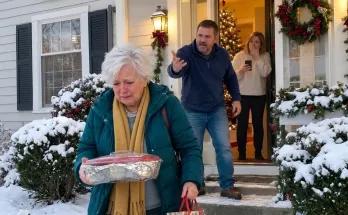
Two weeks before Christmas, Mom appeared on my doorbell camera.
Gray coat.
No flowers.
No suitcase.
No audience.
I watched her for nearly a minute.
Then opened the door.
I did not invite her inside.
“Can we talk?”
“On the porch.”
Her mouth tightened.
But she nodded.
That was new.
We sat overlooking the winter lake.
Juniper planted herself between my feet and watched Mom like a suspicious package.
Mom spoke first.
“I started therapy.”
I said nothing.
“Keaton told me he wouldn’t come home for Christmas unless I did.”
She looked at her hands.
“I haven’t been a good mother to you.”
The words landed heavily.
They didn’t repair anything.
But they were true.
“I used you,” she continued.
“When you were little, I used you to help with Keaton.”
“When you were a teenager, I used you to make the house look normal.”
“When you became a nurse, I used your success to feel like I’d done something right.”
Then she looked toward the house.
“And when you bought this place, I thought I deserved part of it because I made you.”
She began crying.
Quietly.
For once, her tears did not demand that I rescue her.
“I can’t give back what I took.”
“I’m not asking to come inside.”
“I’m not asking you to give me the old relationship.”
She swallowed.
“I’m asking whether someday we could have coffee in a public place for thirty minutes.”
“If that’s too much, I’ll accept it.”
The old Arden would have comforted her immediately.
The new Arden let the silence breathe.
“Your apology does not undo the past.”
“I know.”
“You are not welcome in this house unless I specifically invite you.”
“I understand.”
“You won’t contact my workplace.”
She nodded.
“You won’t use relatives to reach me.”
Another nod.
“You won’t demand information about my finances, schedule, home, or relationships.”
“I understand.”
“If we have coffee, it will be one meeting.”
“Public place.”
“Thirty minutes.”
“If you push, it ends.”
“Okay.”
I looked toward the water.
“I’ll consider it.”
That was all.
Mom left without asking to come inside.
Without asking to use the bathroom.
Without touching the door.
And most importantly—
without asking for a key.